

Thread on life & revolutionary exploits of Samarveer Rao Gokla Jat.
He was born around 1625 CE to Thakur Madhu, Thakur of Mouza Sinsini (Bharatpur, Rajasthan).
Both his father & elder brother Prithviraj were in open revolt against Mughal Emperor ShahJahan I & perished fighting
He was born around 1625 CE to Thakur Madhu, Thakur of Mouza Sinsini (Bharatpur, Rajasthan).
Both his father & elder brother Prithviraj were in open revolt against Mughal Emperor ShahJahan I & perished fighting
Mughal forces in 1650-52 CE while defending flame of Independence & subsequently Mughal forces captured their ancestral seat i.e Sinsini fortress.
This forced Rao Gokla Jat to migrate east & cross river Yamuna & took shelter-cum-residence in the Ghirsa fort in Mahawan pargana of
This forced Rao Gokla Jat to migrate east & cross river Yamuna & took shelter-cum-residence in the Ghirsa fort in Mahawan pargana of
Mathura which was either a possession of his elder brother or any relative/friend.
Gradually, Rao Gokla Jat exerted his dominance in Mathura & built a strong fortress in Tilpat (in Mathura taluqa) sometime between 1655-1665 CE & made it his headquarters.
During the same period,
Gradually, Rao Gokla Jat exerted his dominance in Mathura & built a strong fortress in Tilpat (in Mathura taluqa) sometime between 1655-1665 CE & made it his headquarters.
During the same period,
the fanatic Islamist Aurangzeb had resort to narrow-minded discrimination. In 1659 CE, the year following his occupation of Mughal throne, he declared that ''his Islamic Canon Law prohibited the construction of new temples.....''
Soon he opened out & started demolishing Hindu
Soon he opened out & started demolishing Hindu

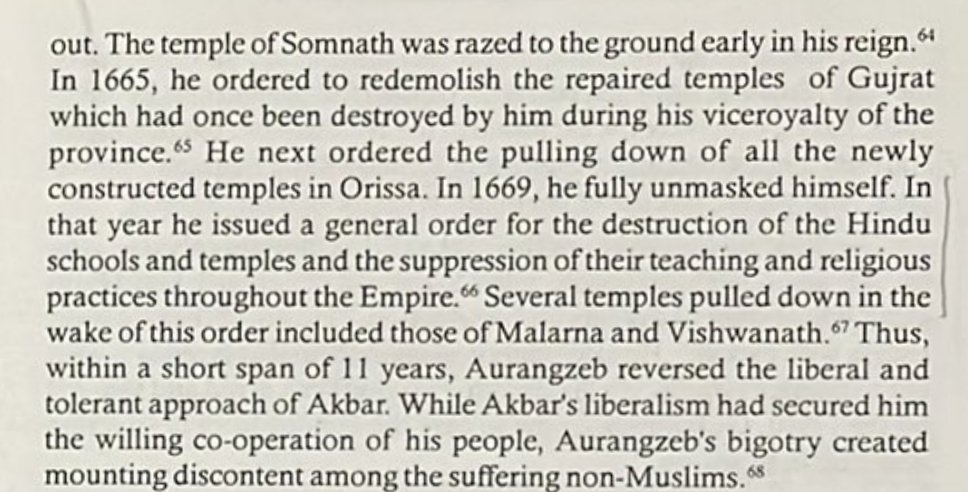
temples throughout his Empire.
Mathura, the birthplace of Jat uprising,suffered heavily in Aurangzeb's reign.This venerated place of Hindu worship was naturally an object of annoyance to Aurangzeb.Therefore,he appointed a fanatic by name of Abd-un-Nabi Khan as Faujdar of Mathura
Mathura, the birthplace of Jat uprising,suffered heavily in Aurangzeb's reign.This venerated place of Hindu worship was naturally an object of annoyance to Aurangzeb.Therefore,he appointed a fanatic by name of Abd-un-Nabi Khan as Faujdar of Mathura
in 1660 CE to ''supress the Hindus'' who were revolting from the time as late as 1637 CE.
Soon after taking charge, in 1661 CE, that wretch Khan showed his colours & built a mosque in the heart of Mathura city (Katra Masjid) after demolishing a ''grand Hindu Temple''.
Next in
Soon after taking charge, in 1661 CE, that wretch Khan showed his colours & built a mosque in the heart of Mathura city (Katra Masjid) after demolishing a ''grand Hindu Temple''.
Next in

persuance of Aurangzeb's order, Abd-un-Nabi Khan removed the stone railing of the famous Keshav Rai temple in 1666 CE.
Only a year earlier, in 1665 CE, utterly provocative promulgations were issued, restrictions were imposed on the public celebrations of major Hindu festivals of
Only a year earlier, in 1665 CE, utterly provocative promulgations were issued, restrictions were imposed on the public celebrations of major Hindu festivals of
Holi & Diwali.
In the same 1665 CE, discriminative duties were imposed on the Hindus.They were ordered to pay 5% duty on their goods while the Muslims had to pay mere 2.5%.
In 1667 CE, Muslims were made totally free of paying any daty.
Aurangzeb went one step further in 1668 CE,
In the same 1665 CE, discriminative duties were imposed on the Hindus.They were ordered to pay 5% duty on their goods while the Muslims had to pay mere 2.5%.
In 1667 CE, Muslims were made totally free of paying any daty.
Aurangzeb went one step further in 1668 CE,
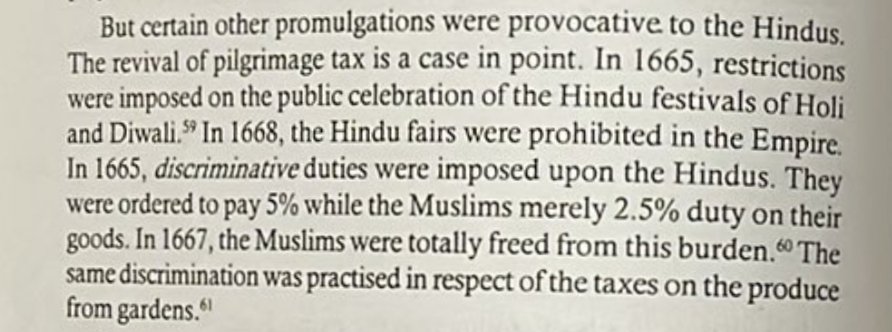
& he prohibited Hindu fairs throughout his Empire.
In April 1669 CE,Aurangzeb fully unmasked himself & issued general order for the destruction of Hindu temples & schools & the suppression of Hindu teachings & religious practices throughout the Empire.Several temples were pulled
In April 1669 CE,Aurangzeb fully unmasked himself & issued general order for the destruction of Hindu temples & schools & the suppression of Hindu teachings & religious practices throughout the Empire.Several temples were pulled

down in the wake of his orders included those of Malarna in Ranthambhaur & Shri Vishwanath in Kashi.
The magnificent Keshav Rai Temple built upon the Krishn Janmbhumi seemed obvious target of that Islamist servant of Aurangzeb i.e. Abd-un-Nabi Khan.
This ignited an unprecedented
The magnificent Keshav Rai Temple built upon the Krishn Janmbhumi seemed obvious target of that Islamist servant of Aurangzeb i.e. Abd-un-Nabi Khan.
This ignited an unprecedented
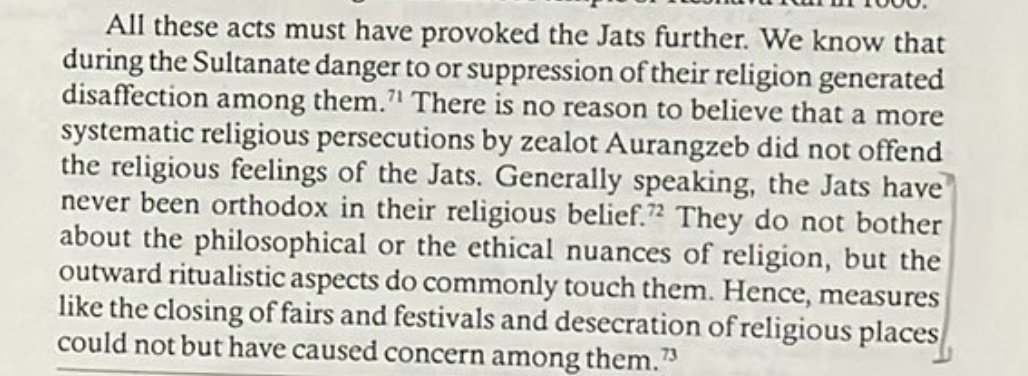
flame of Hindu nationalism & Hindu self-rule in the hearts of the Hindus of Braj & especially in the hearts of zealous Jats who take pride in being defenders of this sacred Brajbhumi.
Attached are the views of many scholars about religious zeal of Jats & devotion in its defence.
Attached are the views of many scholars about religious zeal of Jats & devotion in its defence.
In these tough circumstances, a son of soil emerged in Braj for keeping the flag of Hindu esteem fluring high.He was Rao Kanhardev or Gokla Jat, a powerful Zamindar of Tilpat in the taluqa of Mathura.
He vowed to defend the sacredness of beloved Brajbhoomi & embarked with a dream
He vowed to defend the sacredness of beloved Brajbhoomi & embarked with a dream
of Hindu self-rule in his heart. He threw off Mughal yoke & revived Ram Dal after assuming its leadership by taking a vow on leaves of Peepal tree & sacred water of the Yamuna & the Ganga.
His followers taking vow of devotion & faith in leadership of Rao Gokla Jat,pledged on the
His followers taking vow of devotion & faith in leadership of Rao Gokla Jat,pledged on the
same Peepal leaves & sacred water of Ganga & Yamuna, exclaiming ''We shall be in firm union & company with Gokla & we will obey Gokla Jat till the last drop of blood & breath of lives in our body''.
On the instruction of his Guru, Rao Gokla Jat picked up betel leaf & chewed it &
On the instruction of his Guru, Rao Gokla Jat picked up betel leaf & chewed it &
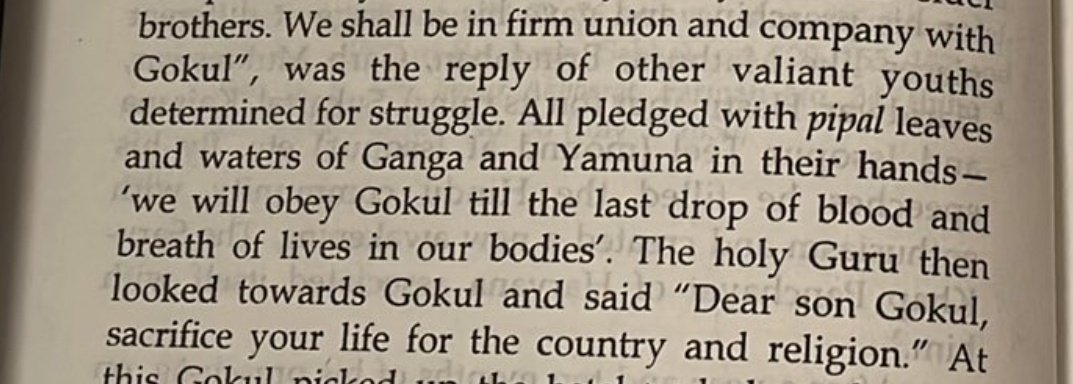
placed the bare sword in Guru's feet & said ''May your blessings remain with me. I shall never step back'', Gokla was followed by his chosen warriors who chewed betal leaves.
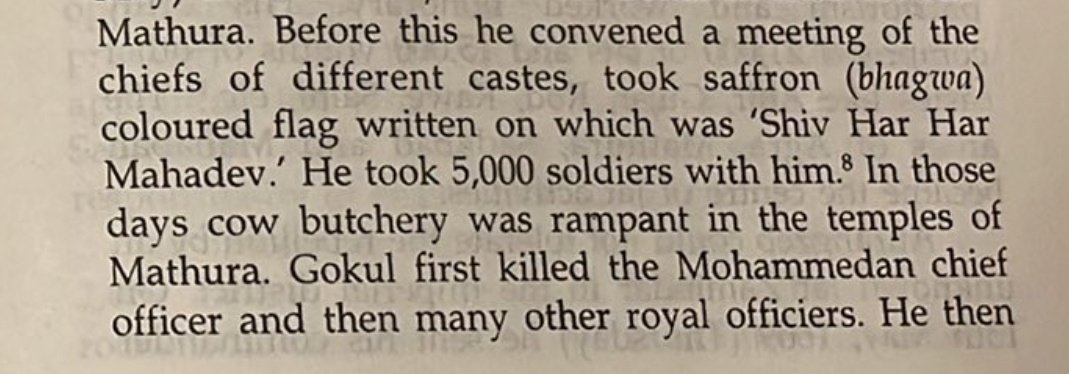
After convening a meeting of different chiefs, he took saffron colored flag written on which was ''Shiv
After convening a meeting of different chiefs, he took saffron colored flag written on which was ''Shiv
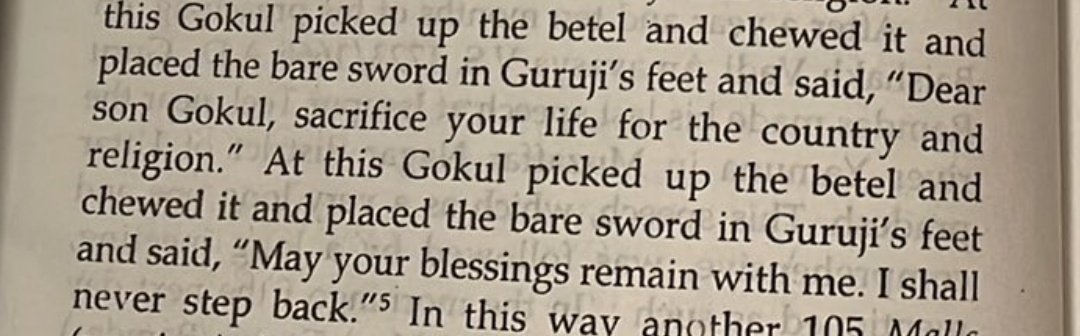
Har Har Mahadev''. He took 5,000 soldiers with him. In those dark days, cow butchery was rampant in the temples of Mathura. First, Gokla killed the Mohammadan chief officer responsible for it & then many other royal officials.
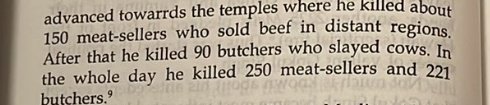
He then advanced towards the temples where he killed
He then advanced towards the temples where he killed
about 150 meat-sellers who sold beef in distant regions, moreover he killed 90 other cow slayers & freed the region from Adharm by destroying Mughal thanas & establishing their own thanas on that place.
Hearing all this,Aurangzeb called back fanatic Abd-un-Nabi Khan from his the
Hearing all this,Aurangzeb called back fanatic Abd-un-Nabi Khan from his the
then posting at Jhunjhunu & made him Faujdar of Mathura again on 14th Sept 1668 CE.
Soon after taking charge, accursed fanatic started pressing atroticites on people of Braj like lifting of cattle, womenfolk & children & ravaging beautiful fields.
He started raiding Jat villages
Soon after taking charge, accursed fanatic started pressing atroticites on people of Braj like lifting of cattle, womenfolk & children & ravaging beautiful fields.
He started raiding Jat villages
& in turn Jats started ravaging Mughal posts.
By the time, the revolutionaries had very well furnished their fortresses.
When in such a fortress at Sihora, Rao Gokla Jat was convening a secret meeting with his chiefs, the news of their presence got leaked to Abd-un-Nabi Khan &
By the time, the revolutionaries had very well furnished their fortresses.
When in such a fortress at Sihora, Rao Gokla Jat was convening a secret meeting with his chiefs, the news of their presence got leaked to Abd-un-Nabi Khan &
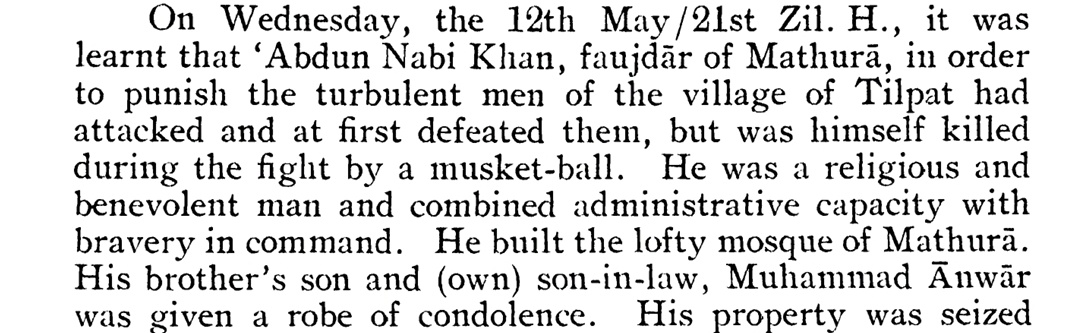
he laid a seige on the said fortress of Sihora (Raya block, Mathura), Jats were caught in tough circumstances & Mughal forces were encircling their grip gradually in the ongoing clash when suddenly the tide changed when a Jat marksman shot dead that wretch iconoclast, Abd-un-Nabi
around 10th May 1669 CE & soon the energetic Jats fell upon encroacher Mughal forces, routed them after killing many, numerous Mughal soldiers were taken prisoner, rest fled & their weapons were snatched by the victorious revolutionaries.
News of this debacle reached Aurangzeb
News of this debacle reached Aurangzeb
in the Red Fort of Delhi on 12th May 1669 CE.
Meanwhile, Jats who had become emboldened after killing the fantic Faujdar of Mathura & routing his Mughal forces, set out for total subjugation of Mughal authority in the then Agra Suba, they raided & fell upon the important Mughal
Meanwhile, Jats who had become emboldened after killing the fantic Faujdar of Mathura & routing his Mughal forces, set out for total subjugation of Mughal authority in the then Agra Suba, they raided & fell upon the important Mughal
cantonment of Sadabad pargana, founded & named upon the famous Wazir of ShahJahan I (24 miles East of Mathura, currently in Hathras), zealous Jats slayed the garrison & set in ablaze, leaving the cantonment into ashes. After making their control firm on Sadabad, they rode into

the environs of Agra.
During the same time, on 13th May 1669 CE, Aurangzeb appointed one of his chief officers, Radandaz Khan to counter the Jat advancements & to ''root out the rebels'' in imperial district of Agra with a powerful force & presented a horse with gold trappings.
During the same time, on 13th May 1669 CE, Aurangzeb appointed one of his chief officers, Radandaz Khan to counter the Jat advancements & to ''root out the rebels'' in imperial district of Agra with a powerful force & presented a horse with gold trappings.

But forces of even Radandaz Khan was defeated & made ineffective, this move of Aurangzeb also resulted in nothing & situation become very perilous.
After killing on Abd-un-Nabi, a close confident & chief General of Aurangzeb, Saf Shikan Khan was made Faujdar of Mathura in May
After killing on Abd-un-Nabi, a close confident & chief General of Aurangzeb, Saf Shikan Khan was made Faujdar of Mathura in May


1669 CE & Brahm Dev Sisodia was appointed to accompany Saf Sikhan Khan.
On taking charge as Faujdar of Mathura, Shaf Shikan Khan got indulged in trying to suppress the rebellion but he found it impossible & reported it Aurangzeb, Aurangzeb sensing that the ground situation has
On taking charge as Faujdar of Mathura, Shaf Shikan Khan got indulged in trying to suppress the rebellion but he found it impossible & reported it Aurangzeb, Aurangzeb sensing that the ground situation has

out of his hands, tried to use diplomatic methods.
After full 4 months of failed power trails, Mughals were left upto seeking for peace, albeit in the same haughty & outword show-off of 'generosity'.
Aurangzeb sent peace proposal to Rao Gokla Jat through the same Saf Shikan Khan
After full 4 months of failed power trails, Mughals were left upto seeking for peace, albeit in the same haughty & outword show-off of 'generosity'.
Aurangzeb sent peace proposal to Rao Gokla Jat through the same Saf Shikan Khan
in Sept 1669 CE, Saf Shikan Khan met Samarveer Rao Gokla Jat & put these words in front of him:
''Emperor is ready to forgive all your past mis-conducts & want you give imperial favour, but the Emperor has posed 3 pre-requisites for it
1. Stop all your rebellious actions now.
''Emperor is ready to forgive all your past mis-conducts & want you give imperial favour, but the Emperor has posed 3 pre-requisites for it
1. Stop all your rebellious actions now.

2. Return all the booty which you have looted from imperial posts.
3. Promise to never ever raising standards of rebellion in future.
Rao Gokla Jat replied ~ ''What is even my fault that I would ask forgiveness from the Emperor ?, Your Emperor should ask forgiveness from me bcoz
3. Promise to never ever raising standards of rebellion in future.
Rao Gokla Jat replied ~ ''What is even my fault that I would ask forgiveness from the Emperor ?, Your Emperor should ask forgiveness from me bcoz
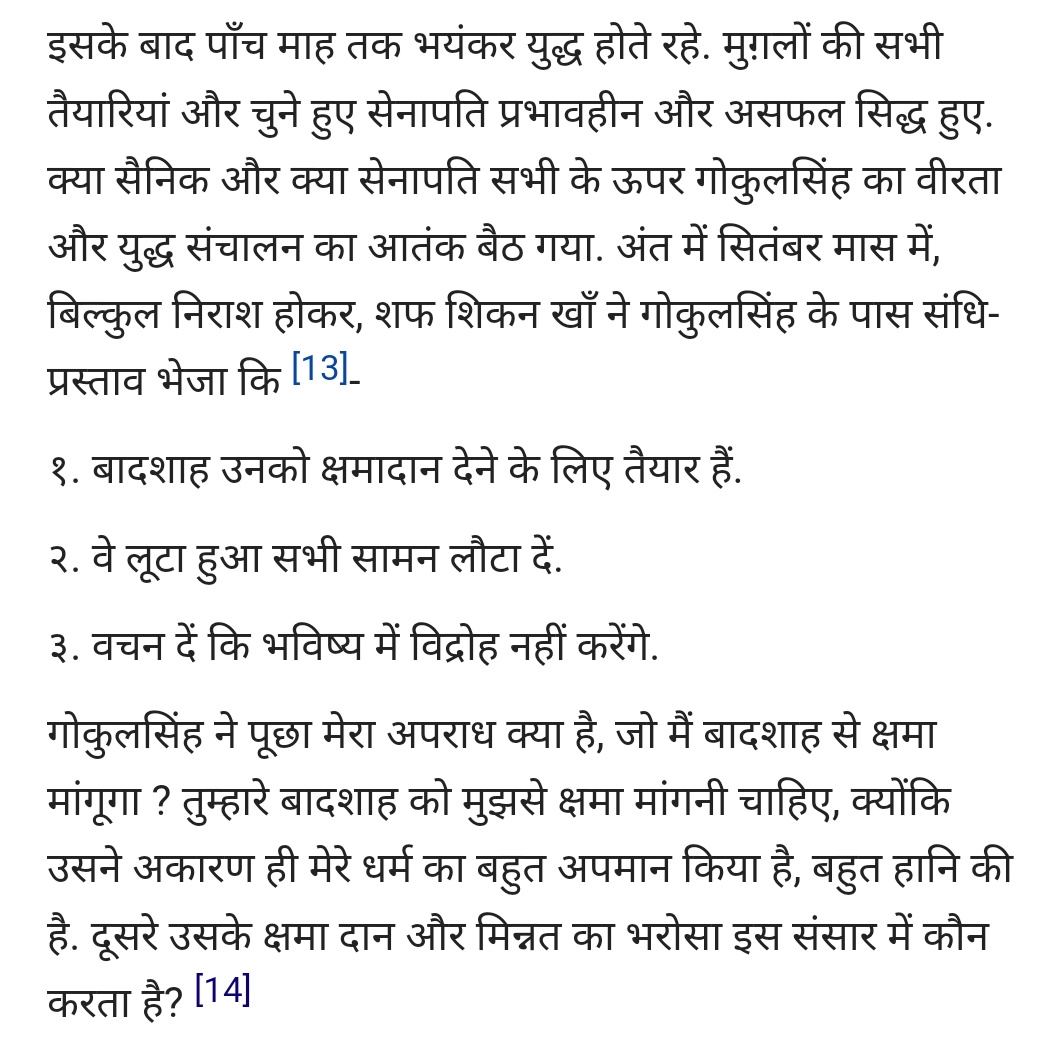
he has done insult of my faith, done injuries to it without any cause & who the hell in this world believe his pardon & oath ?''
After this reply by Rao Gokla Jat, it was difficult for Saf Shikan Khan to carry on the peace-talks.
Mughals had thought that Rao Gokla Jat will be
After this reply by Rao Gokla Jat, it was difficult for Saf Shikan Khan to carry on the peace-talks.
Mughals had thought that Rao Gokla Jat will be
won over by giving imperial favours & royal titles, but Rao Gokla Jat proved to be loyal to his oath of opposing enemies of Dharm & ''never step back''
He continued his exertions of self rule & became de-facto ruler of Braj.Mughal administration & control was completely paralysed
He continued his exertions of self rule & became de-facto ruler of Braj.Mughal administration & control was completely paralysed
& the imperial roads from Delhi to Agra & south beyond were made inaccessible for Mughal admins.
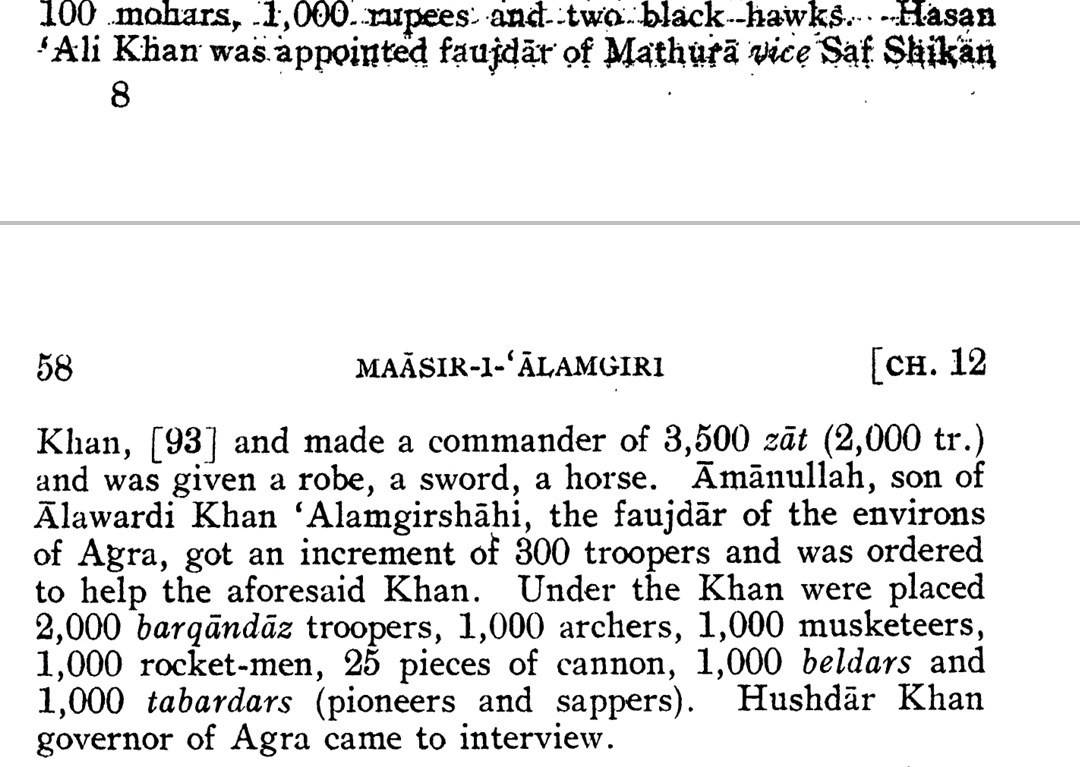
Infuriated at failed peace talks & prevailing Hindu dominance in his own imperial province, Aurangzeb replaced Saf Shikan Khan with another close confident Hasan Ali Khan as Faujdar
Infuriated at failed peace talks & prevailing Hindu dominance in his own imperial province, Aurangzeb replaced Saf Shikan Khan with another close confident Hasan Ali Khan as Faujdar
of Mathura in Nov 1669 CE & presented him a robe, a sword, a horse.Under this Hasan Ali Khan, Aurangzeb placed 2,000 barqandaz toppers, 1000 archers, 1000 musketeers, 1000 rocket-man, 25 pieces of cannons, 1000 beldars, 1000 pioneers & sappers.
Faujdar of Moradabad Amanullah was
Faujdar of Moradabad Amanullah was
summoned & after increment of 300 sawars, was order to help Hasan Ali Khan in his campaign against Jat rebels.
At the same time, Hushdar Khan, the Subedar of Agra came to Aurangzeb in Delhi & briefed Aurangzeb about the prevailing situation.
Faujdar of Mathura, Hasan Ali Khan
At the same time, Hushdar Khan, the Subedar of Agra came to Aurangzeb in Delhi & briefed Aurangzeb about the prevailing situation.
Faujdar of Mathura, Hasan Ali Khan
started inflicting brutalities on people of Braj & the valiant rebels came to out to fight imperial forces.
Sensing gravity of situation, Aurangzeb himself set out from Delhi a large & well-equipped army on 28th Nov 1669 CE & pitched himself at the Yamuna & set out for Mathura
Sensing gravity of situation, Aurangzeb himself set out from Delhi a large & well-equipped army on 28th Nov 1669 CE & pitched himself at the Yamuna & set out for Mathura
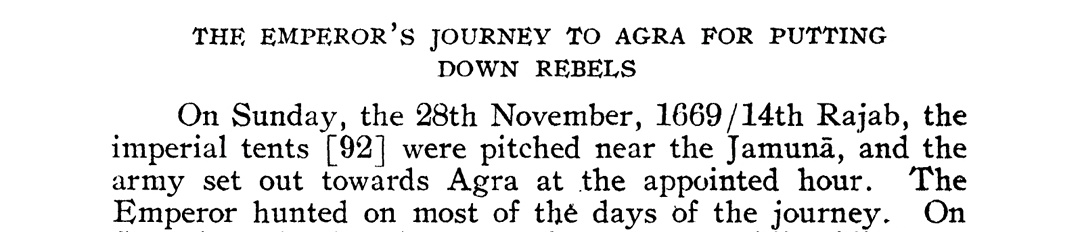
at a time appointed by astrologers.
On 4th Dec 1669 CE,Aurangzeb learnt the circumstances of the rebellion in the villages of Rewara, Chandarkha & Sarkhud.
By order of Aurangzeb, Hasan Ali Khan attacked them.
The revolutionaries fought valiantly upto noon with bows & muskets and
On 4th Dec 1669 CE,Aurangzeb learnt the circumstances of the rebellion in the villages of Rewara, Chandarkha & Sarkhud.
By order of Aurangzeb, Hasan Ali Khan attacked them.
The revolutionaries fought valiantly upto noon with bows & muskets and

and then being uable to resist better trained & equipped Mughal forces any longer,their women performed Jauhar & the revolutionaries rushed to fight at the close quarters doing Kesariya Saka.
Revolutionary fighters showed such heroics that ''the lose of the imperials was heavy''
Revolutionary fighters showed such heroics that ''the lose of the imperials was heavy''
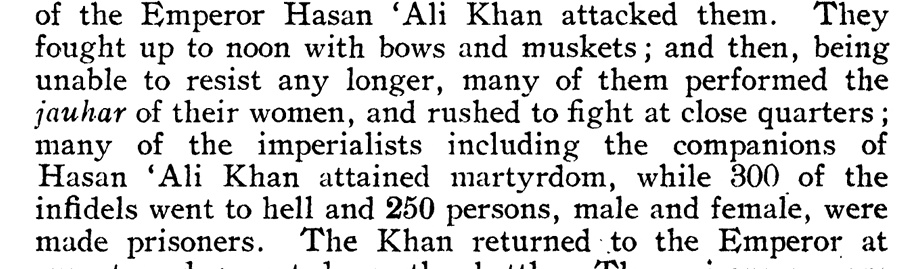

to an extent that many close companions of Faujdar Hasan Ali Khan were killed in the fight.The revolutionaries suffered casualties of 300 & 250 captive.
Hasan Ali Khan returned to Aurangzeb at sun-set & reported the battle.
Aurangzeb reached Mathura, the hotbed of the rebellion,
Hasan Ali Khan returned to Aurangzeb at sun-set & reported the battle.
Aurangzeb reached Mathura, the hotbed of the rebellion,
someday around 10th Dec 1669 CE & assumed leadership of the campaign against the Jat rebellion.
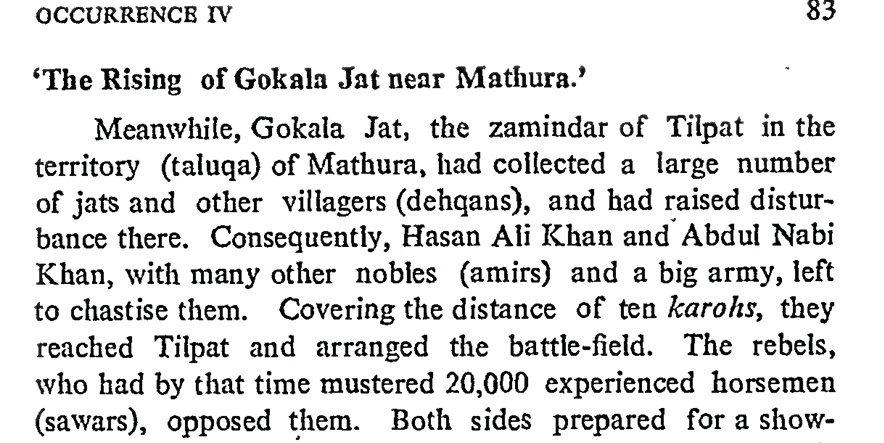
Aurangzeb's & his officers' (Hasan Ali Khan, Amanullah) well-equipped armies with pack of artillery, after covering a distance of 10 Kos (30 Km) reached environs of Tilpat & arranged
Aurangzeb's & his officers' (Hasan Ali Khan, Amanullah) well-equipped armies with pack of artillery, after covering a distance of 10 Kos (30 Km) reached environs of Tilpat & arranged
their armies in battle field, the combined Mughal force can be estimated not less than 35,000 strong (7000+ was with Hasan Ali Khan alone)
Soon,the forces of the Jat revolutionaries registered their presence in that plain of Tillat.
Contemporary account Futuhat i Alamgiri tells
Soon,the forces of the Jat revolutionaries registered their presence in that plain of Tillat.
Contemporary account Futuhat i Alamgiri tells
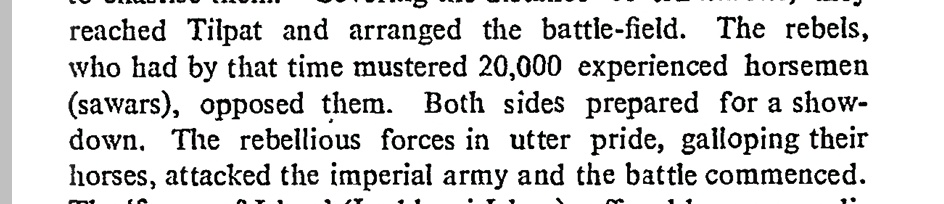
that Gokla Jat (Rao Kanhardev) had mustered 20,000 experienced horsemen & got determined to oppose the Mughal armies.
Both sides prepared for a showdown.
The revolutionaries on seeing those fanatics who are responsible for injuries done to Hindu esteem & their pride, decided to
Both sides prepared for a showdown.
The revolutionaries on seeing those fanatics who are responsible for injuries done to Hindu esteem & their pride, decided to
teach them an everlasting lesson.
It can be visualize that those heroes must have hailed the jaikara ''Bol Girraj Maharaj ki Jai'' & then unleashed their valiant calavry + infantry charge upon the imperial Mughal army & thus a grim and bloody pitched battle followed.
It can be visualize that those heroes must have hailed the jaikara ''Bol Girraj Maharaj ki Jai'' & then unleashed their valiant calavry + infantry charge upon the imperial Mughal army & thus a grim and bloody pitched battle followed.
The revolutionary warriors fought most heroically & inflicted such pains & loses on the imperial Mughal army which they had witnessed a few time till then.
The freezing plains of December in that battlefield of Tilpat turned smoked & ablaze by fire of Mughal artillery directed
The freezing plains of December in that battlefield of Tilpat turned smoked & ablaze by fire of Mughal artillery directed
towards the valiant cavalry + infantry charge of Hindu Jat warriors upon Mughal entrenchment.
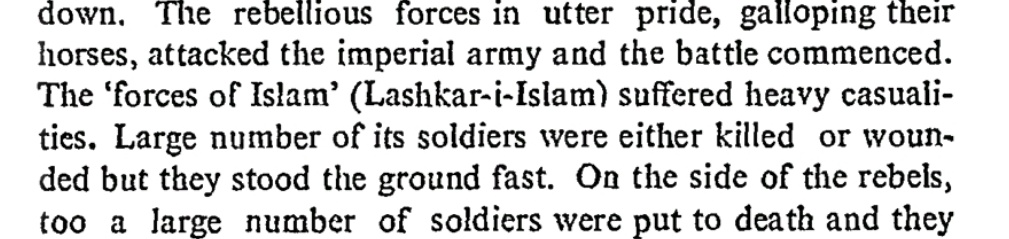
Those fire-blowing cannon pieces wracked havoc in the Jat army but determined & undaunted, they kept on fighting with bows, muskets-balls & inflicted such a toll on imperial forces that
Those fire-blowing cannon pieces wracked havoc in the Jat army but determined & undaunted, they kept on fighting with bows, muskets-balls & inflicted such a toll on imperial forces that
the ''Lashkar i Islam suffered heavy casualties.Large number of its soldiers were either killed or wounded....''
But soon, around early evening,the revolutionary forces had to give way to artillery backed & better trained imperial Mughal forces & they towards the fort of Tilpat.
But soon, around early evening,the revolutionary forces had to give way to artillery backed & better trained imperial Mughal forces & they towards the fort of Tilpat.
Imperial forces close-on upon the revolutionaries but only to find the upcoming fight more blood-sucking them the battle on the plains of Tilpat.
Tilpat fortress was an epitome of firmness of its lord Rao Kanhardev aka Gokla.
Imperials laid seige on Tilpat fortress, early next
Tilpat fortress was an epitome of firmness of its lord Rao Kanhardev aka Gokla.
Imperials laid seige on Tilpat fortress, early next
started a bloody clash between Jats & Mughal forces which would be continuing next full 3 days with exchange of cannon-guns & matchlock fires.
This exchange proved sanguinary &
resulted in high number of deaths.
What happened on 4th day has 2 version, one of Mughals & one
This exchange proved sanguinary &
resulted in high number of deaths.
What happened on 4th day has 2 version, one of Mughals & one

of Jat revolutionaries (Records of Pandit Kahna Ram,archives of Sarv Khap,Shoram)
From the records of Pt Kahna Ram, we get to know that when the seige clash took a high toll on imperialists, Aurangzeb resort to acting of reconciliation & Sheikh Razi-ud-din (Peshkar or Lieutenant
From the records of Pt Kahna Ram, we get to know that when the seige clash took a high toll on imperialists, Aurangzeb resort to acting of reconciliation & Sheikh Razi-ud-din (Peshkar or Lieutenant
of Hasan Ali Khan) was sent with chosen troops & amidst the farce of talks, he took control of Gokla Jat & arrested him in his seige.
Obviously, the Mughal sources provide slightly different version.
Although they agree on the arrest of Rao Gokla Jat inside Tilpat fortress bcoz
Obviously, the Mughal sources provide slightly different version.
Although they agree on the arrest of Rao Gokla Jat inside Tilpat fortress bcoz
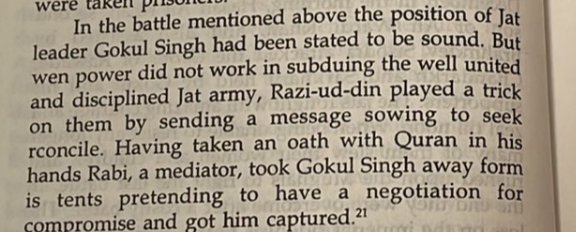
some heroic 'efforts of Sheikh Razi-ud-din' but they attribute his entry into the fortress of Tilpat to the breaching of walls of Tilpat fortress by Mughal cannons & experience + bravery of Mughal soldiers.
Therefore, it seems that the version of Sarv Khap records holds water.
Therefore, it seems that the version of Sarv Khap records holds water.
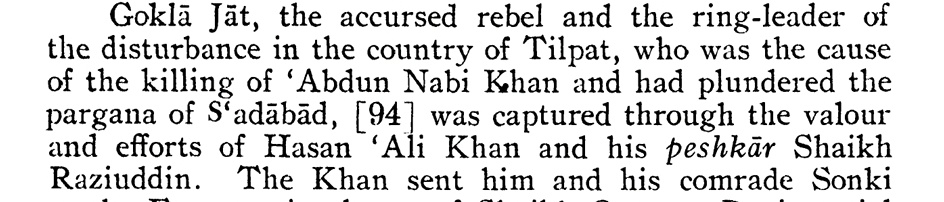

Various sources claim that this conflict ended with a whooping loss of 4000 soldiers on the Mughal side & 5000 veergati on part of Jat rebels.
Futuhat e Alamgiri says that Mughals captured 7,000 enemy, many of them were ladies, children & oldies.
Ma'asir e Alamgiri tells that
Futuhat e Alamgiri says that Mughals captured 7,000 enemy, many of them were ladies, children & oldies.
Ma'asir e Alamgiri tells that

the Faujdar of Mathura i.e. Hasan Ali Khan sent the captured Rao Gakla Jat & his comrade Sonkhi (his uncle Uday Singh) in the presence of Aurangzeb.
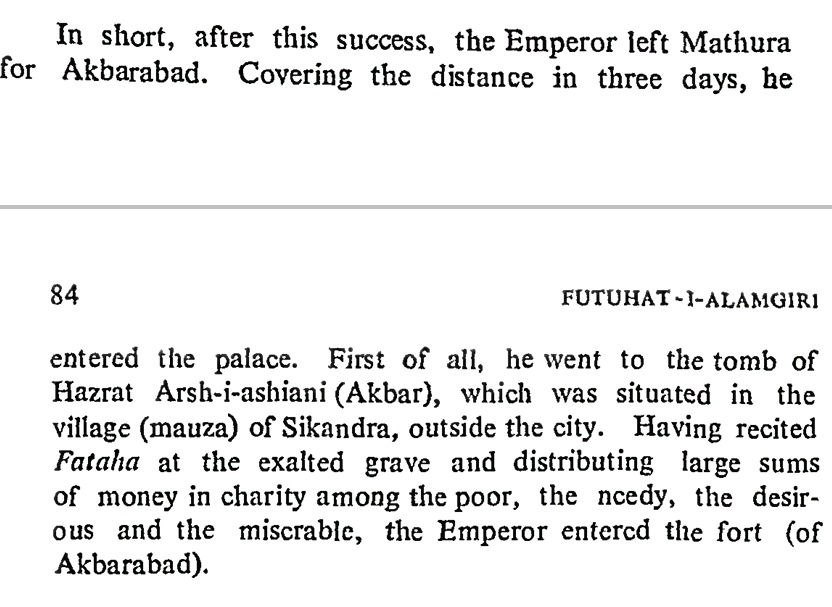
From there, Aurangzeb proceeded towards Agra & alighted at Sikandra to the tomb of his great-grandfather, Emperor Akbar.
Here, he
From there, Aurangzeb proceeded towards Agra & alighted at Sikandra to the tomb of his great-grandfather, Emperor Akbar.
Here, he
recited Fatiha & must have thanked his ancestor for the hard-fought victory at Tilpat (Mathura) & distributed large sums of money in the charity. (Futuhat e Alamgiri)
From there he reached the Red Fort of Agra wherein he entered on 1st Jan 1670 CE.
Sheikh al-Qaum presented both
From there he reached the Red Fort of Agra wherein he entered on 1st Jan 1670 CE.
Sheikh al-Qaum presented both
prisoners of battle i.e Samarveer Rao Kanhardev Gokla Jat & his uncle Uday Singh aka Sonkhi.
Some sources say that still Gokla Jat was offered pardon if accepts Islam but offical Ma'sir e Alamgiri doesn't tell about it.
Although,it's not impossible that he might have been offered
Some sources say that still Gokla Jat was offered pardon if accepts Islam but offical Ma'sir e Alamgiri doesn't tell about it.
Although,it's not impossible that he might have been offered
especially when we take Aurangzeb's missionary zeal into account.
Anyway,Rao Gokla had irritated Aurangzeb far enough & he ordered ''the accursed (Rao Gokla Jat) be taken to the abode of punishment where his limbs be hacked off one by one to set an example for the enemies.....''
Anyway,Rao Gokla had irritated Aurangzeb far enough & he ordered ''the accursed (Rao Gokla Jat) be taken to the abode of punishment where his limbs be hacked off one by one to set an example for the enemies.....''
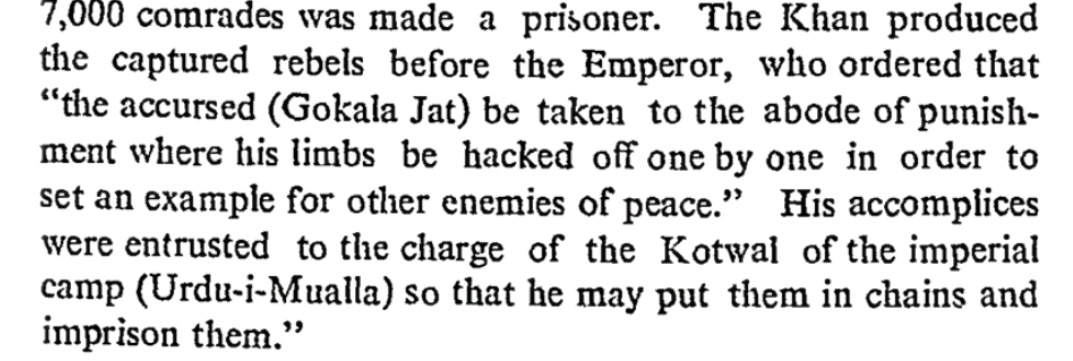
According to Aurangzeb's orders, Rao Gokla Jat & his companions were taken to Agra Kotwali & there at the chabutra, they were mercilessly hacked to pieces one by one about 2nd Jan 1670 CE.
This inhuman scene must have made the eyes of onlookers moist but Rao Gokla Jat & his
This inhuman scene must have made the eyes of onlookers moist but Rao Gokla Jat & his
selfless companions must be having their heads high that they showed Hindu determination & utmost valour to Islamist occupiers & it must have instilled apprehensions in the hearts of Islamist missionaries about their dream of converting Dar-ul-Harb Hind into Dar-ul-Islam anyday.
The valorous & selfless end of Rao Kahardev Gokla Jat wasn't the end of the flame of Hindu self-rule which he has re-ignited with his heavenly dedication & bravery.
The shrub of independence & Hindu dominance which he had planted was later raised into a well-built tree of liberty
The shrub of independence & Hindu dominance which he had planted was later raised into a well-built tree of liberty
by his successors & companions like Brajraj (Thakur Bukna Singh of Sinsini-Au),Rao Nand-Ram Thenua of Jawar (invincible pearl of Jat Confederacy), Raja Ram Jat of Sinsini (Kated ko Raja), Rao-Bahadur Ram Singh Chahar of Akola-Fatehpur Sikri,Rao Amar Singh Nauhwar of Khair etc etc
Just after getting rid of the thorn in the chest of Mughal pride i.e. Rao Gokla Jat, Aurangzeb concentrated on this iconoclasm & turned his hateful eyes on the famous Keshav Rai Temple over Shri Krishn Janm-Bhoomi.
In the same month of Gokla Jat's martyrdom i.e. Jan-Feb 1670 CE
In the same month of Gokla Jat's martyrdom i.e. Jan-Feb 1670 CE
his 9 months old order of general demolition of Hindu temples & schools throughout his Empire was pressed to be expedited.
As one scholar has remarked ''When limbs of Gokla Jat fell in Agra, at the same time the temple of Keshav Rai in Mathura was pulled down''
This can be
As one scholar has remarked ''When limbs of Gokla Jat fell in Agra, at the same time the temple of Keshav Rai in Mathura was pulled down''
This can be
substantiated from the recording & remarks of the author of offical record-book of Aurangzeb's reign.
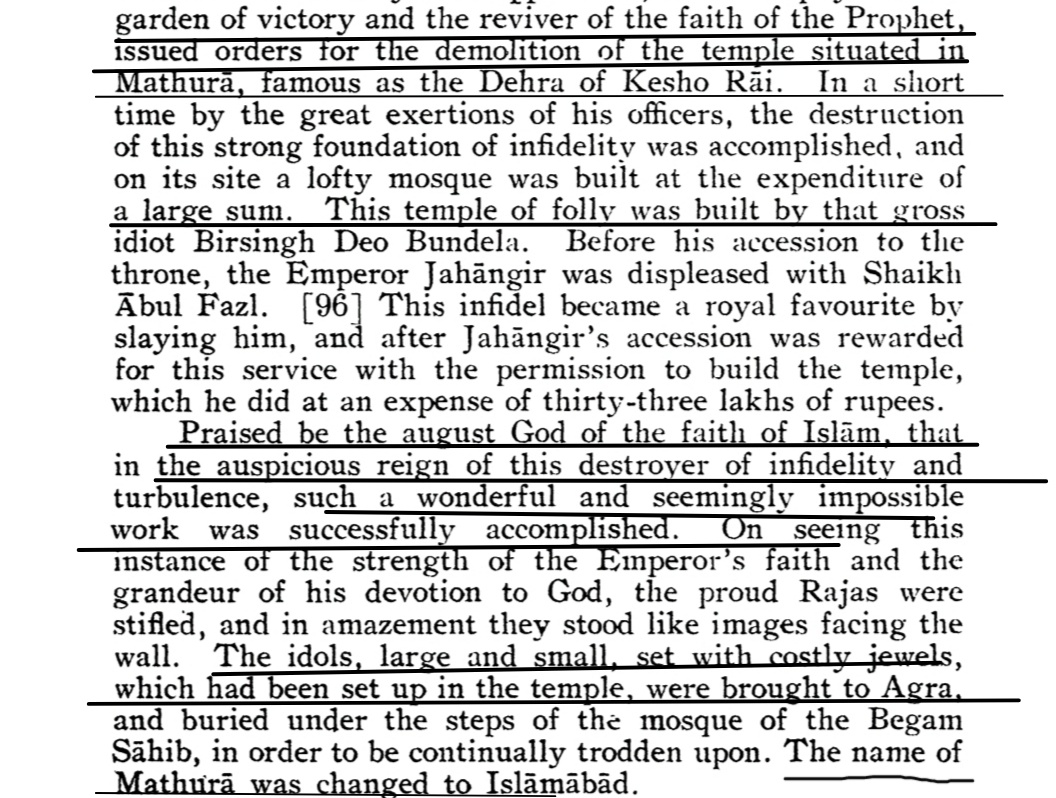
He puts ''In the month of Ramzan (Jan-Feb 1670 CE)..... the destruction of this strong foundation of infidelity (Keshav Rai Temple on Krishn Janmabhoomi) was accomplished & a
He puts ''In the month of Ramzan (Jan-Feb 1670 CE)..... the destruction of this strong foundation of infidelity (Keshav Rai Temple on Krishn Janmabhoomi) was accomplished & a
lofty mosque was built in its place..Praise to be august God of the faith of Islam that in auspicious reign of this destroyer of infidelity (Aurangzeb), such a wonderful & ''SEEMINGLY IMPOSSIBLE WORK'' was successfully accomplished}
These remarks hint about the grim resistance
These remarks hint about the grim resistance
posed by Hindu Jat revolutionaries under the heavenly leadership of Samarveer Rao Gokla Jat of Tilpat.
This thread was my humble tribute to that unsung hero of Braj who ignited a never-ending flame of Hindu self-rule in Brajwasis.
कोटिशः ऋणी 🙏
शत-शत नमन 🙏
ॐ शान्ति: शान्ति: 🌸
This thread was my humble tribute to that unsung hero of Braj who ignited a never-ending flame of Hindu self-rule in Brajwasis.
कोटिशः ऋणी 🙏
शत-शत नमन 🙏
ॐ शान्ति: शान्ति: 🌸
Sources:
* Ma'asir e Alamgiri by Saqi Mustaid Khan
* Futuhat e Alamgiri by Ishwardas Nagar
* History of Aurangzeb Vol.3 (Jadunath Sarkar)
* The Jats: Their Role in Mughal Empire by GC Dwivedi
* Sarv Khap Archives (Muzaffarnagar)
*Records of Pandit KahnaRam
*Memories of Brajwasis
* Ma'asir e Alamgiri by Saqi Mustaid Khan
* Futuhat e Alamgiri by Ishwardas Nagar
* History of Aurangzeb Vol.3 (Jadunath Sarkar)
* The Jats: Their Role in Mughal Empire by GC Dwivedi
* Sarv Khap Archives (Muzaffarnagar)
*Records of Pandit KahnaRam
*Memories of Brajwasis
Loading suggestions...