
1. Coming to the second part where I tried to decipher Piramal Pharma. For the first part on Piramal, here is the thread:
2. Firstly understanding the industry of Pharma. There are 4 major products in the sequential order of the value chain: Key Starting Material, Intermediate, API’s and Finished Dosage
3. We start with the key starting material and intermediates (Mostly imported from China). Some of the Indian companies are expert in manufacturing API’s (think of Divis, Granules etc.) while some other firms go one step ahead and manufacture finished dosage
4. Finished dosage is the end product of the Pharma (think of Dr Reddy’s, Aurobindo etc.) which we consume. Generally finished dosages are manufactured for generic drugs.
5. Coming to generic drugs, these drugs are the ones which were sold by the innovator companies for 15-20 years. Now their patent is expired and the formulation is out in public.
6. The companies like Dr Reddy’s put up their own brand name on these generics and hence these products are known as branded generics (think of Saridon) and they cost a lot cheaper than original product
7. Now since India is the low cost producer of Pharma products, they also provide CDMO services (contract research, development and manufacturing) to the innovator Pharma companies. CDMO players act as provider of low cost research, manufacturing to global pharma
8. Divis lab is the rising giant for the CDMO space for the few years. Piramal Pharma is also one such player. Piramal Pharma Ltd’s business is divided into primarily 4 categories: CDMO, , Complex hospital generics, Indian consumer healthcare & Ophthalmology branded products
9. Out of the 5100 cr of revenue, CDMO constitutes 3600 crores. 44% comes from USA and 30% from Europe. 70% of the revenue comes from manufacturing, 26% from development services and 4% from discovery services
10. 88% clients have association for 7-10 years. This underlies the important point: Newer clients come for the low ticket size research and development projects. But due to ongoing relations, outsource manufacturing to Piramal
40% of the order book is from integrated projects. The revenue from integrated projects were $51mn up from $7mn in FY17. This is benefit from client side since it reduces supply chain cost and operational complexities. They get all the services under 1 umbrella
12. From the CDMO perspective, they are probably the only players having expertise in peptide API’s, antibody drug conjugates and oral dosages. These are niches and high margin categories
13. 44% and 32% of CDMO revenues come from USA and Europe. Revenues from top 20% clients have increase by 26% CAGR. All these figures highlight the longevity of relationship with PPL
14. The next vertical is Complex hospital generics (CHG). These include branded generics in the vertical of inhalation anaesthesia, general anaesthesia and intrathecal therapy
15. Inhalation anaesthesia contributes to 54% of CHG’s revenues (~1700 cr). The advantage in CHG is the competition intensity is very low since these are complex doses. Also the devices used to deliver these doses are very complex
16. While some of the PPL’s competitors can manufacture CHG doses, they lack the expertise in manufacturing the devices which leads to the orders flowing towards PPL (Scuttlebutt)
17. In Inhalation Anaesthesia, it manufactures key starting material (Fluorine), the expertise of which it got from the acquisition of JV with Navin Fluorine which was done 7-8 years ago. As a result, it has in-house manufacturing of servoflurane and desflurane
18. In Intrathecal therapy, it manufactures Gablofen which is having the largest market share in USA. Further it is having the strong and entrenched relationship with GPO’s due to which it is able to push its CHG products in USA healthcare ecosystem
19. The next division is Indian Consumer Healthcare (ICH) which generates ~500 crore of revenues. It is having products in analgesics, Skin care, vitamin supplements, women’s health, digestives and kids wellness
20. This division is a purely FMCG play where the company has to increase the distribution and drive the visibility at point of sales. In addition to this, it has started foraying into modern trade and e-commerce
21. Currently it is present across 2 lac chemists, 8000 modern trade, 22 e-commerce stores. I tried researching the products on Amazon and it seems like this category is having a lot of headwinds in the form of competition of D2C companies
22. Consolidated media and trade spends are 18%-20% of sales to strengthen the brand. This shows the competitive intensity in this field
23. This segment is the least attractive for me since the products can derive a lot of value through e-commerce and traditional companies are not great in scaling the brands digitally
24. The last segment was ophthalmology branded products. Here PPL manufactures and sell ophthalmology products via the JV with Allergan (US Pharma with 16 bn$ revenue). It has the market leader by a wide margin in ophthalmology in India.
25. 62% of ophthalmology revenue (~370 crores) comes from top 5 brands. It has only 500 employees with 33% PAT margins. This shows the strong hold of the company in distribution and recall
26. The total revenue of 5100 crores with 22% EBITDA margin (~1100 crores) was valued at ~$2.5bn(17000 crores) by Carlyle in October 2020. PEL is having market value of 60000 crores today. This means the remaining 43000 crores (60000-17000) is attributed to financial services
27. While the ICH part of Pharma does not look attractive, the company plans to use the same facilities to enter domestic formulation business. This could have posed the threat to existing clients of CDMO. How?
28. If the firm provide big Pharma with the discovery and manufacturing services, they could use the proprietary knowledge for their domestic formulation business. However, Ajay Piramal has clarified his approach in the recent con-call
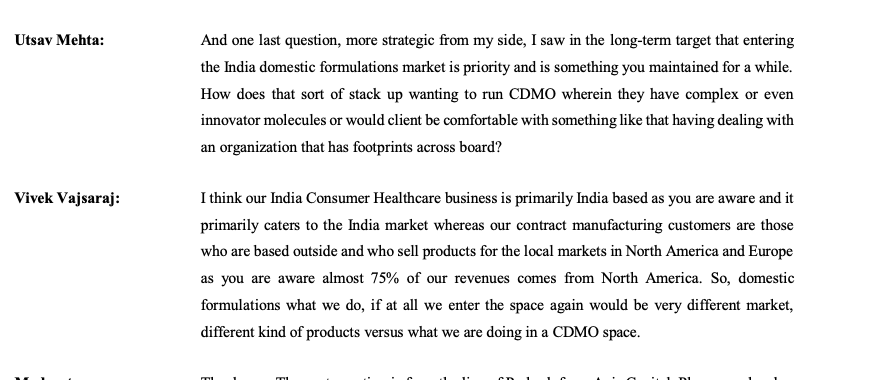
29. Although he pointed out that all his clients cater to North America and Europe and hence there would be no conflict of interest, we have to wait and watch
30. The first part of the tweet can be accessed here:
31. If you like my thread, do retweet. Feedback on DM
@bharatbetpf @Dhruvapandey @Sanjay__Bakshi @10kdiver
@bharatbetpf @Dhruvapandey @Sanjay__Bakshi @10kdiver
Loading suggestions...