

Thread on the Kalpana Chawla on their death anniversary
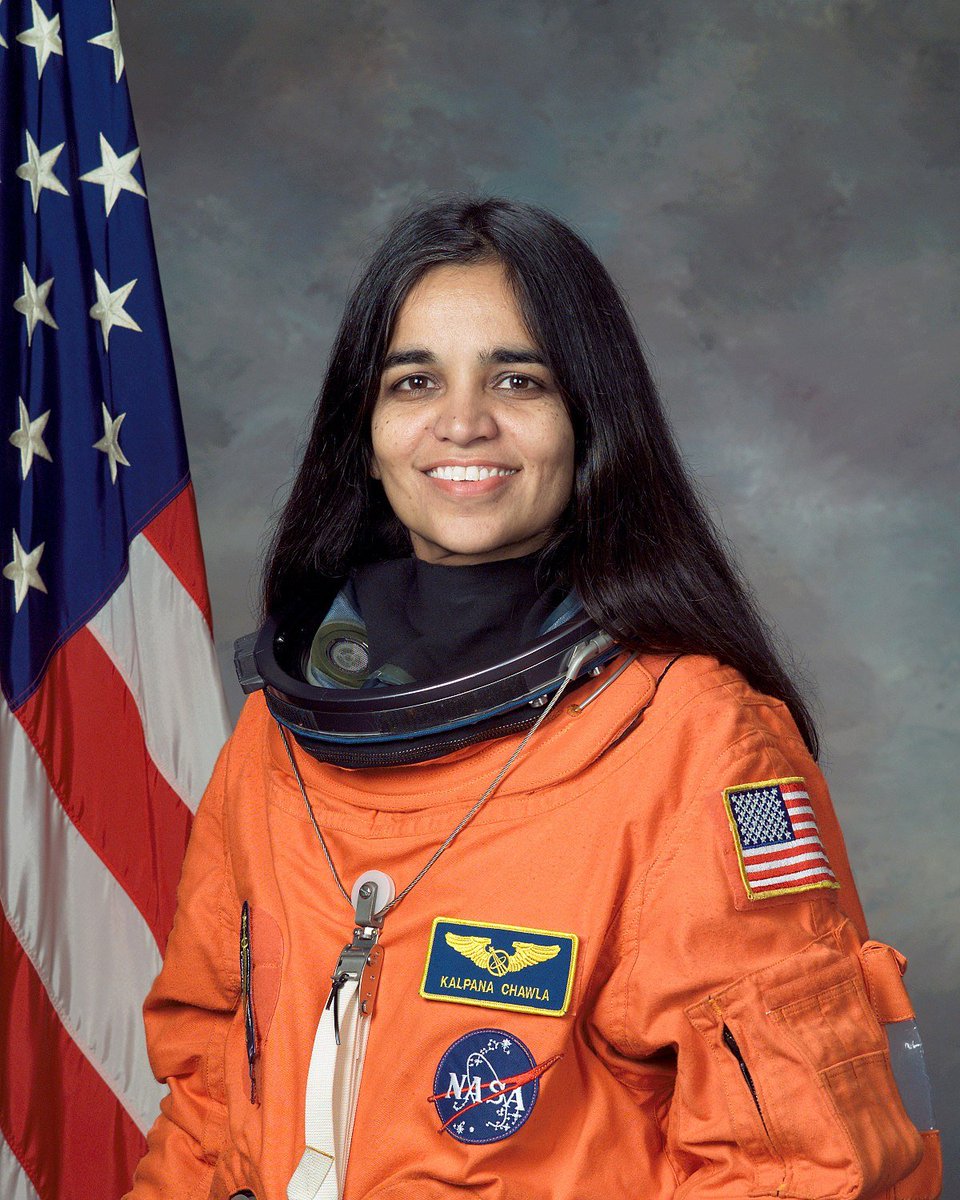
She was born in Karnal. She was the youngest of four sisters and brothers at home and was affectionately known as Montu. Kalpana had informed her father that she wanted to be an engineer when she was in class 8,but her father wanted to be a doctor or a teacher instead
As a child, flying in planes and the sky enthralled her. She would accompany her father to the local flying club. She was also a poet and used to take part in school dance programmes
During her earlier education in India, Chawla attended Tagore Baal Niketan Senior Secondary School, Karnal. She showed an interest in aviation while at school
Chawla obtained a degree in aeronautical engineering from Punjab Engineering College. While selecting the course, professors tried to dissuade her, as there were limited opportunities for girls in India following this career path. However, Chawla was adamant that this was the+
+subject for her
After completing her engineering degree in India, Chawla immigrated to the United States in the 1980s and became a naturalized citizen to continue her studies. She earned a doctorate in aerospace engineering from the university of Colorado in 1988,having previously obtained her+
+masters degree from the university of Texas. She began working at NASA's Ames Research Center the same year, working on power-lift computational fluid dynamics.
Her research concentrated on simulation of complex air flows encountered around aircraft such as the Harrier in "ground-effect".Following completion of this project she supported research in mapping of flow solvers to parallel computers, and testing of these solvers by carrying+
+out powered lift computations
In 1993 Kalpana Chawla joined Overset Methods Inc., Los Altos , California, as Vice President and Research Scientist to form a team with other researchers specializing in simulation of moving multiple body problems.
She was responsible for development and implementation of efficient techniques to perform aerodynamic optimization. Results of various projects that Kalpana Chawla participated in are documented in technical conference papers and journals
She was selected by NASA in 1994,and as an astronaut candidate a year later for the 15th group of astronauts. Part of two space missions in her astronaut career, she flew in the STS-87 (1997) and STS-107 (2003), logging 30 days , 14 hours and 54 minutes in space
As part of STS-87, Kalpana had made 252 orbits of the earth, traveling 6.5 million miles in 376 hours and 34 minutes, according to NASA
Final flight
Kalpana's final mission was the STS-107 in 2003, which was a 16-day mission dedicated to science and research in space. NASA says that the six-membered Columbia crew performed 80 experiments before the mission ended in a disaster.
Kalpana's final mission was the STS-107 in 2003, which was a 16-day mission dedicated to science and research in space. NASA says that the six-membered Columbia crew performed 80 experiments before the mission ended in a disaster.
February 1 will mark the 18th death anniversary of the woman who pioneered as an Indian woman in space and the second Indian to travel beyond Earth's atmosphere, second only to Rakesh Sharma.
Kalpana Chawla’s final rites were performed at Zion National Park in Utah, USA.
Kalpana Chawla was married to Jean-Pierre Harrison. After the Columbia disaster, Harrison was approached by filmmakers to make a movie on Chawla's life, but he refused, as he prefers to keep their life private. Harrison has since remarried and has a young son.
Loading suggestions...