

@TweetAtAKK I liked this talk (may or may not have crashed it, lol). One of @HamelHusain's great points is the high activation energy to merely get started with TFX, which tends to be a thing at bigcos (custom and complicated stack such that by the time you set it up, you can't go back)
@TweetAtAKK @HamelHusain Anecdotally I heard spotify took > 1 year to fully migrate to TFX (engineering.atspotify.com). Literally from a business POV you cannot go back. No matter how unusable the DSL is, you will just build extensions to make it usable
@TweetAtAKK @HamelHusain One great point we got in an mltrace CIDR review was: why is TFX not good enough for end-to-end ML observability? From a practitioner's view it's a no-brainer (too verbose, hard to get started, vendor lock-in), but I think it's hard to articulate this to appeal to researchers
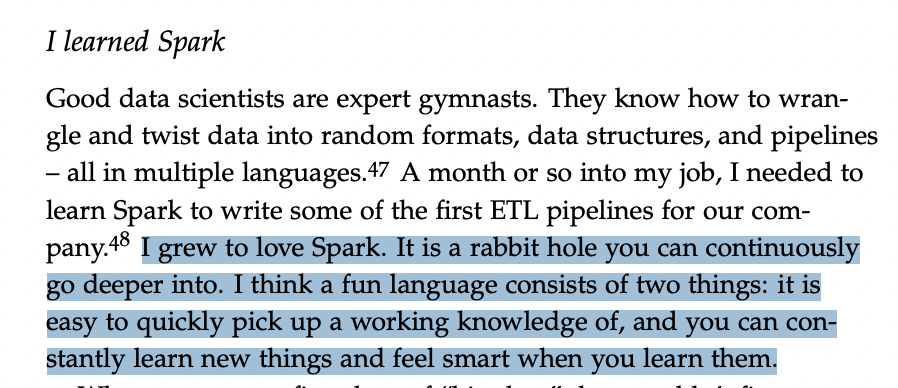
@TweetAtAKK @HamelHusain (last point in my long-winded rant) I've been thinking about Spark as an example for academic-born DSLs to solve industry data management problems. I wrote this about Spark > 1 year ago. I really, really think there is room for an academic-born soln to prod ML data management
Loading suggestions...