

📌 325/235: The Best Formation in Football? [Thread]
![📌 325/235: The Best Formation in Football? [Thread] https://t.co/8RpXCc9g59](https://pbs.twimg.com/media/FLP-2qhWQAI2C82.jpg)
Most of the top teams utilise a variant of the 325/235 formation in possession. This thread will explore why teams use the 235/235 formation, and why it is optimal in the fast-paced, hyper-technical/physical modern game - where the margins are fine.
Simply broken down, the 235/325 is ideal in possession, because the team has occupation of all five lateral zones, which is conducive of good spacing and balance, while maintaining overloads and security in deep central areas.

The interplay between risk and reward, or ‘‘expansive’’ play and solidity, can be characterised by the demands of different players in different phases. In build-up, focus on retaining possession, establishing control, and maintaining a strong rest defence is paramount.
In attacking phases, things become more complex, but generally the aim is to create space/an option to progress through, and ultimately access the dangerous areas to create from routinely; ideally in a methodical/reproducible manner.
As Field of Green present (link:(
Top teams need to account for all phases of the game - while very top teams can manipulate the phases of the game. The 235/325 dynamics are conducive of establishing this manipulation.
Top teams need to account for all phases of the game - while very top teams can manipulate the phases of the game. The 235/325 dynamics are conducive of establishing this manipulation.

The 235/325 offers the best of both worlds: tight control with an eye on rest defence and avoiding being exploited in defensive transition, without losing vertical dynamics, width + depth to break down deep blocks and generating those fabled artificial attacking transitions.
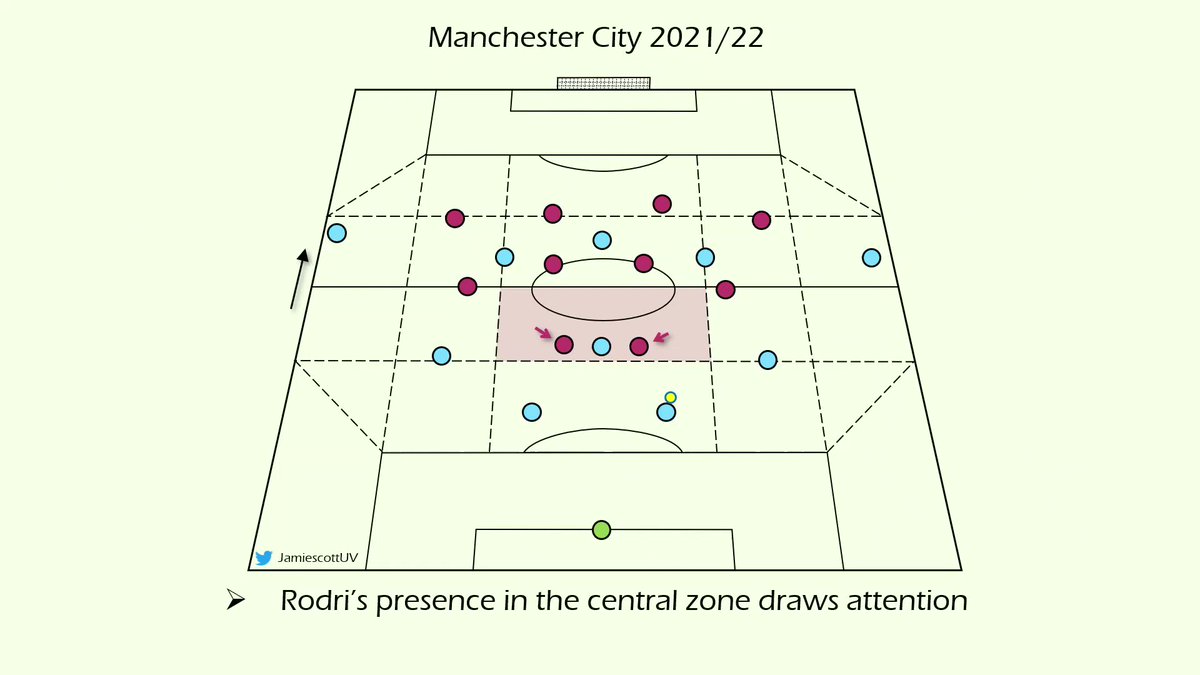
If we look at Manchester City, they have these dynamics nailed down perfectly. Their back two are complemented by the inverting fullbacks alongside Rodri in the midfield. They establish control so easily in this mode.

Rodri’s ability to occupy the central space and dominate physically tends to open space for City to progress using the fullbacks. Establishing Control? Check. Rest Defence? Check. Dynamics to Progress Play? Check.
Chelsea act similarly: their 3-2 is so compact, with technical ability to match. They’re very hard to press and the prospective threat of their width + depth forces teams to sit off and relinquish any modicum of control in Chelsea’s build-up.

(Note – Werner + the technical/physical quality of James/Chilwell helps the vertical dynamics – when Chelsea lost these players to injury/poor form, teams became more comfortable against Chelsea)
Liverpool are less similar than Chelsea to City, in the regard that they place less emphasis on total control from build-up, but the prospective threat of Salah, Mane (and often) Jota running the channels helps their cause in establishing the front five.

So the 235/325 is great at establishing control. But what dynamics make is such a threat in the final third? So many teams shunt their fullbacks into advanced areas and invert their wingers (to make a five), but struggle – appearing stagnant, easy to defend against.
The key, is manipulating the opposition. The opposition will always prioritise defending central areas. Pep had success in destroying teams repeatedly using KDB/Silva as free #8s and exploiting the half-spaces – but teams are savvy now.
In a similar vein, teams know not to give Salah or Mane time/space to run into when coming off the flank. Or giving the likes of Mount/Havertz/Lukaku the space to operate in as the nominal front three. 442 blocks are common and reasonably effective game-to-game.
Fullbacks/wingbacks/wingers receiving in the correct manner can be just as conducive of creating that reproducible threat going forwards, and the 235/325 offers the opportunity to reap the benefits of these dynamics.
Utilising the fact that teams will first focus on central security, City/Chelsea/Liverpool manipulate opposition blocks. City will load up to three players between the lines to pin opposition blocks to a narrow berth – Chelsea are similar. Liverpool invert Salah/Mane.
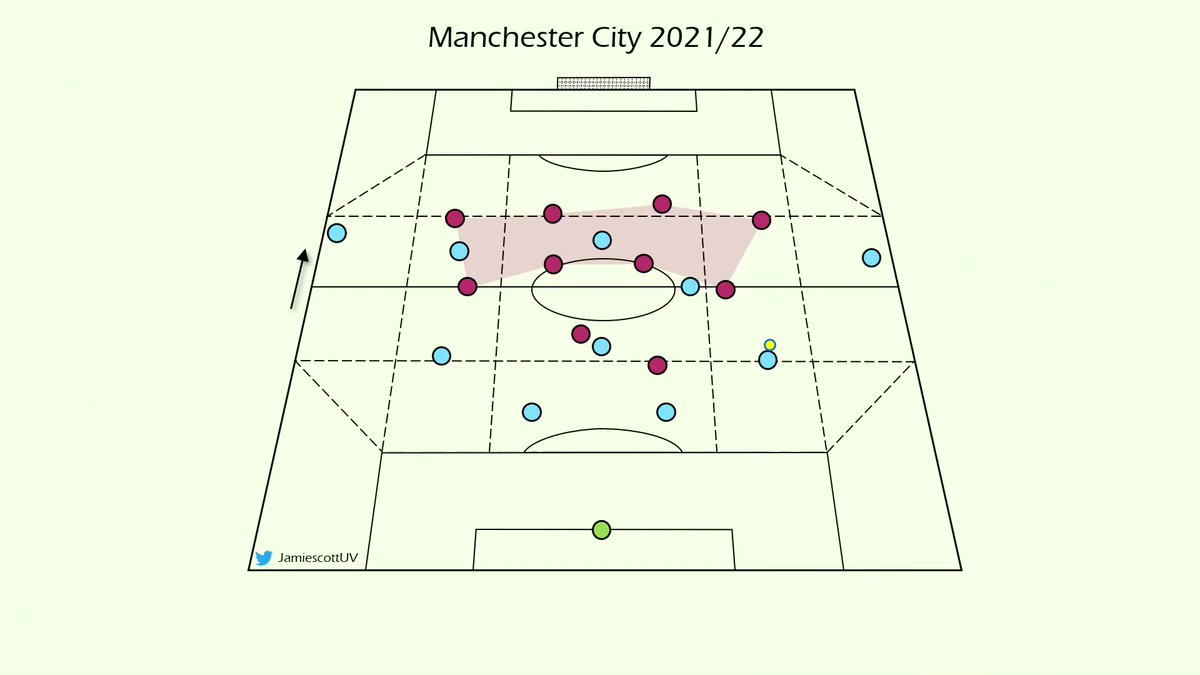
This allows these teams to access their wide players in areas of danger. For Liverpool, this is generally accessing Trent Alexander Arnold as the spare man – whether that’s due to Henderson/Elliot overlapping or otherwise.
As we can see from Yash’s (@Odriozolite's) brilliant visualisation, Trent adds the most Expected Threat for Liverpool.
This is primarily done from the half-space or deep wide space – Trent’s distribution is immense and he’s Liverpool’s primary danger.
This is primarily done from the half-space or deep wide space – Trent’s distribution is immense and he’s Liverpool’s primary danger.

But again, it is worth noting that Trent can only be Liverpool’s primary danger because the space created for him is a downstream benefit of Liverpool’s 235 system. Salah/Mane inverting generates the opportunity to create space.

Chelsea and City operate slightly differently. The aim of their progression is often to access the lone wide player in a favourable scenario. As City use non-inverted wingers, and Chelsea use wingbacks, these can be viewed as similar.
Chelsea use their narrow front three and compact 3-2 structure to open space out wide. This allows James/Chilwell to receive in movement – an underestimated facet. These wingbacks have time/space to execute their actions upon overlapping.

Similarly, City often use Foden on the left and Sterling on the right. Because of the nature of the front three pinning the opposition block and the 2-3 offering the central superiority, Foden/Sterling can receive with space to gain momentum in their dribbles.
Receiving with space is so important. A common limitation with wingers who have a tendency to invert is they can receive at less favourable angles, thus, can often be tightly marked by opposition fullbacks, thus, stagnating attacks (youtube.com).

Foden/Sterling’s 1v1 abilities down the line force the opposition defenders to anticipate the threat and pay attention to defending down the line. This in turn generates space for Cancelo in the half space, where he has been a massive threat this season.
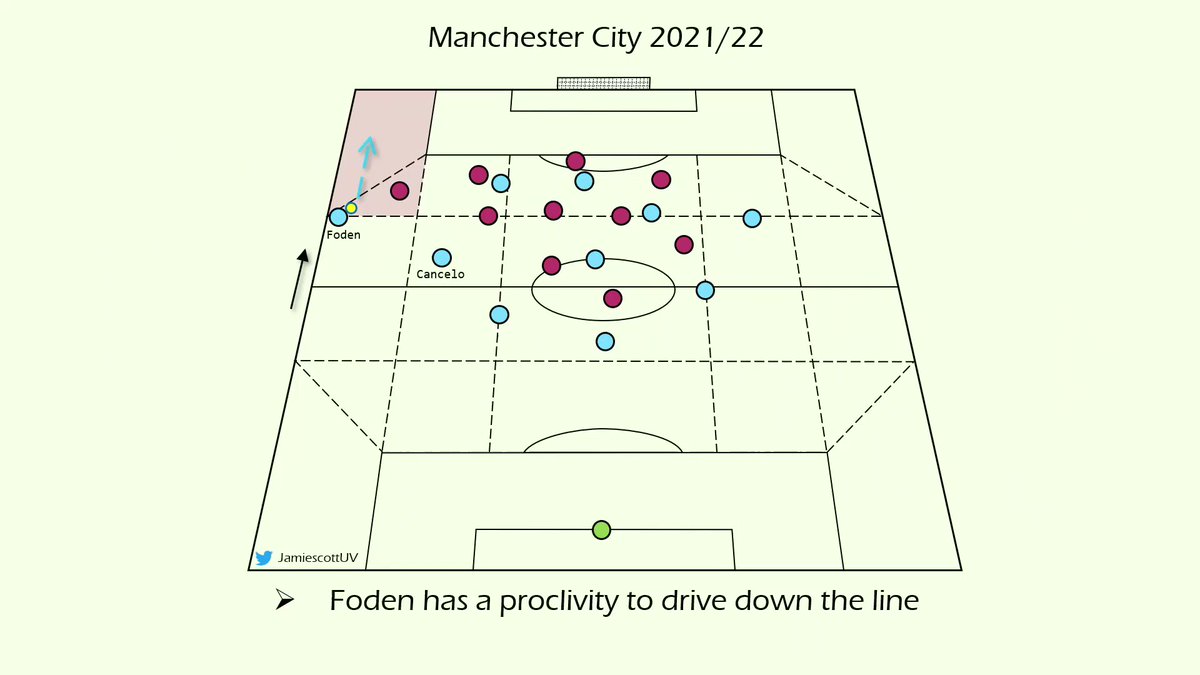
To back up this notion, here is an example of Cancelo's technical execution from such a zone, alongside another excerpt of @Odriozolite's Expected Threat visualisation.

Chelsea, although seemingly most potent through their wingbacks, actually have Mount as their individual with the highest expected threat. Again, the half spaces are a threatening location for Mount, who is a beneficiary of the width + depth of Chilwell/James.

As a final point, it is also worth noting that the 325/235 is also conducive of effective counter-pressing for offensive benefit – be it through generating artificial attacking transition-like scenarios, or merely overloading (rest defence) near the ball.
So, to conclude, the 235/325 is a very potent formation which allows teams to establish dominance in most phases of the game, by manipulating the dynamics of each phase using their individual team’s principles.
Any feedback is more than welcome!
(reply/DM - I’m happy to discuss)
Any feedback is more than welcome!
(reply/DM - I’m happy to discuss)
Loading suggestions...