

Legality of Islamic dresses for women
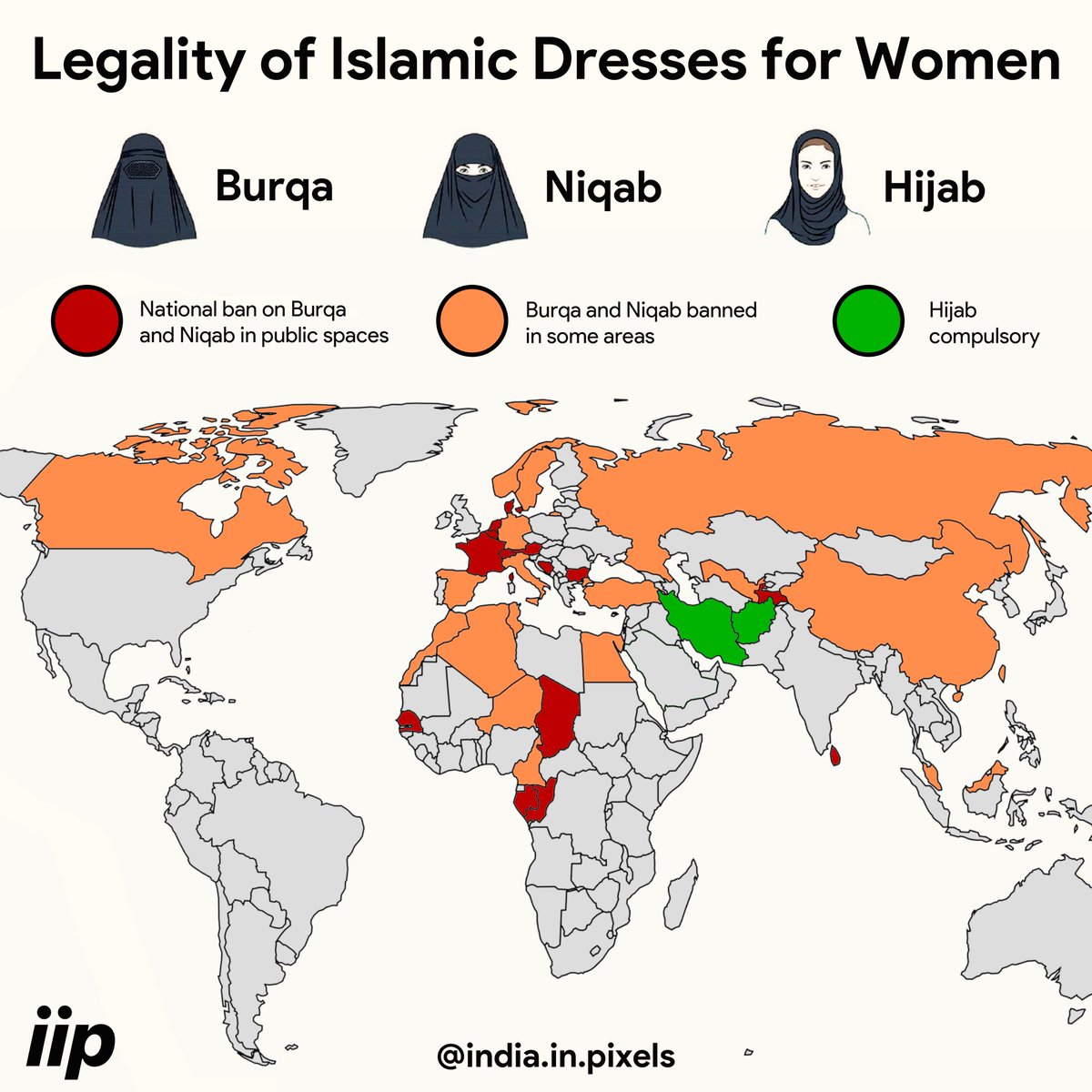
Burqa and Niqab - dress worn by Muslim women that cover the face and head are banned in public spaces in France, Belgium, Austria, Netherlands, Denmark, Bulgaria, Congo, Chad, Gabon, Tajikistan, Senegal, and Sri Lanka
All countries in Europe banned the attire in the last decade. Austria banned the burqa in 2017, Belgium in 2015, Bulgaria in 2016, Denmark in 2018, France in 2010, the Netherlands in 2012, Switzerland in 2021.
Major reason behind this move is the concern for safety & security
Major reason behind this move is the concern for safety & security
The Sri Lankan government banned all types of clothing covering the face, including the burqa and niqab, on 29 April 2019 following the Easter terror attack. In 2015, following a suicide attack by women dressed in religious garments, Cameroon banned it in the Far North region.
Following a double suicide bombing on 15 June 2015 which killed 33 people in N'Djamena, the Chadian government announced on 17 June 2015 the banning of the wearing of the burqa in its territory for security reasons.
It's not just the European nations that have banned the attire - Tunisia in 2019 banned the wearing of the niqab in public institutions citing security reasons. Morocco bans the attire in its military and also has ban on manufacturing and sale of burqa.
Norway has banned the burqa in educational institutes. Sweden has banned it in 2 municipalities - Skurup and Staffanstorp. China banned the burqa in the Islamic area of Xinjiang in 2017. Russia's Stavropol region has had a ban on hijabs in schools Since 2012.
Afghanistan and Iran are the only countries where the hijab is compulsory. Hijab covers the head while the face can be visible. Saudi Arabia has recently made hijab not compulsory as long as the attire is modest.
Loading suggestions...