

How to understand the financial performance of any business:
If you're intimidated by financial information or numbers,
This thread will help you analyze the financial results of any business using a simple framework
Let’s go:
This thread will help you analyze the financial results of any business using a simple framework
Let’s go:
1/ The three statements
Every company (big or small) has financial statements that are comprised of three individual statements:
• The Income Statement
• The Balance Sheet
• The Cash Flow Statement
Here is what each one means:
Every company (big or small) has financial statements that are comprised of three individual statements:
• The Income Statement
• The Balance Sheet
• The Cash Flow Statement
Here is what each one means:
2/ The Income Statement
Tells you how much profit a business has made over a certain period
Think of the income statement like your household budget for the year
Your household budget includes:
- how much money you make (salary)
- how much money you spend (expenses)
Tells you how much profit a business has made over a certain period
Think of the income statement like your household budget for the year
Your household budget includes:
- how much money you make (salary)
- how much money you spend (expenses)
The income statement is the same thing for a business
It tells you:
• How much money was collected from customers -> revenue
• How much it cost to get that revenue -> expenses
• How much was left over -> profit
It tells you:
• How much money was collected from customers -> revenue
• How much it cost to get that revenue -> expenses
• How much was left over -> profit
3/ The Balance Sheet
Tells you:
• What a business owns, and
• Who it owes money to
Going back to the household example:
Ask yourself what your household:
• Owns, and
• Who it owes money to
Tells you:
• What a business owns, and
• Who it owes money to
Going back to the household example:
Ask yourself what your household:
• Owns, and
• Who it owes money to
Things a household owns:
- House
- Cars
- Furniture
Things a household owes:
- Mortgage
- Credit card debt
- House
- Cars
- Furniture
Things a household owes:
- Mortgage
- Credit card debt
The balance sheet is the same thing but for a business
It tells you:
What a business owns:
- Building
- Equipment
What a business owes:
- Bank Debt
It tells you:
What a business owns:
- Building
- Equipment
What a business owes:
- Bank Debt
4/ The Cash Flow Statement
The Cash Flow Statement helps you understand how profit for a business is converted into actual cash
NEWS FLASH: The number a business reports as PROFIT isn’t the same as the CASH it made during the year
The Cash Flow Statement helps you understand how profit for a business is converted into actual cash
NEWS FLASH: The number a business reports as PROFIT isn’t the same as the CASH it made during the year
This is because financial statements are prepared using rules based on “accrual accounting”
These rules don’t match how a business makes and spend its cash
For more on this, check out my previous thread:
[
These rules don’t match how a business makes and spend its cash
For more on this, check out my previous thread:
[
5/ Analyzing Financial Performance
Any type of financial performance analysis for a company’s starts with the -> Income Statement
Here is what to look for:
Any type of financial performance analysis for a company’s starts with the -> Income Statement
Here is what to look for:
6/ Revenue Growth
Revenue can cure 99% of all problems in a business
When you look at revenue, a good business should show revenue growth year over year or from one period to another
Revenue can cure 99% of all problems in a business
When you look at revenue, a good business should show revenue growth year over year or from one period to another
7/ Revenue Growth Questions
Ask how is the company growing revenue?
• Is it selling more product?
-> volume-driven
• Is it raising prices?
-> price-driven
• Is the company buying its competitors?
-> M&A driven
Ask how is the company growing revenue?
• Is it selling more product?
-> volume-driven
• Is it raising prices?
-> price-driven
• Is the company buying its competitors?
-> M&A driven
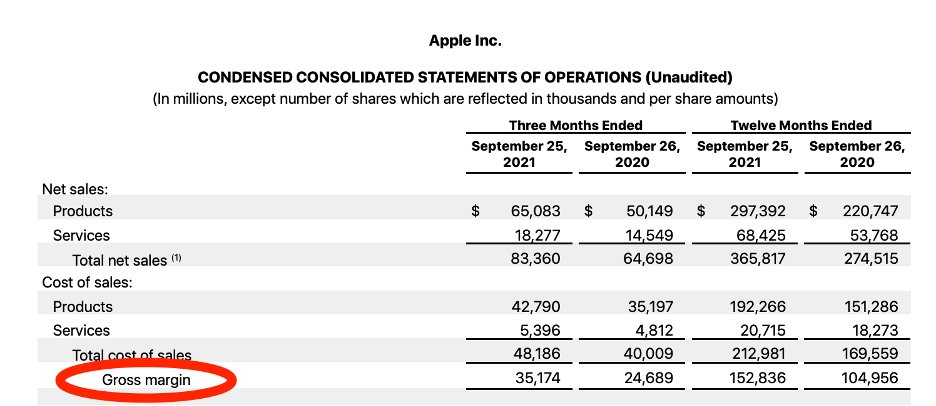
8/ Gross Margin
After revenue, the second most important item to look at on the Income Statement is
-> Gross Margin
The basic calculation for Gross Margin is:
• Revenue – Cost of Sales
After revenue, the second most important item to look at on the Income Statement is
-> Gross Margin
The basic calculation for Gross Margin is:
• Revenue – Cost of Sales
Cost of Sales is the amount you pay to generate the revenue you’ve earned
As an example, here is a look at Apple’s Gross Margin:
As an example, here is a look at Apple’s Gross Margin:
Good companies have a high gross margin
This means:
1. You’re efficient at generating revenue
2. It costs you little to earn a sale
This means:
1. You’re efficient at generating revenue
2. It costs you little to earn a sale
9/ Expense Growth
As a company’s revenue grows, expenses will also grow
There is nothing wrong with expense growth but ideally, you want a situation where:
• Expense Growth < Revenue Growth
As a company’s revenue grows, expenses will also grow
There is nothing wrong with expense growth but ideally, you want a situation where:
• Expense Growth < Revenue Growth
If Expense Growth > Revenue Growth
You have to ask yourself if the revenue growth is “quality” revenue growth
You have to ask yourself if the revenue growth is “quality” revenue growth
10/ Common Expense Issues
If a company is spending tons of money on marketing and other expenses to generate revenue
It means, it's spending more cash than what it earns from its customers
If a company is spending tons of money on marketing and other expenses to generate revenue
It means, it's spending more cash than what it earns from its customers
The only way to sustain a situation like this is to burn through investor cash or debt
You would have to hope that one day you can charge your customers more than what you spend to get them
You would have to hope that one day you can charge your customers more than what you spend to get them
11/ Cash Flow Statement Questions
“Revenue is vanity, profit is sanity, but cash is KING”
Once you’ve looked at the Income Statement,
Turn your attention to the Cash Flow Statement
“Revenue is vanity, profit is sanity, but cash is KING”
Once you’ve looked at the Income Statement,
Turn your attention to the Cash Flow Statement
The Cash Flow Statement helps you answer one question:
• Did the company make cash or spend cash during the year?
• Did the company make cash or spend cash during the year?
12/ Did the business make CASH?
The Cashflow statement has three sections:
i) Cash flow from Operations
Tells you:
• How much cash the business actually made or lost
• How profits were converted into cash
The Cashflow statement has three sections:
i) Cash flow from Operations
Tells you:
• How much cash the business actually made or lost
• How profits were converted into cash
ii) Cash flow from Investing Activities
Tells You:
• What assets did the company buy?
• Did the company do any M&A?
Tells You:
• What assets did the company buy?
• Did the company do any M&A?
iii) Cash flow from Financing Activities
Tells you:
• How is the company funded?
• Did the company raise money from investors?
• Did the company get money from a bank?
Tells you:
• How is the company funded?
• Did the company raise money from investors?
• Did the company get money from a bank?
Remember: Profit on the Income Statement isn’t = Cash
That’s why examining the Cash Flow Statement to determine whether a business made cash is important
Here is a YouTube Video explaining this concept:
[youtube.com)
That’s why examining the Cash Flow Statement to determine whether a business made cash is important
Here is a YouTube Video explaining this concept:
[youtube.com)
11/ Balance Sheet Risks
The last statement to analyze is the Balance Sheet
Here you’re looking for immediate signs of trouble
Similar to a household, if the mortgage and debts in a home are > than the value of its assets, you're in trouble
The last statement to analyze is the Balance Sheet
Here you’re looking for immediate signs of trouble
Similar to a household, if the mortgage and debts in a home are > than the value of its assets, you're in trouble
You’re looking for signs of existential risk in a company
You should ask yourself the following questions:
• Can the business pay its short-term debt?
• Can the business pay its suppliers?
• Did the business borrow too much?
You should ask yourself the following questions:
• Can the business pay its short-term debt?
• Can the business pay its suppliers?
• Did the business borrow too much?
A business is in a good financial position if:
• Current Assets > Current Liabilities
A business is in a bad financial position if:
• Current Liabilities < Current Assets
• Current Assets > Current Liabilities
A business is in a bad financial position if:
• Current Liabilities < Current Assets
These questions are answered by looking at the relationship between:
• Current assets like cash, and
• Current liabilities like accounts payable and short-term debt
• Current assets like cash, and
• Current liabilities like accounts payable and short-term debt
TLDR:
1. Every business has 3 sets of financial statements
2. Start with the Income Statement
3. Check for Revenue Growth
4. Check the Gross Margin
5. Check Expense Growth
6. Look for Expense issues
7. Did the business make CASH?
8. Look at any Balance Sheet Risks
1. Every business has 3 sets of financial statements
2. Start with the Income Statement
3. Check for Revenue Growth
4. Check the Gross Margin
5. Check Expense Growth
6. Look for Expense issues
7. Did the business make CASH?
8. Look at any Balance Sheet Risks
If you learned something new in this thread, retweet it so other people can benefit!
Follow @AliTheCFO
I tweet about:
• Finance
• Business Frameworks
• Personal Growth
Follow @AliTheCFO
I tweet about:
• Finance
• Business Frameworks
• Personal Growth
Loading suggestions...