

"Write what you know" is terrible advice.
Following this strategy will hinder your growth as a new writer.
You should write about what you don't know instead.
Here's why:
Following this strategy will hinder your growth as a new writer.
You should write about what you don't know instead.
Here's why:
Imagine a world without The Lord Of The Rings, American Gods, or Game Of Thrones.
The authors of these books would've deprived us of some of the greatest literary works of all time...
If they'd followed the norm.
This reasoning damages output.
Let's look at the downsides...
The authors of these books would've deprived us of some of the greatest literary works of all time...
If they'd followed the norm.
This reasoning damages output.
Let's look at the downsides...
• Stiffles imagination
First drafts are where creativity roams free...
Where you should follow your muse wherever it leads.
But if you let "write what you know" get into your head...
You invite the enemy of ingenuity⏤
Imposter syndrome.
That's when you can't pull it off.
First drafts are where creativity roams free...
Where you should follow your muse wherever it leads.
But if you let "write what you know" get into your head...
You invite the enemy of ingenuity⏤
Imposter syndrome.
That's when you can't pull it off.
• Hinders growth
The future belongs to polymaths.
Forget "Jack of all trades. Master of none" thinking.
Technology has accelerated the need for a new standard.
It's no coincidence that today's brightest minds dominate a wide range of skills.
Don't stay in your lane. Grow.
The future belongs to polymaths.
Forget "Jack of all trades. Master of none" thinking.
Technology has accelerated the need for a new standard.
It's no coincidence that today's brightest minds dominate a wide range of skills.
Don't stay in your lane. Grow.
• Kills excitement
Writing is a hyperspace jump.
As soon as the words start rolling out...
You're in another dimension of possibilities.
You write to create...
To dream...
To escape.
When you "write about what you know," the wonder and awe of exploration are annihilated.
Writing is a hyperspace jump.
As soon as the words start rolling out...
You're in another dimension of possibilities.
You write to create...
To dream...
To escape.
When you "write about what you know," the wonder and awe of exploration are annihilated.
Seems counterintuitive, but writing what you don't know has its perks...
Freedom being one.
The weight of expectations doesn't hit amateurs as hard.
But wait— there's more...
When you're not an expert, explaining things in simple terms is easier.
Let's look at Tim Urban...
Freedom being one.
The weight of expectations doesn't hit amateurs as hard.
But wait— there's more...
When you're not an expert, explaining things in simple terms is easier.
Let's look at Tim Urban...
He's one of the internet's most-read writers.
His blog has gathered more than 1.5 M views per month, and his Ted Talk is among the most popular.
More shocking than his accolades is the fact that he's an expert at not being an expert.
He writes about many topics.
How?
His blog has gathered more than 1.5 M views per month, and his Ted Talk is among the most popular.
More shocking than his accolades is the fact that he's an expert at not being an expert.
He writes about many topics.
How?

By following a unique framework.
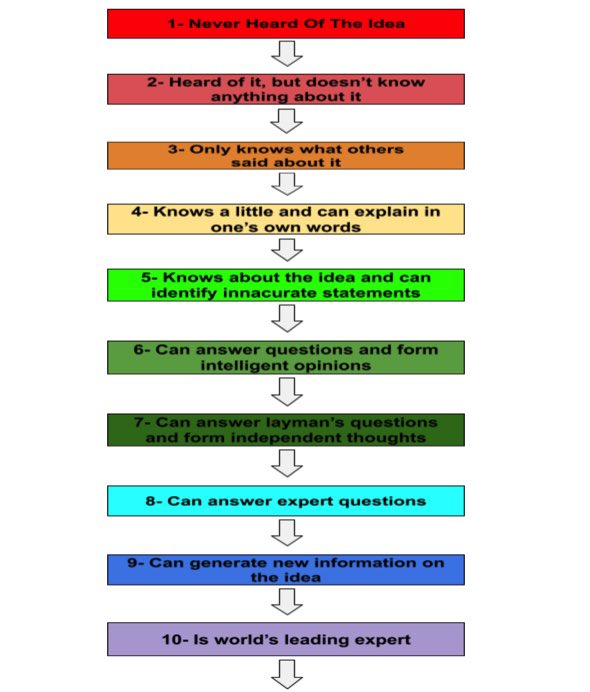
When he wants to explore an idea, he uses a scale from 1-10 to know where he stands on the topic.
1 is when he's never heard of it, and 10 is for the world's leading expert on the idea.
He tries to get to a 6— can answer layman's questions.
When he wants to explore an idea, he uses a scale from 1-10 to know where he stands on the topic.
1 is when he's never heard of it, and 10 is for the world's leading expert on the idea.
He tries to get to a 6— can answer layman's questions.
You can follow his method too...
1) Find your number...
Then, try to get to a 6...
Your goal is to bring readers to a level of clarity about a complex idea.
Start by mapping your audience's current knowledge level.
They need the minimal viable understanding to take action.
1) Find your number...
Then, try to get to a 6...
Your goal is to bring readers to a level of clarity about a complex idea.
Start by mapping your audience's current knowledge level.
They need the minimal viable understanding to take action.
Once you know where you and your readers are positioned...
2- Conduct in-depth research
Determine what's needed to form an intelligent opinion on the idea and explain it to others.
Take the time to strengthen your thinking.
You need to establish credibility— aim for quality.
2- Conduct in-depth research
Determine what's needed to form an intelligent opinion on the idea and explain it to others.
Take the time to strengthen your thinking.
You need to establish credibility— aim for quality.
3- Choose content aligned with your experience
You're writing for the person you were before.
And that person doesn't need theatrics or fancy jargon.
Never lose sight of who you're helping.
Avoid more advanced content like tutorials— if you're not qualified.
Instead...
You're writing for the person you were before.
And that person doesn't need theatrics or fancy jargon.
Never lose sight of who you're helping.
Avoid more advanced content like tutorials— if you're not qualified.
Instead...
Think of what you learned and can authentically contribute.
No one can critique you for sharing your own experiences.
That's why these are the best types of content, to begin with:
• Story post - Mine your life, mistakes, experiments.
What did your research teach you?
No one can critique you for sharing your own experiences.
That's why these are the best types of content, to begin with:
• Story post - Mine your life, mistakes, experiments.
What did your research teach you?
• Case studies - How have others succeeded? What steps did they take to get there? Is there a pattern?
This content is invaluable when it comes to establishing authority.
• Interviews - engage with the content of people ahead of you.
Add value, and then contact them.
This content is invaluable when it comes to establishing authority.
• Interviews - engage with the content of people ahead of you.
Add value, and then contact them.
• News Post - what are the latest developments on your topic?
Explain to your readers the implications of what's happening— how it affects them.
Anyone can read the news, yet you're providing additional insights.
It's an easy outlet to shine and establish your unique POV.
Explain to your readers the implications of what's happening— how it affects them.
Anyone can read the news, yet you're providing additional insights.
It's an easy outlet to shine and establish your unique POV.
• Curated content - look for expert advice from a relevant thought leader.
Share their content, but explain how you agree or disagree with them.
Detail the ways you'll put into action the collected info.
Tag the person whose content you've curated. They might even share it.
Share their content, but explain how you agree or disagree with them.
Detail the ways you'll put into action the collected info.
Tag the person whose content you've curated. They might even share it.
4- Optimize for consistency
Tim Urban spends an average of 160 hours researching a topic now.
But initially—he posted once a week.
Consistency is your best ally to gain traction.
Be sure to make a balanced trade-off between quality and frequency.
You need both.
Tim Urban spends an average of 160 hours researching a topic now.
But initially—he posted once a week.
Consistency is your best ally to gain traction.
Be sure to make a balanced trade-off between quality and frequency.
You need both.
My final piece of advice:
Don't let imposter syndrome stop you in your tracks.
No one is an expert at first.
We wouldn't have a Tim Urban or a Tim Ferriss if that were the case.
Stretch your limits by writing what you don't know.
Don't stay in a dull box of certainty.
Don't let imposter syndrome stop you in your tracks.
No one is an expert at first.
We wouldn't have a Tim Urban or a Tim Ferriss if that were the case.
Stretch your limits by writing what you don't know.
Don't stay in a dull box of certainty.
There you have it— a step-by-step framework to write captivating content when you're not an expert.
TL;DR
1- Find your number
2- Conduct in-depth research
3- Choose type of content
4- Optimize for consistency
TL;DR
1- Find your number
2- Conduct in-depth research
3- Choose type of content
4- Optimize for consistency
Glad you made it!
Thanks for sticking with me.
If you enjoyed this thread:
1) RT the first tweet to help others find it (linked below 👇)
2) Follow me: @DanesaGlez
Thanks for sticking with me.
If you enjoyed this thread:
1) RT the first tweet to help others find it (linked below 👇)
2) Follow me: @DanesaGlez
Loading suggestions...