

@MumbaichaDon This understates China’s tremendous cultural, geog & linguistic diversity—in particular imp cultural differences within tge Han. China is experiencing resurgence of local ethnicity & culture, most notably among southerners such as Cantonese & Hakka, now classified as Han. 2/n
@MumbaichaDon Cultural & linguistic fault lines could worsen in a China weakened by internal strife, economic downturn, uneven growth, or struggle over future pol succession. 3/n
@MumbaichaDon China is also concerned about “Kosovo effect,” accusing its Muslim & other ethnic minorities of seeking outside international (read Western) support for separatist goals. But ethnic problems go far deeper than the “official” minorities. 4/n
@MumbaichaDon Sichuanese, Cantonese, Shanghainese & Hunanese are avidly advocating increased cultural nationalism & resistance to Beijing central control. Ethnic strife did not dismantle former USSR,but it did come apart along boundaries defined in large part by ethnic & national difference4/n
@MumbaichaDon Officially, China is made up of 56 ethnic groups, one majority, Han & 55 minority groups. 2000 census revealed a total official minority population of nearly 104 mil, or approx 9% of population.5/n
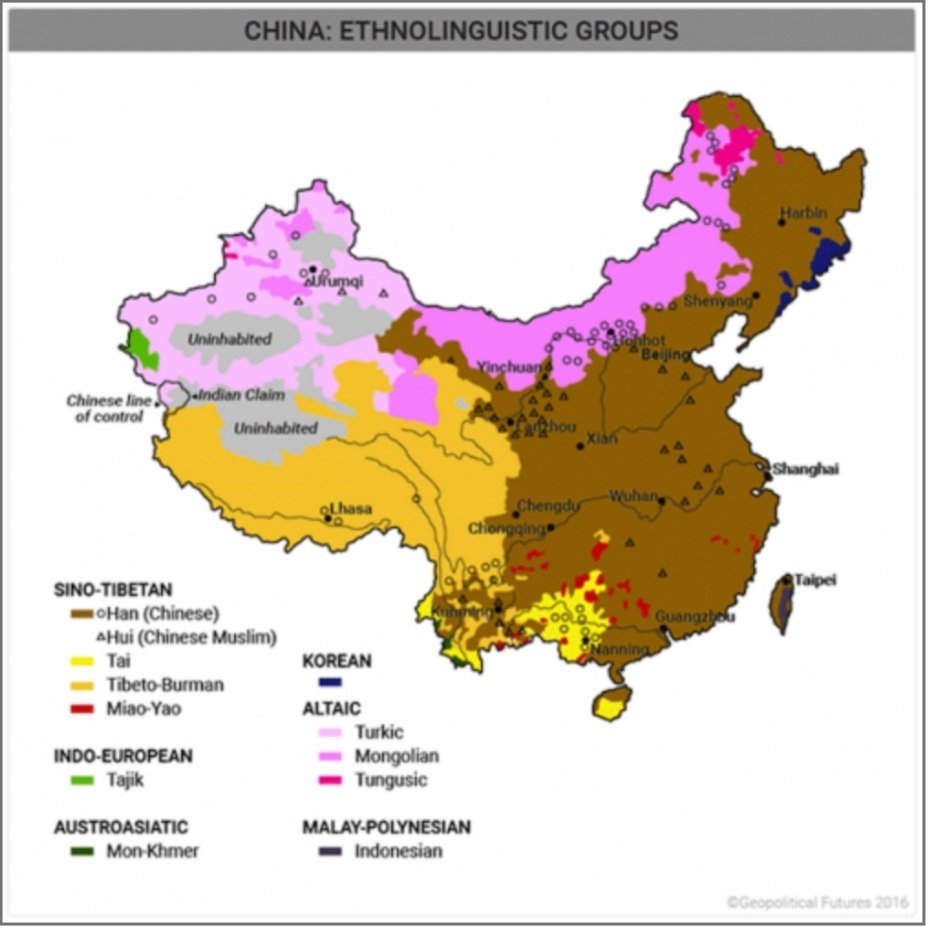
@MumbaichaDon People ident as Han (91%), from Beijing in North to Canton in South, include Hakka, Fujianese, Cantonese & others. These Han are thought to be united by a common history, culture and written language; differences in language, dress, diet and customs are regarded as minor. 6/n
@MumbaichaDon Sun Yat-Sen, leader of movement that toppled last imperial dynasty of China (Qing) in 1911, promoted idea that there were “5 Peoples of China” majority Han & others being Manchus, Mongolian,Tibetan &Hui (term for all Muslims in China, now divided into Uighurs,Kazakhs,Hui etc)8/n
@MumbaichaDon This expanded policy with recognition of 55 official minorities, also helped Communists’ longterm goal of forging united China. Cultural diversity within Han has not been recognized because of a deep(well-founded) fear of breaking up into feuding kingdoms, as in 1910s & 1920s 9/n
@MumbaichaDon Supposedly homogenous Han speak 8 mutually unintelligible languages (Mandarin, Wu, Yue, Xiang, Hakka, Gan, Southern Min & Northern Min). Even these subgroups show marked linguistic & cultural diversity. 10/n
@MumbaichaDon Mandarin was imposed as the national language early in the 20th century and has become the lingua franca, but, like Swahili in Africa, it must often be learned in school and is rarely used in everyday life across much of China.11/n
@MumbaichaDon China’s policy toward minorities involves official recognition, limited autonomy & unofficial efforts at control. Though totalling only 9%, they are concentrated in resource-rich areas spanning nearly 60% of country’s landmass & exceed 90% of popu along many border areas.12/n
@MumbaichaDon Why is it popular to be “officially” ethnic in today’s China despite -ve reporting in West about minority discrimination? Reason is simple. Groups iden as official minorities were beginning to receive real benefits from implementation of several affirmative action programs.13/n
@MumbaichaDon Most significant privileges included permission to have more children, pay fewer taxes, obtain better (Mandarin Chinese) education,access to public office, speak & learn native languages, worship & practice their religion(often including practices still banned among Han) etc 15/n
@MumbaichaDon Rising self-awareness among Cantonese is paralleled by reassertion of identity among Hakka, Southern Fujianese Min, Swatow & others now empowered by economic success & embittered by age-old restraints from north. 16/n
@MumbaichaDon Interestingly, most of these Southern groups traditionally regarded themselves not as Han but as Tang, descendants of great Tang dynasty (618-907 A.D.) & its southern bases. Most Chinatowns in North America, Europe & SEAsia are inhabited by Chinese immigrants from Tang areas.17/n
@MumbaichaDon Next decade may see resurgence of Tang Nationalism in S China in opposition to Northern Han, especially as economic wealth in South eclipses North. Heavy coverage by state media of riots in Xinjiang v/s news blackout in Tibet, could be deliberate effort.18/n
@MumbaichaDon China’s economic vitality has potential to fuel ethnic & linguistic division. As Southern & coastal areas get richer, much of Central, Northern & NW China hasn’t kept up, increasing competition & contributing to ageold resentments across ethnic, linguistic & cultural lines. 19/n
@MumbaichaDon China weakened by internal strife/inflation/uneven economic growth/struggle for pol succession could become further divided along cultural & linguistic lines. China’s threats will most likely come from civil unrest/internal ethnic unrest from within socalled Han majority.20/n
@MumbaichaDon We should recall that it was a Southerner(Cantonese), born & educated abroad(Hawai), Sun Yat-Sen, who led the revolution that ended China’s last dynasty. When that empire fell, competing warlords, often supported by foreign powers fought for turf. n/n
Loading suggestions...