

Financial Analysis Series Post 2: Learn how to adjust historical revenue numbers of a company for accounting standard changes. This is crucial while conducting Y-o-Y growth rates & Revenue CAGR analysis. let's get started🧵🧵🧵🧵 (1/n)
Now that we understand how companies present and calculate revenue figures in the first thread (link: ), the question is, should we take their reported Operating revenue as Revenue for our analysis?
Answer is No (2/n)
Answer is No (2/n)
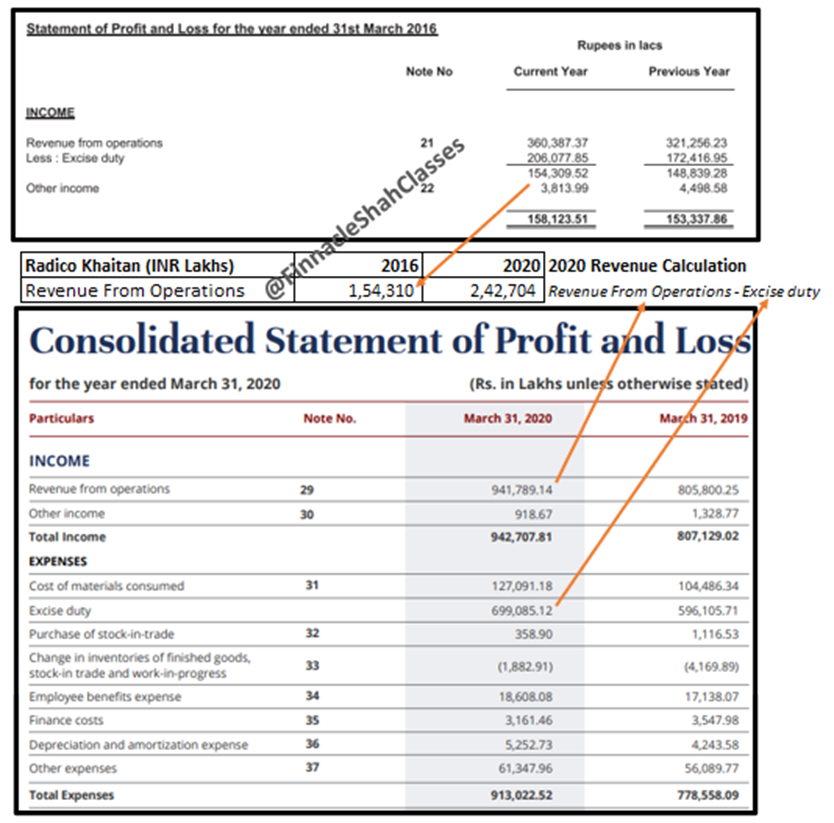
1) Excise Duty: Often companies report excise duty separately in expenses and don't net it out of revenues. As a practice, we should deduct excise duty from revenues to calculate Net Operating Revenues. (3/n)
Even after the GST regime, some companies have to pay state level Excise duties along with GST, such as Radico Khaitan, they would still be reporting revenues net of GST and gross of Excise duty which you will have to deduct from its revenue to make revenues comparable. (4/n)
We have done a sample analysis for you.(5/n)
2) Other Income Items: Well, we happened to be lucky in the case of HUL where the company’s quote of its operating revenue happens to be its actual operating revenue. (6/n)
Otherwise, often we may see that in the Other Income section/ footnote, we may find few operating items using which one may need to adjust the reported Operating income to derive actual Operating Revenue of a business.(7/n)
Let’s try and apply this concept to a sample scenario. Below is a snapshot of computation of Net operating revenue: (8/n)
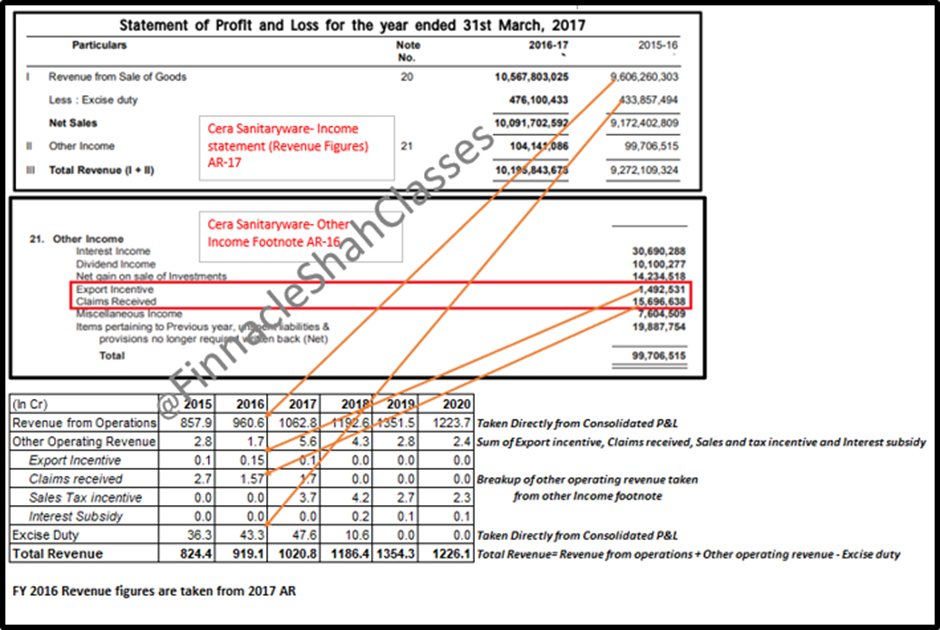
Note, Often while analyzing figures, always take prior year figures from the current year comparable i.e. take FY16 figures from FY17 annual report. This is done to ensure any minor corrections or restatements of financials (if any) are incorporated in your analysis. (9/n)
Thus, For time series comparison and analysis, we should take Gross figures post FY18 and prior to the same, take Net Revenue figures (adjusted for VAT). (10/n)
Please don't get us wrong, the materiality and impact of these points may be questionable in many cases, however they can be staggering in a few cases as you will find in our next blog! (11/n)
Our perspective of sharing this mindset is to help an analyst develop ground level understanding of numbers rather than directly start crunching them and create projections/ conclusions based on false/ incorrect reality.(12/n)
Especially with Revenues, one has to be extremely careful. As rightly put, Many valuation techniques are extremely sensitive just like the Hubble telescope, a small change in growth inputs and you end up in an entirely different galaxy! (13/n)
4) Accounting standard changes: We will discuss this in much more detail in our upcoming threads of What is defined as revenue.
5) Revenue Recognition policy changes: We will discuss this in much more detail in our upcoming threads of What is defined as revenue. (14/n)
5) Revenue Recognition policy changes: We will discuss this in much more detail in our upcoming threads of What is defined as revenue. (14/n)
Please read our full blog here:
finnacleshahclasses.com
Watch our YouTube video explaining the entire thread in detail with live annual report:
youtu.be
If you want to learn investing & have fun simultaneously then do follow us on Instagram: Finnacle_shah(15/n)
finnacleshahclasses.com
Watch our YouTube video explaining the entire thread in detail with live annual report:
youtu.be
If you want to learn investing & have fun simultaneously then do follow us on Instagram: Finnacle_shah(15/n)
Loading suggestions...