
For the longest period of the 1990s, Serbia, a tiny landlocked country without oil or gas resources, was under international sanctions. Still its leader Slobodan Milošević managed to stay in power for more than ten years. So why wouldn´t Putin? (Guess what: a 🧵)
Russian propaganda, Serbian nationalists and (some) left-wing westerners like to claim these days that Putin's war against 🇺🇦 is just a repetition of/more or less the same as NATO's war against Yugoslavia (Serbia & Montenegro) in 1999 over Kosovo. This is absurd on many levels
The 78-day NATO war against Serbia did indeed claim civilian casualties (albeit much less than the indiscriminate Russian of entire cities today.) But, yes: there were civilian, innocent victims in Serbia in 1999, and they died because of NATO bombing them.
NATO at the time in official statements euphemistically spoke of “collateral damage”. Those responsible for this deadly “damage” have never been held accountable. But from here on, almost everything is different between Kosovo 1999 and Ukraine 2022.
War crimes (“collateral damage”) by NATO in Serbia - e.g. in Aleksinac, Grdelica, Varvarin etc. - received & still get a lot of attention in the media of NATO countries. In Putin's Russia, just mentioning that there is a war in 🇺🇦 (let alone war crimes) will get you arrested.
In 1999, NATO bombed Serbia (and partly Montenegro) for 78 days. But neither Belgrade nor any other Serbian city after the war even remotely resembled Kharkiv or Mariupol today, after less than three weeks of Putin's war.
In Serbia, NATO mostly shelled military and security infrastructure, usually with high accuracy. Individual ruins in Belgrade bore witness to this precision for a long time. (The Chinese embassy, which may have housed military hardware, is another topic for another occasion).
When NATO attacked Yugoslavia in 1999, Bosnia-Hercegovina had already endured a war for more than four years with at least 100,000 dead. In and around Srebrenica in 1995, Serbian troops had killed more than 7,000 captured Bosniaks within days.
While the slogan "Never again Auschwitz", which 🇩🇪 Foreign Minister Joschka Fischer used to rally his sceptical party behind war was absurd, the concern that Serbian troops might commit another Srebrenica in Kosovo was not.
And now on sanctions: The international embargo policy on Miloševićs Yugoslavia (there were different embargos in different times) had harsh consequences. The population became impoverished. The hyperinflation of the dinar destroyed wealth that had been built up over decades.
Still the regime lasted for a long time - also thanks to friendly help in circumventing the sanctions. Gasoline was smuggled into the country via neighboring countries such as Bulgaria and Romania, Cyprus rendered useful services to the regime in banking transactions and so on.
However, over the years years, the sanctions did indeed contribute to Milosevic’s demise. In the end, the regime lacked the resources to shield the pillars of its own power - above all the highly armed special units of the Ministry of the Interior - from general impoverishment.
When those units switched sides and refused to take action against demonstrators, it was game over for Milošević. He was overthrown in a popular uprising on October 5, 2000 – 11 years and five months after he had taken power in Serbia.
During all those years, sanctioning Serbia was easy for the West. Serbia could not really fight back. So life in the West went on. Nobody had to freeze in cold apartments, no factory had to close. Business as usual.
Fast forward to 2022: The desire to bring Putin to his knees with ever tougher sanctions is understandable. But is it realistic? Do western societies have the stamina to endure sanctions for years to come if they feel their effects themselves? Not saying no, just asking.
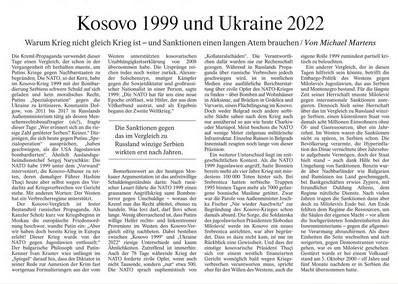
For F.A.Z. I tried to summarize (far, far from complete) the differences between Kosovo/Serbia 1999 and Ukraine 2022. Bottom line: Sanctions can work. But they were no quick fix in Serbia and are even less likely to be a quick fix now. If I err, even better.
Addendum: Technically, Yugoslavia was not "landlocked" in 1999, as it had access to the sea via Montenegro. However, Djukanovic had already turned away from Milosevic by 1999. (thanks to @AntonMilan)
Loading suggestions...