
( 🧵)
A demo of what might occur when one gives absolute precedence to ʿaql over revelation and how different it is from the way of the salaf
Fakhr al-Dīn al-Rāzī wrote quite extensively on this topic and his work, taʾsīs al-taqdīs, will be the core of this short thread
A demo of what might occur when one gives absolute precedence to ʿaql over revelation and how different it is from the way of the salaf
Fakhr al-Dīn al-Rāzī wrote quite extensively on this topic and his work, taʾsīs al-taqdīs, will be the core of this short thread
I'll first share the assessment of al-Ṭabarī before going into the work of Fakhr al-Dīn al-Rāzī
This to eventually show the differences in approach
This to eventually show the differences in approach
Imām al-Ṭabarī رَحِمَهُ ٱللَّٰهُ said: "The correct approach in our view is to affirm the meaning in a real sense, without likening Him to His creation, as Allah said of Himself in the Qur’an: 'There is nothing like unto Him, and He is the All-Hearer, the All-Seer' [ 42:11]"
1/
1/
So we affirm all of the meanings that we said are mentioned in the reports and the Qur’an and the revelation according to their apparent meaning, and we reject any likening of Him to His creation
2/
2/
"Hence we say: He, may He be glorified and exalted, hears all sounds, but not through a hole in an ear or through any physical faculty like Bani Adam. Similarly, He sees all people with vision that is not like the vision of Bani Adam, which is a physical faculty of theirs"
3/
3/
"He has a countenance or face, but it is not like the physical faces of Bani Adam that is made of flesh and blood. We say that He smiles upon whomever He will of His creation, but we don't say that this is showing teeth; and He descends every night to the lowest heaven"
4/4
4/4
As for Al-Rāzī, he starts with the idea that Allāh cannot be occupied in a space and therefore cannot have a body
Vice versa, if one would to affirm a space or direction it would then, by definition, mean that Allāh is similar to His creation according to al-rāzī and his ilk
Vice versa, if one would to affirm a space or direction it would then, by definition, mean that Allāh is similar to His creation according to al-rāzī and his ilk
He then goes on a long tangent per attribute and makes an attempt to reject the apparent meaning behind the attributes and while doing so mainly gives his own reasoning behind it
For example the attribute of laughter (Dahik)
al-Rāzī says that this cannot be accepted for several reasons:
1. It's Allāh who makes other laugh, not the other way. He then cites 53:43: "And that it is He who makes [one] laugh and weep"
This is a non-argument full stop
al-Rāzī says that this cannot be accepted for several reasons:
1. It's Allāh who makes other laugh, not the other way. He then cites 53:43: "And that it is He who makes [one] laugh and weep"
This is a non-argument full stop
2. Laughter necessitates a facial expression and results in heartfelt joy, this is impossible for Allāh
Now this is problematic for a couple reasons but most importantly that al-Rāzī is trying to understand Allāh's attributes by comparing Him to His creation
Now this is problematic for a couple reasons but most importantly that al-Rāzī is trying to understand Allāh's attributes by comparing Him to His creation
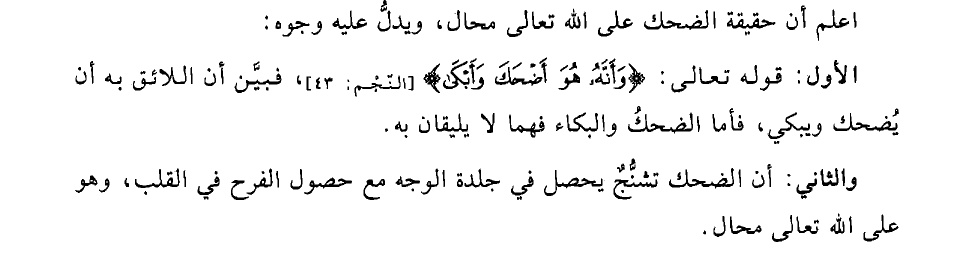
He basically says that Allāh cannot laugh because we, bani Adam, have a created face made of skin and whenever we laugh there is a change in facial expression
The question then is, where in the nuṣūṣ can we find this conclusion and methodology?
The question then is, where in the nuṣūṣ can we find this conclusion and methodology?
Furthermore, he, al-Rāzī, continues by saying: "that if we were to accept that Allāh does indeed laugh, we must then also accept that He weeps out of sadness (etc.)
Moreover, it was said by some that He felt sad by the events of Noah but why would He feel sad if He willed it?"
Moreover, it was said by some that He felt sad by the events of Noah but why would He feel sad if He willed it?"

So what does Fakhr al-Dīn al-Rāzī do for each attribute? He gives his own re-interpertation, i.e. does unnecessary taʾwīl, to somehow make it befitting
And this is the gate that opens up to more unnecessary taʾwīl and distortions
And this is the gate that opens up to more unnecessary taʾwīl and distortions
A short re-cap:
Fakhr al-Dīn al-Rāzī and the followers of kalām negate or distort the attributes by comparing it with 'Bani Adam' via their own reasoning
Afterall, nowhere in the nusūs are we instructed to conclusively judge Allāh's sifāt by comparing it with the sons of Adam
Fakhr al-Dīn al-Rāzī and the followers of kalām negate or distort the attributes by comparing it with 'Bani Adam' via their own reasoning
Afterall, nowhere in the nusūs are we instructed to conclusively judge Allāh's sifāt by comparing it with the sons of Adam
However, we do have a clear Qurʼānic verse which states that there is nothing similar to Allāh, which al-Ṭabarī correctly used to argue his postion:
"He, may He be glorified and exalted, hears all sounds, but not through a hole in an ear or through any physical faculty"
"He, may He be glorified and exalted, hears all sounds, but not through a hole in an ear or through any physical faculty"
The latter is the way of the Salaf, the only way to unconditionally accept revelation and give precedence to it
And this is why they were critisized by many righteous ʾaʾimma like Abū Naṣr al-Sijzī, Shaykh al-Islām, Ibn Qudāmah, al-Isfarāyīnī and many more
And this is why they were critisized by many righteous ʾaʾimma like Abū Naṣr al-Sijzī, Shaykh al-Islām, Ibn Qudāmah, al-Isfarāyīnī and many more
Loading suggestions...