

I was reading the story of a market wizard Jeffrey Neumann.
He started trading in 2002 with $2500
and has grown his account to $50million even with withdrawals.
Some of his trade stories contain incredible lessons for stock traders.
Here are 15 takeaways from his story. 🧵
He started trading in 2002 with $2500
and has grown his account to $50million even with withdrawals.
Some of his trade stories contain incredible lessons for stock traders.
Here are 15 takeaways from his story. 🧵
1/ Follow big money:
Watch stocks for big block orders to understand what the big money is doing.
It’s better to be in those stocks where large entities are showing accumulation.
Watch stocks for big block orders to understand what the big money is doing.
It’s better to be in those stocks where large entities are showing accumulation.
2/ Learn why and how stocks move technically:
Look at all the charts that had made big moves.
Why did a stock launch off a particular point?
Was there a volume spike beforehand?
Analyse through different lenses and find patterns you can trade on.
Look at all the charts that had made big moves.
Why did a stock launch off a particular point?
Was there a volume spike beforehand?
Analyse through different lenses and find patterns you can trade on.
3/ Breakouts:
Breakouts from longer term trendlines lead to much bigger moves than breakouts from shorter term trendlines.
So, you could look at one to five year trendlines and accumulate positions for bigger price moves.
Breakouts from longer term trendlines lead to much bigger moves than breakouts from shorter term trendlines.
So, you could look at one to five year trendlines and accumulate positions for bigger price moves.
4/ On creating your own sector list:
Define your own niche sectors.
So many sectors aren’t even defined under classification and are broadly classified instead of being specific.
Ex: Lithium, Alt energy, Robotics, Security, Genetic testing, Wearables, 3d Printing, etc.
Define your own niche sectors.
So many sectors aren’t even defined under classification and are broadly classified instead of being specific.
Ex: Lithium, Alt energy, Robotics, Security, Genetic testing, Wearables, 3d Printing, etc.
5/ A strong sector move requires the following three things:
• a hard catalyst
• a well defined date for the catalyst to work
• technical positioning in terms of the price chart
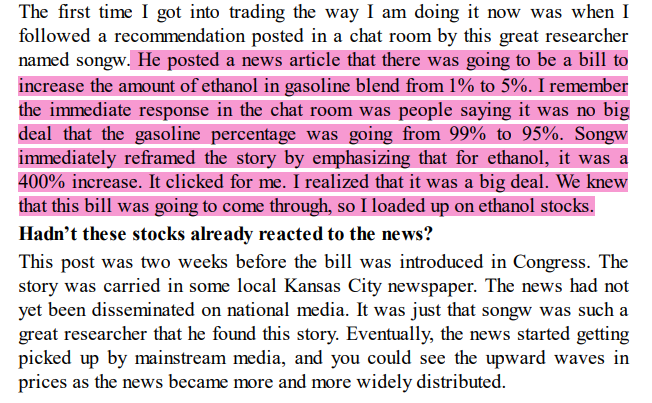
For ex: read this story from one of Neumann's trades.
• a hard catalyst
• a well defined date for the catalyst to work
• technical positioning in terms of the price chart
For ex: read this story from one of Neumann's trades.

6/ How to do sectoral analysis:
When you start researching about a specific space/sector, explore everything you could.
• Attend sector specific conferences
• Read all the recent annual reports of all the companies
• Listen to shareholder calls
When you start researching about a specific space/sector, explore everything you could.
• Attend sector specific conferences
• Read all the recent annual reports of all the companies
• Listen to shareholder calls
Learning enough about a sector and the companies in it will allow you to position yourself early in that space before it takes off.
- Do the field work
- Talk to the company, its distributors, and its associates.
Once you get conviction, start pyramiding your positions.
- Do the field work
- Talk to the company, its distributors, and its associates.
Once you get conviction, start pyramiding your positions.
7/ On trading what you are familiar with:
For any company you’re considering trading, if they make consumer products, buy and try the products.
Trade only if you like the products that they are making.
For any company you’re considering trading, if they make consumer products, buy and try the products.
Trade only if you like the products that they are making.
Try any new product in the market early on.
You will be able to envision applications for those products if you study the sectors they operate in.
This will help you acquire a much stronger fundamental basis to take a technical trade.
This story was an incredible one:
You will be able to envision applications for those products if you study the sectors they operate in.
This will help you acquire a much stronger fundamental basis to take a technical trade.
This story was an incredible one:

8/ On how the fraudulent promoters, especially the penny stock companies manipulate the market:
When a penny stock promoter wants to increase the liquidity
• They release controlled positive news flow about the company
• They have analysts start coverage of their company
When a penny stock promoter wants to increase the liquidity
• They release controlled positive news flow about the company
• They have analysts start coverage of their company
• They will also use social media and other advertising platforms to spread the word about their company.
• They will use the increased interest in their shares as liquidity becomes more available, to exit their holdings.
• They will use the increased interest in their shares as liquidity becomes more available, to exit their holdings.
9/ On exit techniques:
If you pick the right trades, and the stock moves sharply higher, excitement builds.
When the stock starts experiencing increased liquidity due to increased publicity,
it’s time to start locking in some profits and start scaling out of your position.
If you pick the right trades, and the stock moves sharply higher, excitement builds.
When the stock starts experiencing increased liquidity due to increased publicity,
it’s time to start locking in some profits and start scaling out of your position.
10/ On recognising when you should scale out of a sector:
Once a stock starts getting mentions in chat rooms, blogs, forums, CNBC, there will be lots of people talking about it.
Once everyone starts talking about it, you no longer have an edge.
Once a stock starts getting mentions in chat rooms, blogs, forums, CNBC, there will be lots of people talking about it.
Once everyone starts talking about it, you no longer have an edge.
That is also the time with the highest liquidity.
So, you could use an up trendline break as a signal to start scaling out.
When the sector leaders break their uptrend lines, even though some of the smaller stocks hold on, you must start getting out of everything.
So, you could use an up trendline break as a signal to start scaling out.
When the sector leaders break their uptrend lines, even though some of the smaller stocks hold on, you must start getting out of everything.
11/ On the importance of betting big:
You have to place large bets when you have the right set up and small bets when you don’t.
This in itself will determine how successful you are as a trader.
You have to place large bets when you have the right set up and small bets when you don’t.
This in itself will determine how successful you are as a trader.
It’s important to recognize the trades that happen few times a year - where multiple things align.
It’s also important to bet big on such trades.
It’s also important to bet big on such trades.
12/ On Risk Management:
Once you study a stock thoroughly and you have been observing it for weeks in the market, you know how the price and volume are acting.
If you’re in a position, and if the stock starts showing behavior outside of your expectations, it’s time to get out.
Once you study a stock thoroughly and you have been observing it for weeks in the market, you know how the price and volume are acting.
If you’re in a position, and if the stock starts showing behavior outside of your expectations, it’s time to get out.
• Stock starts moving down instead of up
• Liquidity is declining
• Big orders are hitting the bids
or any other sign that shows that your theory doesn’t hold true anymore, start cutting positions.
• Liquidity is declining
• Big orders are hitting the bids
or any other sign that shows that your theory doesn’t hold true anymore, start cutting positions.
13/ The Golf Course Indicator:
If some of your friends/acquaintances who never discuss markets with you suddenly come and talk to you about a stock, scrip, or a security,
and you have a position in it,
it’s time to start looking for an exit.
If some of your friends/acquaintances who never discuss markets with you suddenly come and talk to you about a stock, scrip, or a security,
and you have a position in it,
it’s time to start looking for an exit.
14/ On recognising mistakes fast:
It’s always better to get out of a position that’s not acting right.
You can always get back in.
Better taking a small loss and being wrong, than trying to prove you’re right and take a big loss.
It’s always better to get out of a position that’s not acting right.
You can always get back in.
Better taking a small loss and being wrong, than trying to prove you’re right and take a big loss.
15/ Trading is a puzzle:
First you have to arrange the four corners of the puzzle.
• Technical analysis (have the right chart pattern)
• Clean share structure
• Being in the right sector
• Having a catalyst or a story that will make the sector move up
First you have to arrange the four corners of the puzzle.
• Technical analysis (have the right chart pattern)
• Clean share structure
• Being in the right sector
• Having a catalyst or a story that will make the sector move up
Once the four corners of the puzzle are in place, you can fill in on other things.
• Filings
• Management and governance
• Trying the product(s)
• Pyramiding your position and sizing it correctly
• Filings
• Management and governance
• Trying the product(s)
• Pyramiding your position and sizing it correctly
If you found these insights valuable, jump back to the first tweet and retweet this thread for wider reach.
I write such weekly threads on systematic trading, traders, business, and finance.
Follow me @theBuoyantMan to get updated whenever I post something new.
Follow me @theBuoyantMan to get updated whenever I post something new.
Loading suggestions...