

📌 Erik ten Hag to Manchester United [thread]:
- ten Hag's Principles of Play at Ajax
- Strengths and Complexities of the System
- Suitability for the Premier League and United's Squad
- ten Hag's Principles of Play at Ajax
- Strengths and Complexities of the System
- Suitability for the Premier League and United's Squad
![📌 Erik ten Hag to Manchester United [thread]:
- ten Hag's Principles of Play at Ajax
- Strengths and...](https://pbs.twimg.com/media/FOd0jC8XMAQ3Tc1.jpg)
Erik ten Hag has been strongly linked with the Manchester United managerial position, commencing this summer, so this thread will aim to analyse Ten Hag’s principles of play to date, and how these will fare in line with United’s squad and expectations.
Erik ten Hag has typically lined his Ajax side up with a 433 nominal formation. This is quite straightforward; there’s nothing too notable to discuss yet, but that’s fine. Both Klopp and Pep use a nominal 433 too – it’s the most conventional 4atb nominal set-up in possession.

In the interest of keeping this concise, let’s dive straight in to ten Hag’s in-possession principles. The principles most widely associated with his team are width, verticality (for example counter-movements), decoy runs and manipulation of opposition presses/blocks.
From goal-kicks, ten Hag’s Ajax build from a deep position with the keeper plus two CBs. This offers a conventional build-up structure – a solid foundation to work with. The CBs are typically comfortable with the ball and can regularly make simple progressive passes.

Utilising the ‘‘ring of security’’ – the CBs + goalkeeper and one or both fullbacks dropping in, Ajax can regularly establish dominance in build-up against an opposition block; particularly if the opposition uses a front one or two - both of which are very common.

Ajax often drop one of the fullbacks (Blind or Mazraoui) into a deeper + more narrow position to aid the ring of security. This is conducive of either FB becoming a deep playmaker as they have time + space to find the vertical options on their side of the pitch.

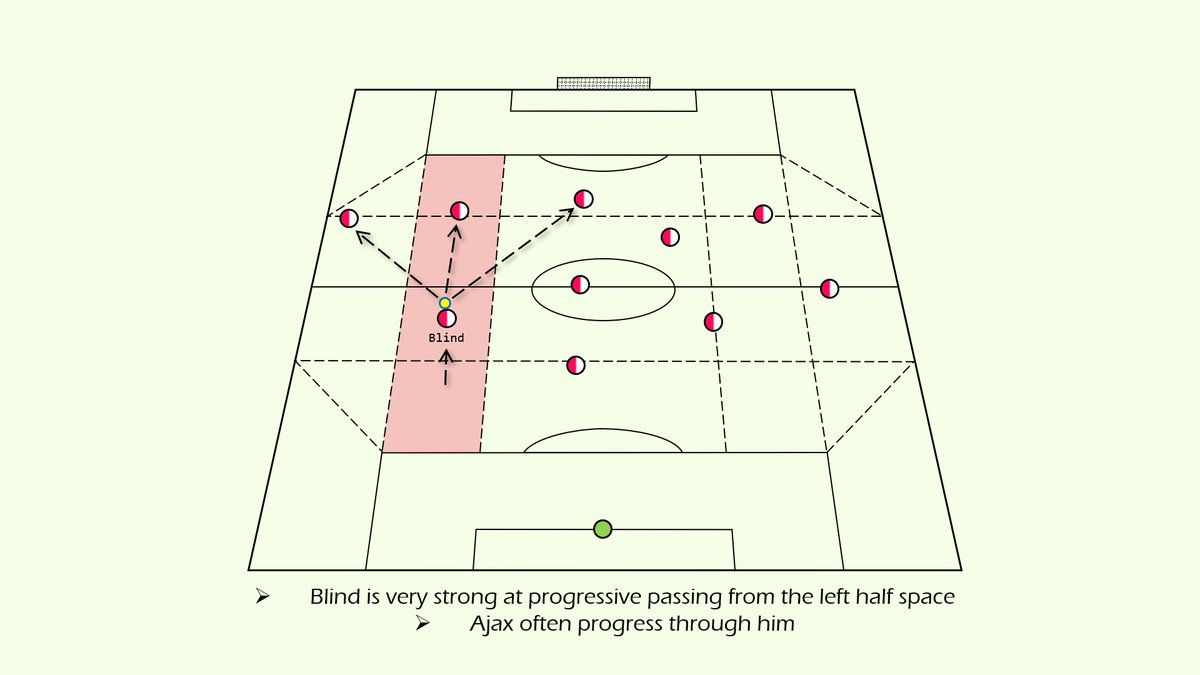
This is very much akin to how Pep uses his fullbacks in the 424 structure (deep + wide can make them more accessible vs a front two).

Ajax also frequently stagger their deep midfielders too, pushing one higher, to create a single pivot. The single pivot acts as an anchor, holding the opponent’s front line to a narrower berth, again similar to how Pep uses Rodri.

The foundations of ten Hag’s build-up are solid, and really quite conventional. But where the value lies, is not only how Ajax are able to progress the ball and begin to create, but how they can utilise coached movements and problem solving to adapt vs various opposition shapes.
In terms of progression, the keys, once in settled possession, are:
1)opening the passing lanes
2)having time + space to make the pass
3)allowing the receiver to consistently receive in an optimal manner
1)opening the passing lanes
2)having time + space to make the pass
3)allowing the receiver to consistently receive in an optimal manner
When Ajax create the ring of security, the fullbacks tend to drop into a narrower position. To oppose this, the wingers move wider to open a diagonal lane. This is beneficial for numerous reasons (see next slides):
1) The wingers (who are typically inverted) can receive in a consistent manner, back to touchline/pressure, which is conducive of cutting inside/making their go-to dribbles/actions.
Antony & Mazraoui share a strong relationship, with the RB knowing when to leave the winger 1v1.
Antony & Mazraoui share a strong relationship, with the RB knowing when to leave the winger 1v1.

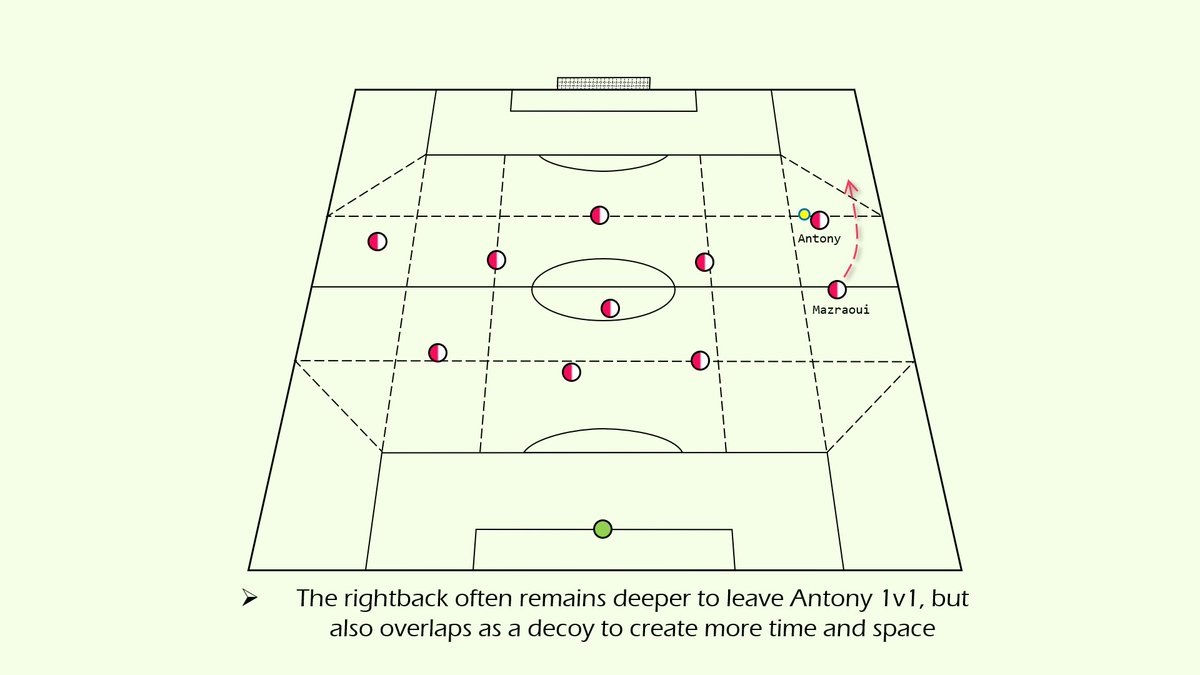
2) The opposition block is stretched laterally, and from here Ajax can begin to distort and pick holes. Chance creation doesn’t just occur in the final third: distorting the block in early phases can generate chances downstream.
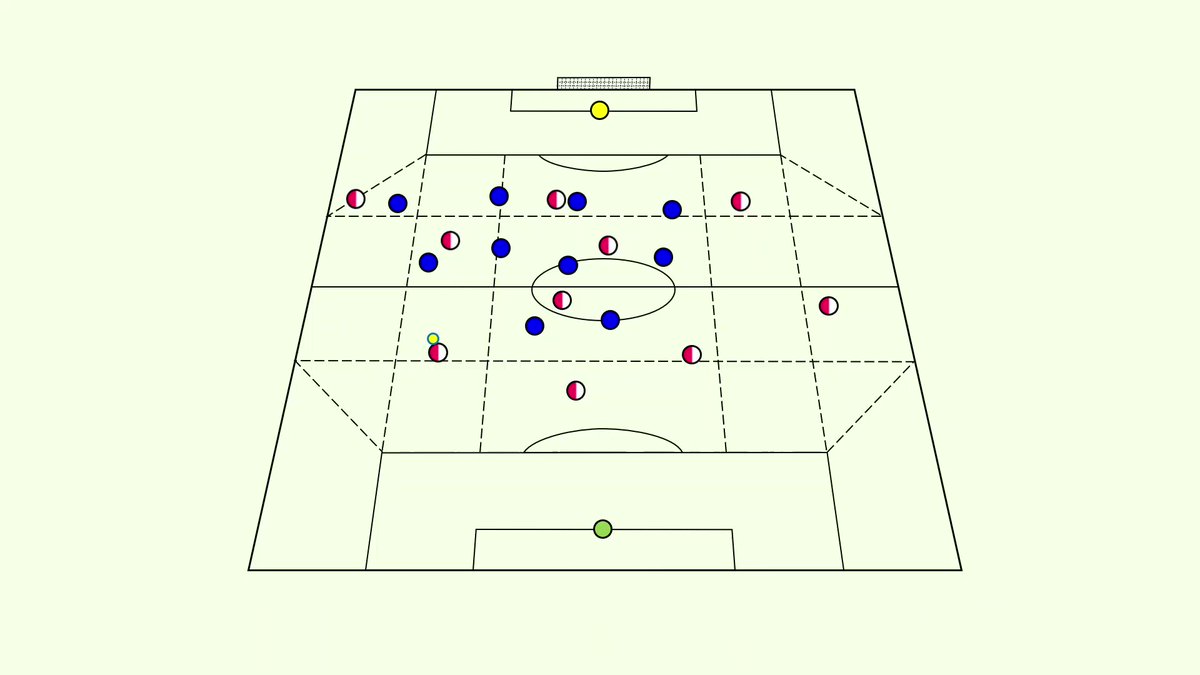
When posed problems in possession, Ajax begin to display their more complex principles. Their match against Dortmund is a good case study of this.

When pressed from goal-kicks, Ajax utilised vertical decoy runs from their centrebacks to open passing lanes directly from the keeper. Ajax could play out – or at least play to areas of lower risk despite sticking to their principles.
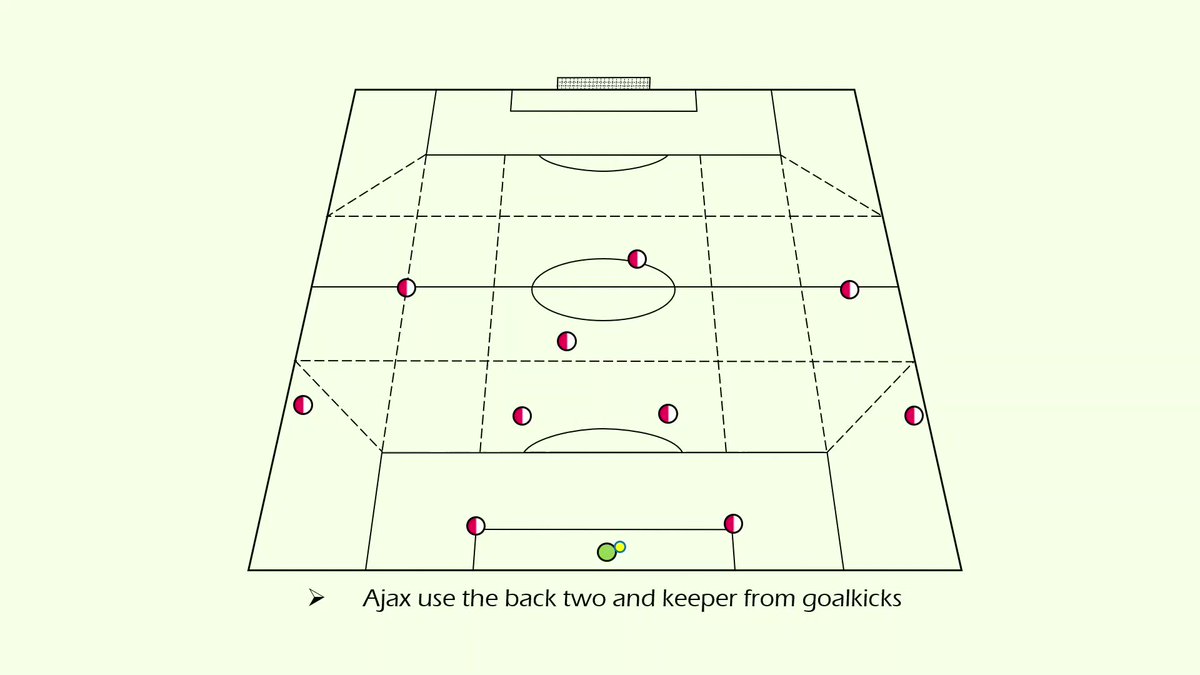
The degree of tactical complexity that the centrebacks must be aware of is rare – centrebacks do not usually move ahead of play in this regard, as they’re typically the most important constituents of rest defence.
(rest defence = predictive defending in possession)
(rest defence = predictive defending in possession)
Even from a throw in, we can see how aggressive Martinez is at occupying vacated space, making himself an option. This occurred despite causing him and Timber (the centreback pair) to stagger to quite a severe degree. It *appears* high risk.

Furthermore, in settled build-up, Martinez was often found vacating his post in centreback entirely. It may be a stretch to call him a centreback in this regard, because of how much conviction he’d stagger the lines with.

Alvarez, one of the deep midfielders actually dis-marked to receive deep in this scenario. Martinez is still seen staggering the lines. This is a vertical rotation as such: the CB advancing and the CM dropping in. Blind (out of shot) has dropped narrow to aid rest defence.

These vertical counter-movements are typically seen further up the pitch, when looking to progress (and sometimes force) play. Seeing it executed with such regularity in deep positions in build-up is unconventional.
Cue Gary Neville calling it arrogance...
Cue Gary Neville calling it arrogance...
This now begs the question: if Ajax are so expansive, surely their rest defence will be exposed? Surely, they’re understaffed in defensive transition, given the number of players moving ahead of the ball? This could be an issue.
Moving to the Premier League, ten Hag may need to re-evaluate just how expansive his team is in build-up. Having a CB move past the first line of pressure, *without* the ball, is risky.
Conversely, with the left back dropping in and the security + clarity in possession, the risks are mitigated - to an extent.
Compared to teams who have little tactical clarity and routinely lose the ball in their own half, ten Hag’s strategy seems less risky.
Compared to teams who have little tactical clarity and routinely lose the ball in their own half, ten Hag’s strategy seems less risky.
ten Hag’s build-up principles are an improvement over United’s current + previous ‘‘principles’’ at the very least. At best, they could revolutionise how teams build up in the Premier League. Most likely reality will fall in the middle of that spectrum.
Progressing up the pitch, Ajax stick to similar principles. They establish lateral superiorities, using maximum width, to stretch the opposition block, before utilising vertical movements and decoy runs to tear holes in these defensive blocks.
Gravenberch, the more advanced of the deep midfielders, and Berghuis, the advanced midfielder, often vacate space and move up the pitch. Conversely, Haller is seen dropping to combine. Ajax then utilise wall passes, and them, aim to find third man runners.

There is an element of pragmatism to Ajax’s play; particularly going forwards. They aren’t rigidly set in a system that doesn’t utilise the players’ strengths – rather, they combine the principles with maximising their players’ skillsets.
Ajax often play so Antony can receive 1v1 in a deep + wide position. His distribution from here is excellent – particularly his inswinging crosses. He also enjoys being in a 1v1 scenario regardless of whether Mazraoui is overlapping or standing off.
In the case study match against Dortmund, Antony notched three assists. This game isn’t perfectly representative (a sample size of one game never is), and while Dortmund were down to ten men, we can see the angles Antony likes to create from, on the right.


The overarching point regarding chance creation, is that the distortion through movement and width facilitates the individual quality, which ultimately adds another layer to the level of attacking threat ten Hag’s Ajax produce.
In terms of defensive transitions, Ajax generally perform reasonably, despite a system which makes having a consistent rest defence rather tedious. They often pack areas near the ball, thus, upon losing possession they are able to nip transitions in the bud with a counter-press.
This point feeds into a weakness that @lambertsmarc suggested to me: their reliance on fullbacks. Blind and Mazraoui are not only vital to build-up, progression, and (decoy) overlaps/underlaps in the final third, but are also integral to the rest defence.

To conclude this thread, it is important to discuss how ten Hag can play with United’s squad. To do this, profiling the players ten Hag will use is one way forward.
Here is a very tentative depiction of the players who fit the system perfectly:
Here is a very tentative depiction of the players who fit the system perfectly:

Disclaimer: this isn’t to say Rashford or Amad can’t be the left winger, or that Dalot can’t be the right back, or Ronaldo the striker. These are just the players whose profiles are a very good fit at this exact moment, in the exact structure ten Hag is currently using.
I hope to make a part two to this thread discussing which players will be nailed-on starters, which players will certainly have utility in the squad, and which areas United need to strengthen in (and who realistic targets are).
To summarise: ten Hag’s Ajax have displayed some very impressive principles of play. That doesn’t necessarily mean United will play like Ajax, it doesn’t mean that United will certainly play a 433.
I see these principles of play as transferable, and if ten Hag moves to United, we can expect a strong brand of possession-based football, where the players have a high level of clarity in terms of their role and how to break down the opponent, systematically, as a team.
End of thread. Thanks for reading - feedback is always welcome!
Loading suggestions...