

With lots of interest in the 'early' fires that have burnt across the UK over the last few weeks, I thought I'd add some facts to enable people to understand what is happening, why, and what we are doing. (mostly based on data and information from South Wales)
a thread🧵
a thread🧵
2. Firstly, are these fires a new phenomenon?
No, there have been over 75,000 wildfires across South Wales since the year 2000, 55,000+ between 2000&2008, 21,000+ between 2009&2020 (the 2nd group of figures are for a smaller geographic area).
No, there have been over 75,000 wildfires across South Wales since the year 2000, 55,000+ between 2000&2008, 21,000+ between 2009&2020 (the 2nd group of figures are for a smaller geographic area).
3. Are these Fires burning earlier in the year?
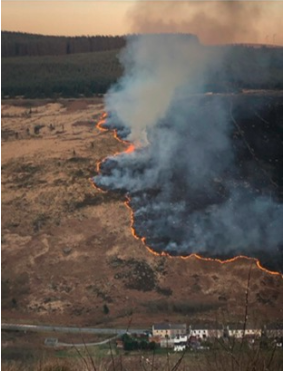
No, springtime fires burn the dead annual vegetation (fuel) and once dry weather arrives so do the fires. Our busiest month for wildfires is usually April, with March not far behind dependant on year - fire below 30/3/2020
No, springtime fires burn the dead annual vegetation (fuel) and once dry weather arrives so do the fires. Our busiest month for wildfires is usually April, with March not far behind dependant on year - fire below 30/3/2020

4. Are these fires related to climate change? A high pressure system centered to the East of the UK brings sunny days, dry easterly winds and low humidity which rapidly dries out the dead annual vegetation. This weather pattern is associated with large wildfires on the uplands.
5. Highs at this time of year are not abnormal, but a sustained high is unusual. What is also unusual is that these early season fires are normally self-extinguished at night as the temperature drops below dew point as the vegetation becomes wet.
6. We (in Wales, the South West of the UK) were not getting night time temperatures low enough to achieve dew point, which is another reason these wildfires are burning for multiple days.
7. Why do the fires become so large? We've had some very large fires already, one of which was measured at 1600 hectares by @DrTELS . Once these fires are ignited they become difficult to extinguish, not because of fire behaviour but because of access on the saturated ground.

8.A lot of the uplands areas are drinking water catchments so are very wet, we are lucky to have some capable 6x6 ATV vehicles with fire fogging units to extinguish fires within @SWFireandRescue but even these struggle in these locations.

9. Effects from these fires? Both short and long term. These fires tie up huge amount of fire service resources, which reduces fire cover for our communities. Long term effects of the smoke lingering in the valleys for days isn't fully understood but is being researched

10. These fires, early in the year burn the surface vegetation and luckily do not burn into the saturated peat. The loss of wildlife isn't really known, but the effects of deep seated peat fires in summer could have serious consequences.
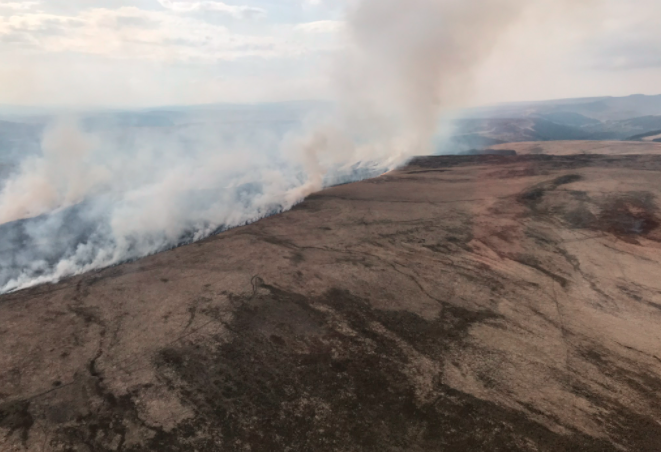
11. Early fires can be a drain on resources but the areas effected 'green up' quickly, whereas summer fires (like experienced in 2018) can leave our steep sided valleys bare over winter and result in erosion.
12. Are these severe fires?
Fire severity relates to the impacts of fire on ecosystems, fire intensity is the energy released, and fire behaviour such as flame lengths. Generally early season fires although intense(big flames) are less severe than later fires in dryer months.
Fire severity relates to the impacts of fire on ecosystems, fire intensity is the energy released, and fire behaviour such as flame lengths. Generally early season fires although intense(big flames) are less severe than later fires in dryer months.
13. How do these fires start?
Nearly all fires in the UK are started by people. We very rarely get naturally ignited wildfires from sources such as lightening. There are lots of anecdotal evidence about who light fires and why, but little actual fact.
Nearly all fires in the UK are started by people. We very rarely get naturally ignited wildfires from sources such as lightening. There are lots of anecdotal evidence about who light fires and why, but little actual fact.
14. Young children are usually associated with fire setting but this is very hard to prove. Children are encouraged to see firefighters as 'heroes' so there is little wonder they appear at fires when they see fire engines - whoever the real culprit is.
15. Land owners following the rules are allowed to use fire to manage their land and yes, a minority may light fires and leave. This is difficult to prove. Unproved accusations can do serious damage to partnerships and stakeholder groups.
16. Approx 96% of wildfires attended in South Wales are deliberate- anti social fire setting. Although not impossible, the ignition of vegetation from carelessly discarded cigarettes is high unlikely in our conditions.
17. We have spent a huge amount of time and resources trying to stop people lighting fires. Fire exclusion without fuel management is not really the answer. We cannot control the weather, we cannot stop the arsonists, but we can manage the fuel.

18. We have formed partnerships such as the @Hillsides_Wales with @NatResWales (funded by @WelshGovernment) where we are engaging with all stakeholders, we are managing land at trial sites, educating, trialling fire wise schemes and reintroducing grazing.

19. We have trained our firefighters and officers to manage wildfires. We have introduced prescribed burning and trained firefighters to use fire to manage the build up of vegetation at strategic locations to reduce risk during the prescribed burn season. (1st Oct- 31st March)

20. Through a European funded project facilitated by the @PauCostaF we have been a partner at the @AfanUcpm project. We are building a framework of best practice for remote fire analysis, to support firefighting decisions on the ground at more than one incident at a time.
21. We have FF's who are part of the UK wildfire tactical advisor group hosted by the @NFCC_FireChiefs. Through this group we can assist UK services and receive help when we request it. We are working to embed the remote fire analyst skills into this group for UK resilience.

22. Our FF's trained in prescribed burning can also use fire to fight fire, this enables them to stop large fires by removing the vegetation in its path. This is quicker and safer than trying to fight the wildfire flames.

23. Through partnerships we have access to a remote control flail mower which is used to create fire breaks to break up fuel continuity and also open up footpaths to increase footfall onto our hillsides. This can also be used to stop large wildfires.

24. Trees are not only important for the environment but also for the economy of Wales and it is important that fires in @NatResWales woodlands are extinguished quickly, to enable this a firefighting helicopter is available from @AirbourneHeli for forestry fires.

25. Hopefully this has given some info regarding the complex issues around wildfires and how we protect communities from them. In my opinion the challenge is not to exclude them but to learn to live with them #wildfire #ClimateCrisis
Loading suggestions...