

#Privy Speciality Chemical - Superior Business Model ?
A Detailed Thread 🧵🧵
Like & Retweet for Max Reach !!
Price : ₹ 1986 🌹🥀
A Detailed Thread 🧵🧵
Like & Retweet for Max Reach !!
Price : ₹ 1986 🌹🥀

1. Privi started manufacturing in 1992 with only two products, now having more than 50 products manufacturing at Mahad and Gujrat facilities.
2. India's leading manufacturer, supplier and exporter of aroma and fragrance chemicals.
2. India's leading manufacturer, supplier and exporter of aroma and fragrance chemicals.
3. Privi has developed a backward integrated value chain and manufactures value-added products from the waste generated during the manufacturing process
Management

Industry Outlook
1. Aroma chemicals which form the building blocks of the F & F industry is a size of about USD 5.5bn. This multi-billion-dollar industry impacts daily life for consumers worldwide, often on multiple fronts: From the toothpaste we use, to the coffee, tea,
1. Aroma chemicals which form the building blocks of the F & F industry is a size of about USD 5.5bn. This multi-billion-dollar industry impacts daily life for consumers worldwide, often on multiple fronts: From the toothpaste we use, to the coffee, tea,
and milk we drink, to the deodorants, ice cream, lipstick, fine wine and perfume, the F&F industry is subtle but extensively integrated into our daily lives
2. The industry value chain begins from the petrochemical manufacturers and ends with the FMCG industries.
2. The industry value chain begins from the petrochemical manufacturers and ends with the FMCG industries.

.As per IMARC research, the global flavours and fragrances (F&F)market reached a value of US$31.7 billion in 2020 as compared to US$29.8 billion in 2019.The worldwide market is dominated by four major companies: Firmenich, International Flavours & Fragrances (IFF), Givaudan,
and Symrise. Collectively, the foursome controls up to 50% of the market share

3. An estimated 70% of the organised market in India comprises international players while the remaining market is catered by domestic players. The market is fairly consolidated with the top 5 players accounting for 65% of the total market share
4. The growth in FMCG will drive the growth for the F&F industry. With rise in disposable income and post pandemic “work from home” culture, the demand is expected to be robust in near future.Companies like HUL, Pepsico, P&G, Coca-cola, Colgate,
The Kraft Heinz Company and other players are in constant requirement of the F&F raw materials for meeting consumer demand
Business Operations
1. Privi manufactures aroma chemicals which are used by the Fragrance and flavours industry to make different formulations having application in the FMCG industry.
1. Privi manufactures aroma chemicals which are used by the Fragrance and flavours industry to make different formulations having application in the FMCG industry.
2. Aroma chemicals are synthetic aromas. Virtually all perfumes on the market are composed of aroma chemicals. 75-90% composition of a perfume fragrance is aroma chemicals.
3. Privi manufactures pinene based, phenol based, citral based and speciality based aroma chemicals.

Understanding value chain
1. In early times, extracts of flowers were used to make fragrances, however in modern times with scarcity of flora and fauna, the aroma industry is dependent on petrochemicals and pinene for their raw material requirement.
1. In early times, extracts of flowers were used to make fragrances, however in modern times with scarcity of flora and fauna, the aroma industry is dependent on petrochemicals and pinene for their raw material requirement.
The key starting material used in manufacturing of aroma chemicals is petrochemicals and pinene. Petrochemicals and Pinene are the only two key starting materials for the F&F industry.
2. Petrochemicals: The aroma we get from fuels such as petrol, diesel and kerosene is because of the presence of volatile aromatic compounds in it. Petrochemicals are derived from fractional distillation of crude oil which has a rich content of volatile aromatic compounds
and Olefins These compounds are further extracted and processed into different aromatic compounds like Benzene, Toluene, and Xylene for application in the petrochemistry industry.
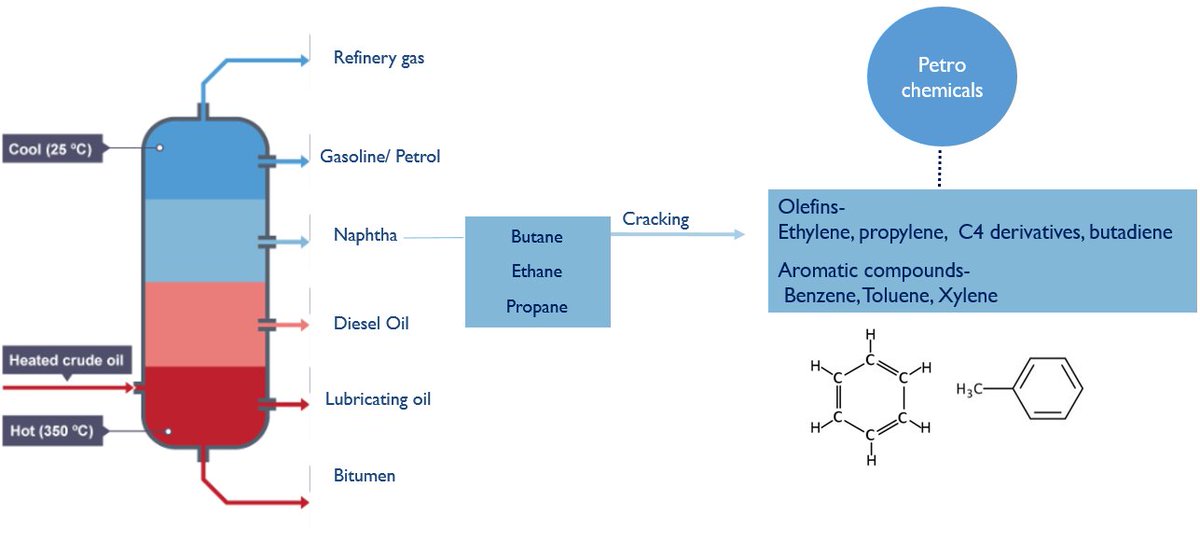
Petrochemical based aroma chemicals
1. From the petrochemicals value chain we derive benzene, toluene, xylene, phenols aldehydes etc and other types of chemicals.These chemicals go hand in hand with essential oils or isolates and under
1. From the petrochemicals value chain we derive benzene, toluene, xylene, phenols aldehydes etc and other types of chemicals.These chemicals go hand in hand with essential oils or isolates and under
differentiated chemistry to achieve a desired final product. Some aroma chemicals are fully synthetic, eg: musk. The musk resembles a woody, leather and animalic fragrance and is used as a base note for most of the perfumes.
The musk is a secretion inside an internal pouch on the abdomen of the male deer. In order to get it, you have to kill the deer. Thus synthetic substitutes were needed to prevent illegal hunting of deers for musk.

Xylene is a KSM used for manufacturing musk. The musk is classified into three types: Nitro musk, Polycyclic musk and Macrocyclic musk.
Nitro musk was widely used during the 20th century but is now prohibited because of certain neurotoxicity and their phototoxicity.
Nitro musk was widely used during the 20th century but is now prohibited because of certain neurotoxicity and their phototoxicity.
Polycyclic musks are low cost fragrances commonly used in soaps, perfumes, etc but are poorly biodegradable. Macrocyclic musks have the best potential for replacement of Polycyclic musks.
However, the low cost and performance of Polycyclics makes the large-scale replacement of PCMs by MCMs a formidable task

Privi manufactures OTBCHA/PTBCHA under the phenol segment. OTBCHA (ortho tertiary butyl cyclohexyl acetate) carries a potent fruity scent, balanced with woody undertones. The butyl phenols are KSM to make OTBCHA. (Continues)....

The phenyl ethyl alcohol ether has floral fragrance notes. Jasmine, rose and other floral fragrance compositions have these ethers. These are generic products having low value and high volume requirements.
Pinene: Pinene is derived from pine coniferous trees.Pine coniferous trees are the richest source of pinene molecules. Pine trees are abundantly found in China, thus it is the largest manufacturer of pine based products globally.
The pinene from pine trees is extracted from two main processes. One is from the Gum turpentine oil (GTO) recovered from tapping the pine trees and the other is extraction from Crude sulphate turpentine (CST) which is recovered from Kraft process in paper industries.
GTO is widely used, as the chemistry to procure pinene from CST is very niche and only few companies like IFF, Firmenich and Privi specialty have the expertise to do it.

Pinene based aroma chemicals
The pinene molecule is derived from two sources i.e. GTO & CST. This pinene molecule has isomers composition of alpha pinene, beta pinene and di-pentenes, all of these belong to the broad family of terpenes.
The pinene molecule is derived from two sources i.e. GTO & CST. This pinene molecule has isomers composition of alpha pinene, beta pinene and di-pentenes, all of these belong to the broad family of terpenes.

Alpha pinene is a mono terpene that means it just contains one terpene chemical block and four membered rings in its chemical structure. The beta pine has identically mirrored structure.
Alpha pinene and beta pinene have chemical structures that mirror each other, thus also known as enantiomers

Alpha pinene and Beta pinene derivatives

DHMOL is known as the god molecule in the fragrance industry. Many blockbuster perfumes like Davidoff cool water, paco rabanne etc were made with DHMOL. The essence of the terpineol resembles the lilac flowers, thus having application in floral notes fragrance.
Alpha pinene epoxide is used to derive alpha camphenolic aldehyde which has applications in sandalwood products. Beta pinene is used to make mycerene. It has a high concentration of fruity and earthy fragrance.
Di-pentens derivatives: Di-pentenes or terpenes are byproduct isomers in pinene molecules. These molecules are forward integrated to make value added products.

Camphene is used to make pharma and industrial grade camphor. The camphene is hydrogenated to make isoborneol which is used in commercial manufacturing of camphor Limonene is used to manufacture citrus based aroma chemicals.
Extraction of menthol from di-penetens requires niche chemistry and privi has developed proprietary technology for manufacturing menthol from di-pentenes.
These aroma chemicals are used by F&F blenders to formulate different flavours and fragrances.

Pinene based molecules have a high contribution to revenue. DHMOL and Ambefleur are key products in basket having close to 35% global market share.
Margin hierarchy: Specialty > Citral > Pinene > Phenols.
Margin hierarchy: Specialty > Citral > Pinene > Phenols.

Infrastructure
Privi has 3 manufacturing units with a total production capacity of - 32,500 TPA spread across Amber fleur, Acetates, Dihydromyrcenol, Ionones, Nitriles, Sandal wood derivatives and Specialty chemicals.
Privi has 3 manufacturing units with a total production capacity of - 32,500 TPA spread across Amber fleur, Acetates, Dihydromyrcenol, Ionones, Nitriles, Sandal wood derivatives and Specialty chemicals.
Unit 2 is the largest unit of Privi. Products like DHMOL, Citral based and specialty products are manufactured at this site. It also houses the Crude sulphated turpentine and Gum turpentine processing facility (Single largest refinery globally).
Process innovation
Conventional technology derived pinene from GTO. GTO is derived from pine trees and is an expensive raw material. Crude sulphate turpentine is comparatively cheaper but due to high sulphur content and
Conventional technology derived pinene from GTO. GTO is derived from pine trees and is an expensive raw material. Crude sulphate turpentine is comparatively cheaper but due to high sulphur content and
niche process of sulphur extraction makes it difficult to derive pinene.
Privi speciality developed in-house technology to derive pinene from CST giving them the competitive advantage over others.
Privi speciality developed in-house technology to derive pinene from CST giving them the competitive advantage over others.
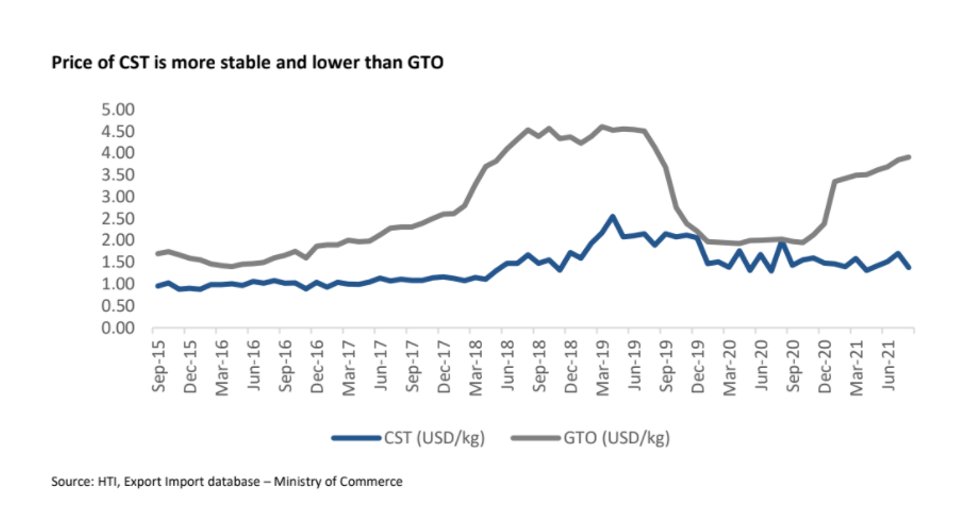
GTO v/s CST

Prices for CST changes annually and hence the company is not vulnerable to market volatility. The company also has right to first refusal contracts with paper manufacturing companies for continuous supply of raw materials
Change in revenues Post CST
The numbers translate the process innovation as the revenues improved post CST manufacturing along with expansion in margins.
The numbers translate the process innovation as the revenues improved post CST manufacturing along with expansion in margins.

Capacity expansions:
Privi is undergoing expansion for Musk, Camphor and Prionyl.
Privi is undergoing expansion for Musk, Camphor and Prionyl.

Prionyl : It is the flavour with an odour described as "buttery, cheesy, sweet, nutty, fruity, creamy having applications in dairy products.
Camphor: Camphor is used in pharmaceutical and industrial applications.
Camphor: Camphor is used in pharmaceutical and industrial applications.
Galaxmusk: It is a polycyclic musk having application in laundry and detergents industry.
Asset Turnover of 2X with 3000 Cr revenue guidance in 3-3.5 years post capex. (Continued)
Asset Turnover of 2X with 3000 Cr revenue guidance in 3-3.5 years post capex. (Continued)
R&D driven business
With CST processing technology and manufacturing value added products from waste is what determines the R&D efforts of privi specialty
With CST processing technology and manufacturing value added products from waste is what determines the R&D efforts of privi specialty

The R&D expense was less than 1% in FY21. With low contribution to expense, Privi still manages to work exceptionally on the product development and innovation process.

With the R&D efforts, Privi has developed proprietary technology to derive L-menthol from di-pentenes. For the past 7 years the company has been developing technology to convert waste from CST and camphene to make methanol and was said to be the dream project for Privi.
Natural methanol costs around 13.5- 14$ whereas the manufacturing cost for Privi is 100 rupees, thus resulting in higher margin products.
The overall market for menthol is over 70,000 MT nearly USD 1 billion of which 50% demand is met by synthetic menthol. The next capex will be more focused on menthol products.
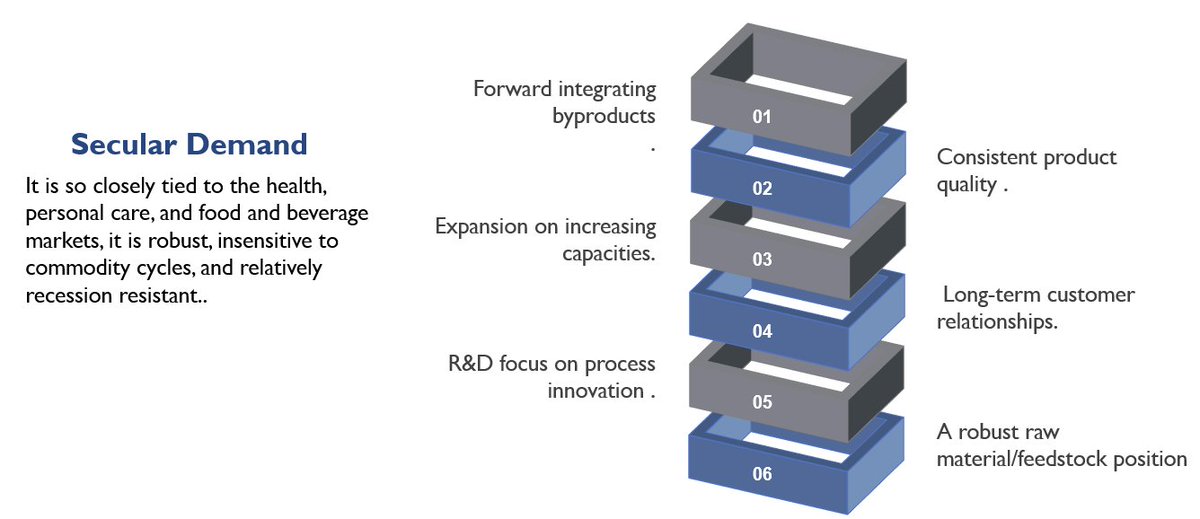
Key strategy in business
Loading suggestions...