

“Man, I love X protocol! I’m gonna go buy X’s token!”
*Record scratch* *Freeze frame*
Yup, that was me back when I first started really getting into crypto.
Little did I know the mistake I was making…
Thread on valueless governance tokens and how to avoid them
🧵👇
*Record scratch* *Freeze frame*
Yup, that was me back when I first started really getting into crypto.
Little did I know the mistake I was making…
Thread on valueless governance tokens and how to avoid them
🧵👇
Valuable protocol =/= Valuable governance token.
This is one of the most important lessons every new DeFi investor must learn.
While the premise itself is simple enough, it is much harder in practice to identify if a governance token is valuable or not.
This is one of the most important lessons every new DeFi investor must learn.
While the premise itself is simple enough, it is much harder in practice to identify if a governance token is valuable or not.
First off, what even is a valueless governance token?
Let’s start with borrowing an example from traditional finance.
When you buy equity in a company (stocks), you expect to receive two things in return:
1) Voting Rights
2) Potential Future Cash Flows (Dividends)
Let’s start with borrowing an example from traditional finance.
When you buy equity in a company (stocks), you expect to receive two things in return:
1) Voting Rights
2) Potential Future Cash Flows (Dividends)
For the average investor, you’re not buying a stock for the first reason. You’re buying a stock for the second reason.
You expect dividends or an appreciation in price of the stock if the company appreciates in value.
Now, let’s get back to tokens.
You expect dividends or an appreciation in price of the stock if the company appreciates in value.
Now, let’s get back to tokens.
For a new crypto investor, they probably approach the crypto markets with this framework in mind. When they buy a governance token, they expect:
1) Voting Rights
2) Potential Future Cash Flows
1) Voting Rights
2) Potential Future Cash Flows
As previously stated, most people don’t care about governance. They’re buying the token because they expect to receive future cash flows from it.
The problem? A lot governance tokens don’t even promise future cash flows! In reality, all they’re getting is voting rights!
Uh-oh…
The problem? A lot governance tokens don’t even promise future cash flows! In reality, all they’re getting is voting rights!
Uh-oh…
As you can see, this can cause quite the dilemma for retail investors. They bought a token because they wanted 2), but in reality they ended up with 1).
When it turns out that governance for that protocol isn’t even all that important, they end up dumping their token at a loss.
When it turns out that governance for that protocol isn’t even all that important, they end up dumping their token at a loss.
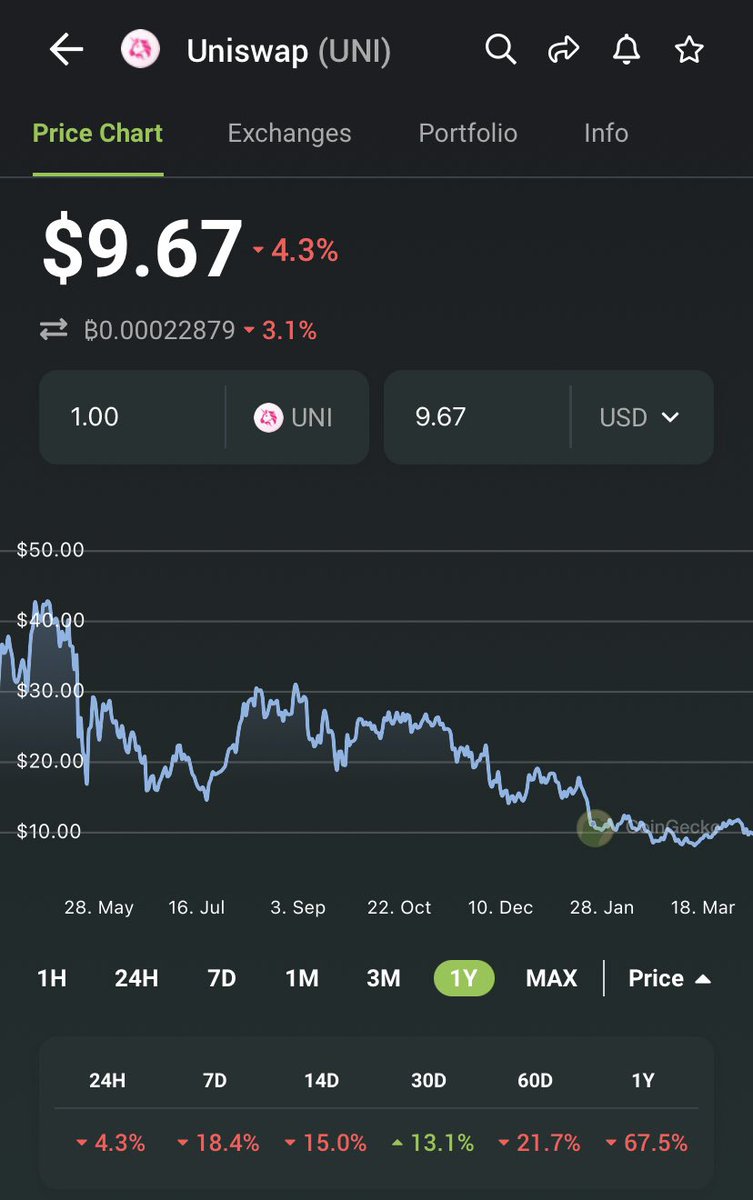
Prime example of a valueless governance token? Look no further than $UNI. While @Uniswap itself is extremely valuable, none of that value accrues to its $UNI token.
And when a token has no value, you get a chart that looks like this:
And when a token has no value, you get a chart that looks like this:
So how do you separate out the valuable governance tokens from the valueless governance tokens? Here are 3 things I look for to see if a token has value:
1) Fee Accrual to Token
2) Value Capture Mechanic
3) Valuable Governance
1) Fee Accrual to Token
2) Value Capture Mechanic
3) Valuable Governance
1) Fee Accrual to Token
The goal of most protocols is to generate fees. The more fees, the better. In the case of @Uniswap, it generates a lot of fees, but all of those fees go Liquidity Providers (LPs).
One way a governance token can have value is if fees accrue to the token.
The goal of most protocols is to generate fees. The more fees, the better. In the case of @Uniswap, it generates a lot of fees, but all of those fees go Liquidity Providers (LPs).
One way a governance token can have value is if fees accrue to the token.
What’s even better is that those fees are paid out in $ETH, not $GMX. This prevents dilution of $GMX token holders.
2) Value Capture Mechanic
Distributing fees to token holders is not the only way in which value can accrue to a token.
2) Value Capture Mechanic
Distributing fees to token holders is not the only way in which value can accrue to a token.
For some protocols, fees are not necessarily the driving force. In the case of protocols like @terra_money and @fraxfinance, their purpose is to mint stablecoins.
When $UST and $FRAX get minted, this value accrues to $LUNA and $FXS in the form of token burns.
When $UST and $FRAX get minted, this value accrues to $LUNA and $FXS in the form of token burns.
As demand for $UST and $FRAX increase, that value is captured by $LUNA and $FXS thanks to their token design.
While fees can also accrue to these tokens, their value comes from capturing demand for their products.
While fees can also accrue to these tokens, their value comes from capturing demand for their products.
3) Valuable Governance
This last one is the most tricky to sort out. Most times, governance is a Fugazi for the average user. It just really doesn’t matter all that much.
For certain protocols however, governance can be extremely valuable.
This last one is the most tricky to sort out. Most times, governance is a Fugazi for the average user. It just really doesn’t matter all that much.
For certain protocols however, governance can be extremely valuable.
The best example of this? Look no further than @CurveFinance and $CRV.
Let’s be real, no one is locking up their $CRV for 4 years because of fees generated by @CurveFinance.
They want veCRV because they want to direct $CRV emissions, and by extent, stablecoin liquidity.
Let’s be real, no one is locking up their $CRV for 4 years because of fees generated by @CurveFinance.
They want veCRV because they want to direct $CRV emissions, and by extent, stablecoin liquidity.
If governance is actually valuable, such as @CurveFinance where governance dictates where billions in liquidity winds up, then a governance token might just be valuable.
Other protocols such as @BalancerLabs and @88mphapp are waking up to this fact and implementing veTokenomics
Other protocols such as @BalancerLabs and @88mphapp are waking up to this fact and implementing veTokenomics
So if you want to avoid being suckered in and buying a valueless governance token, make sure to do you due diligence and see if the token has one of the three:
1) Fee Accrual to Token
2) Value Capture Mechanic
3) Valuable Governance
1) Fee Accrual to Token
2) Value Capture Mechanic
3) Valuable Governance
If it does, chances are you might’ve just found yourself a valuable governance token!
If you enjoyed this thread, make sure to go back to the first tweet and give it a RT!
If you want more content like this, feel free to give me a follow!
I also write on Substack, so make sure to check that out as well!
Thank you and I hope you enjoyed!
avgjoescrypto.substack.com
If you want more content like this, feel free to give me a follow!
I also write on Substack, so make sure to check that out as well!
Thank you and I hope you enjoyed!
avgjoescrypto.substack.com
Loading suggestions...