

There have been a multitude of threads on exotic “Stable Protocols” and “Exciting Yield Opportunities”.
I'm here to touch on the inherent, varying risks across the sector and on how to position yourself ideally.
Stable Yield Diversification - a thread 👨🌾🧵
I'm here to touch on the inherent, varying risks across the sector and on how to position yourself ideally.
Stable Yield Diversification - a thread 👨🌾🧵

Stablecoins are “risk-off” assets, popular for taking profit, hedging and yield farming.
They have been around for years, with Tether ($USDT) being the first one to gain traction back in 2015.
They have been around for years, with Tether ($USDT) being the first one to gain traction back in 2015.
The biggest ones are still centralized and backed by a single entity with real FIAT.
In the last couple of months, however, we’ve seen a big push towards decentralized stables with $UST and $FRAX gaining ground.
In the last couple of months, however, we’ve seen a big push towards decentralized stables with $UST and $FRAX gaining ground.
Centralized Stables - $USDC $USDT
While the risk of the peg failing is low, centralized entities are prone to regulation and can freely freeze emitted assets.
While the risk of the peg failing is low, centralized entities are prone to regulation and can freely freeze emitted assets.
This centralization goes against the ethos of the crypto space and can restrict the growth of DeFi.
Therefore, it’s only a matter of time until they get replaced as market leaders.
Therefore, it’s only a matter of time until they get replaced as market leaders.
Decentralized Stables
All of these fall on a spectrum between Over-collateralization and fully algorithmic stabilisation.
With collateralization being under 100% or in risky assets, there’s a risk of a depeg event.
This added risk is evident through higher yield rates.
All of these fall on a spectrum between Over-collateralization and fully algorithmic stabilisation.
With collateralization being under 100% or in risky assets, there’s a risk of a depeg event.
This added risk is evident through higher yield rates.
3 quick examples:
$DAI (MakerDAO) is over-collateralized. To mint, you have to deposit assets to borrow against at a 66% LTV.
$FRAX is in part backed by $USDC and in part by an algorithm burning/redeeming $FXS.
$UST (Terra) is backed by an algorithm burning/redeeming Luna.
$DAI (MakerDAO) is over-collateralized. To mint, you have to deposit assets to borrow against at a 66% LTV.
$FRAX is in part backed by $USDC and in part by an algorithm burning/redeeming $FXS.
$UST (Terra) is backed by an algorithm burning/redeeming Luna.
With this short, simplified introduction to stables out of the way, let’s get into yield farming.
There are three main ways to earn a yield on your stables:
There are three main ways to earn a yield on your stables:
1. Providing Liquidity
Pair up stables into a pool or a farm and earn through transaction fees and incentivising reward tokens.
beefy.finance
traderjoexyz.com
Pair up stables into a pool or a farm and earn through transaction fees and incentivising reward tokens.
beefy.finance
traderjoexyz.com
2. Staking
You earn by depositing a single stable.
Lending Platforms - hundred.finance
Yield Aggregators - yearn.finance
Centralized Interest Accounts - blockfi.com
You earn by depositing a single stable.
Lending Platforms - hundred.finance
Yield Aggregators - yearn.finance
Centralized Interest Accounts - blockfi.com
(subsidized) staking - app.anchorprotocol.com
Decentralized Option Vaults - ribbon.finance
Unilateral Liquidity Provision - platypus.finance
Decentralized Option Vaults - ribbon.finance
Unilateral Liquidity Provision - platypus.finance
3. “Exotic Yield”
Leveraged yield farming - homora-v2.alphafinance.io
Delta Neutral Yield Farming - francium.io
Quant forex trading - freeway.io
Leveraged yield farming - homora-v2.alphafinance.io
Delta Neutral Yield Farming - francium.io
Quant forex trading - freeway.io
These are just the ones I track and use.
@phtevenstrong made a great thread breaking down some of the mentioned yield sources and introducing others.
Take a look for additional information!
@phtevenstrong made a great thread breaking down some of the mentioned yield sources and introducing others.
Take a look for additional information!
@phtevenstrong Looking at the current macro backdrop and the choppy price action across majors, farming stables has been a great play these last months.
Regardless of the rewards, you outperformed the market by roughly 20% since the beginning of this year just holding stables.
Regardless of the rewards, you outperformed the market by roughly 20% since the beginning of this year just holding stables.
@phtevenstrong But how much can you expect to earn and what should you aim for when deploying your capital?
Anchor Protocol, a lending platform incentivising UST demand, has been paying out 19.33% APY since "forever".
Anchor Protocol, a lending platform incentivising UST demand, has been paying out 19.33% APY since "forever".
@phtevenstrong It established itself as the benchmark through its track record of stable rewards.
I won’t cover the exact workings behind Anchor and the sustainability of its yield but here’s a great thread by @FloodCapital
I won’t cover the exact workings behind Anchor and the sustainability of its yield but here’s a great thread by @FloodCapital
@phtevenstrong @FloodCapital Before putting all your stables into Anchor and calling it a day, we need to take a look at general risks.
These are not specific to any one protocol or stable coin but rather are inherent in all of them to varying degrees/probabilities.
These are not specific to any one protocol or stable coin but rather are inherent in all of them to varying degrees/probabilities.
@phtevenstrong @FloodCapital Depeg Risk
A scenario where the token price considerably falls under the external reference ($1 for stables).
There are various ways this can happen and these are token-specific.
As a rule of thumb, this risk gets smaller with increasing liquidity and demand.
A scenario where the token price considerably falls under the external reference ($1 for stables).
There are various ways this can happen and these are token-specific.
As a rule of thumb, this risk gets smaller with increasing liquidity and demand.
@phtevenstrong @FloodCapital Smart Contract Risks
A smart contract is a programmable, self-executing agreement deployed onto a blockchain.
Once deployed, bad actors can exploit vulnerabilities in the code, potentially resulting in loss of funds.
rekt.news
A smart contract is a programmable, self-executing agreement deployed onto a blockchain.
Once deployed, bad actors can exploit vulnerabilities in the code, potentially resulting in loss of funds.
rekt.news
@phtevenstrong @FloodCapital There’s no way to fully mitigate these risks.
Instead, your goal should be to create a mix of protocols and stables that correspond to your risk tolerance at the highest return possible.
A modern portfolio theory can assist us in this venture.
Instead, your goal should be to create a mix of protocols and stables that correspond to your risk tolerance at the highest return possible.
A modern portfolio theory can assist us in this venture.
@phtevenstrong @FloodCapital The Efficient Frontier (simplified)
A graph plotting “Expected Return” against “Standard Deviation” (Risk) can be used to depict all existing individual assets.
In our case:
Tuples with one part stable one part protocol. These are positively correlated.
A graph plotting “Expected Return” against “Standard Deviation” (Risk) can be used to depict all existing individual assets.
In our case:
Tuples with one part stable one part protocol. These are positively correlated.
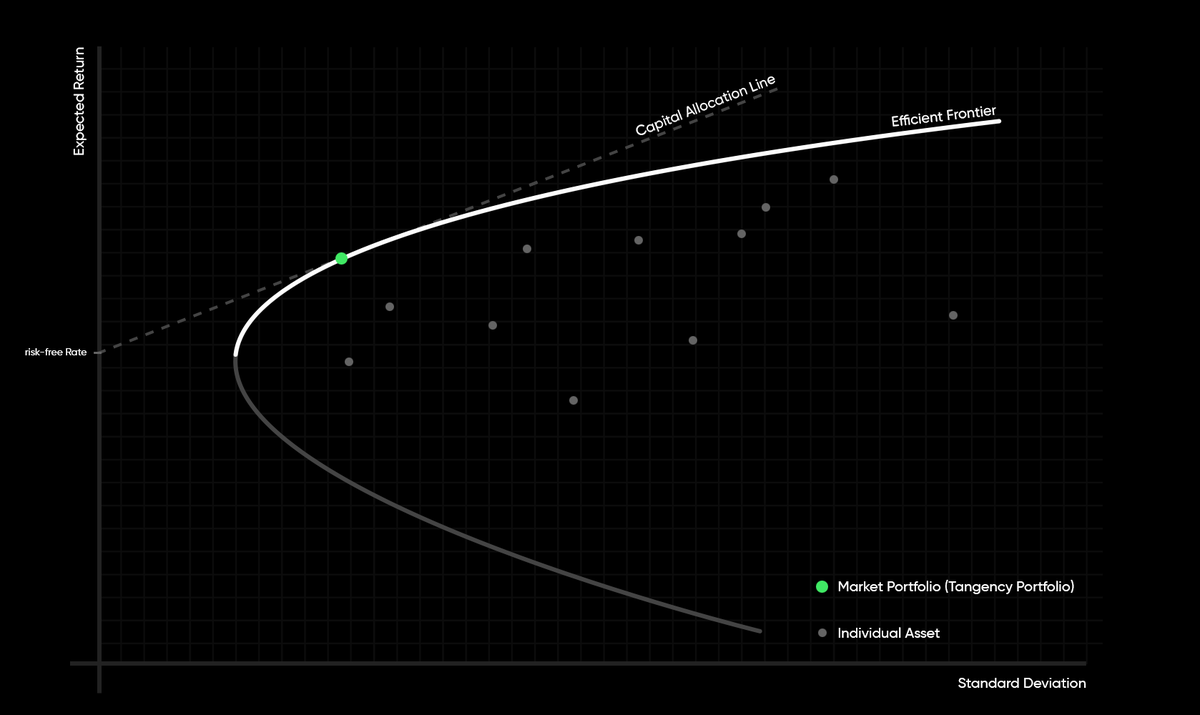
@phtevenstrong @FloodCapital Through diversification, we can lower part of the systemic risk and get a more efficient portfolio.
Example:
70% (Anchor, UST) + 20% (AAVE, DAI) + 10% (Beanstalk, BEAN/3CRV)
is more efficient than:
100% (Anchor, UST)
Example:
70% (Anchor, UST) + 20% (AAVE, DAI) + 10% (Beanstalk, BEAN/3CRV)
is more efficient than:
100% (Anchor, UST)
@phtevenstrong @FloodCapital The efficient frontier reflects the asset combinations (portfolios) that generate the maximum return for various levels of risk.
Depending on the risk-free rate, the rate at which capital can be borrowed/lent with no risk, there is a unique “Market portfolio”.
Depending on the risk-free rate, the rate at which capital can be borrowed/lent with no risk, there is a unique “Market portfolio”.
@phtevenstrong @FloodCapital Combining said portfolio with a risk-free asset allows individual investors to choose their efficient allocation along the Capital Allocation Line (CAL).
Conservative: Lend 20% at the risk-free rate + 80% Market Portfolio
Aggressive: Borrow 20% at the risk-free rate = 120% MP
Conservative: Lend 20% at the risk-free rate + 80% Market Portfolio
Aggressive: Borrow 20% at the risk-free rate = 120% MP
@phtevenstrong @FloodCapital This framework can be practical in traditional finance.
In crypto, we have no way to quantify the risk of stable yields and there’s no risk-free yield.
While it's not possible to find a market portfolio, we can use the diversification effect to reach the efficient frontier.
In crypto, we have no way to quantify the risk of stable yields and there’s no risk-free yield.
While it's not possible to find a market portfolio, we can use the diversification effect to reach the efficient frontier.
@phtevenstrong @FloodCapital Let’s look at how we can implement this:
Easy, just build your stable portfolio as a fractal of your actual portfolio.
That way, you respect your risk tolerance while diversifying both stables and protocols.
Easy, just build your stable portfolio as a fractal of your actual portfolio.
That way, you respect your risk tolerance while diversifying both stables and protocols.
@phtevenstrong @FloodCapital Example Portfolio
60% Stables, 25% Blue chips, 10% High Risk, 5% Ape
Corresponding Stable Portfolio
60% Yearn, Crv, BlockFi
25% Anchor, Beefy, Hundred Finance
10% Lev. Yield, Option Vaults
5% Beanstalk, Looping Anchor
60% Stables, 25% Blue chips, 10% High Risk, 5% Ape
Corresponding Stable Portfolio
60% Yearn, Crv, BlockFi
25% Anchor, Beefy, Hundred Finance
10% Lev. Yield, Option Vaults
5% Beanstalk, Looping Anchor
@phtevenstrong @FloodCapital Using this method should leave you with multiple stables by default.
Here’s an example break-down anyways:
60% $USDC, $USDT
35% $UST, $DAI, $FRAX
5% unproven stable ($BEAN)
Here’s an example break-down anyways:
60% $USDC, $USDT
35% $UST, $DAI, $FRAX
5% unproven stable ($BEAN)
@phtevenstrong @FloodCapital Conclusion
• Diversify your stable yields the same way you diversify your risky assets
• Protocol diversification and Stable diversification are equally important
• Position yourself on an imaginary Efficient Frontier
• Diversify your stable yields the same way you diversify your risky assets
• Protocol diversification and Stable diversification are equally important
• Position yourself on an imaginary Efficient Frontier
@phtevenstrong @FloodCapital • If you want to add risk, borrow stables and deploy them in the established portfolio
• You’re not efficiently positioned if you only own one stable, even on 20 different protocols.
• You’re not efficiently positioned if you own 5 stables on one protocol.
• You’re not efficiently positioned if you only own one stable, even on 20 different protocols.
• You’re not efficiently positioned if you own 5 stables on one protocol.
@phtevenstrong @FloodCapital Personal Opinion:
Stables are supposed to secure your money until you decide to deploy it.
The yield farming aspect is secondary and used to lower opportunity costs.
Stables are not a long term play for me but a way to survive the bear market while also outpacing inflation.
Stables are supposed to secure your money until you decide to deploy it.
The yield farming aspect is secondary and used to lower opportunity costs.
Stables are not a long term play for me but a way to survive the bear market while also outpacing inflation.
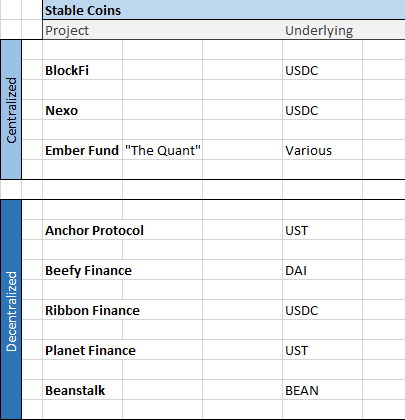
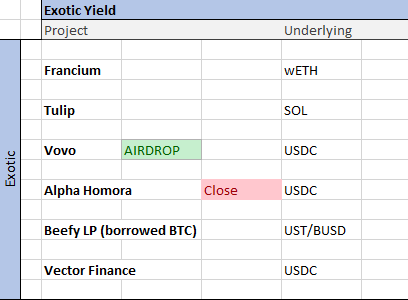
@phtevenstrong @FloodCapital Here’s my current risk-off portfolio. (70%)
I will have to follow my own advice and swap some USDC for FRAX in the near future.
Net APY: 35%
The weights are as follows:
Centralized Yield: 45%
Decentralized Yield: 40% (25% Anchor, Beefy + 15% higher risk)
Exotic Yield: 15%
I will have to follow my own advice and swap some USDC for FRAX in the near future.
Net APY: 35%
The weights are as follows:
Centralized Yield: 45%
Decentralized Yield: 40% (25% Anchor, Beefy + 15% higher risk)
Exotic Yield: 15%
@phtevenstrong @FloodCapital I added some threads that expand on the points I made or give more insight into the topic.
How to farm stablecoins - @Cov_duk
Great deep dive into the different stable yield options and unique risks.
How to farm stablecoins - @Cov_duk
Great deep dive into the different stable yield options and unique risks.
@phtevenstrong @FloodCapital @Cov_duk Case of $UST - @DeFi_Made_Here
Another great thread on the workings behind Anchor and the current adoption issue
Another great thread on the workings behind Anchor and the current adoption issue
@phtevenstrong @FloodCapital @Cov_duk @DeFi_Made_Here Passive income is king - @alpha_pls
A list of staking & farming opportunities
A list of staking & farming opportunities
@phtevenstrong @FloodCapital @Cov_duk @DeFi_Made_Here @alpha_pls An Idiot’s Guide to @BeanstalkFarms - @rektdiomedes
The newest addition to my stable portfolio was $BEANS because of this thread. Amazing read as always!
The newest addition to my stable portfolio was $BEANS because of this thread. Amazing read as always!
If this tweet helped you in any way or you enjoyed it I would appreciate it if you could open the tweet below and retweet it 😀
Thank you anon!
(Disclaimer: The first image is not supposed to be accurate)
Thank you anon!
(Disclaimer: The first image is not supposed to be accurate)
Loading suggestions...