

Arabic poem mentioning Passover coinciding with Nowruz, Easter, and the end of Ramadan
🫓
Four different holidays from
four different religions raced to greet you:
Easter, Eid al-Fitr, and Nowruz
led by Passover, crowding like
camels to drink.
—Ibn al-Rūmī (Iraq, d. 896)
🧵
🫓
Four different holidays from
four different religions raced to greet you:
Easter, Eid al-Fitr, and Nowruz
led by Passover, crowding like
camels to drink.
—Ibn al-Rūmī (Iraq, d. 896)
🧵
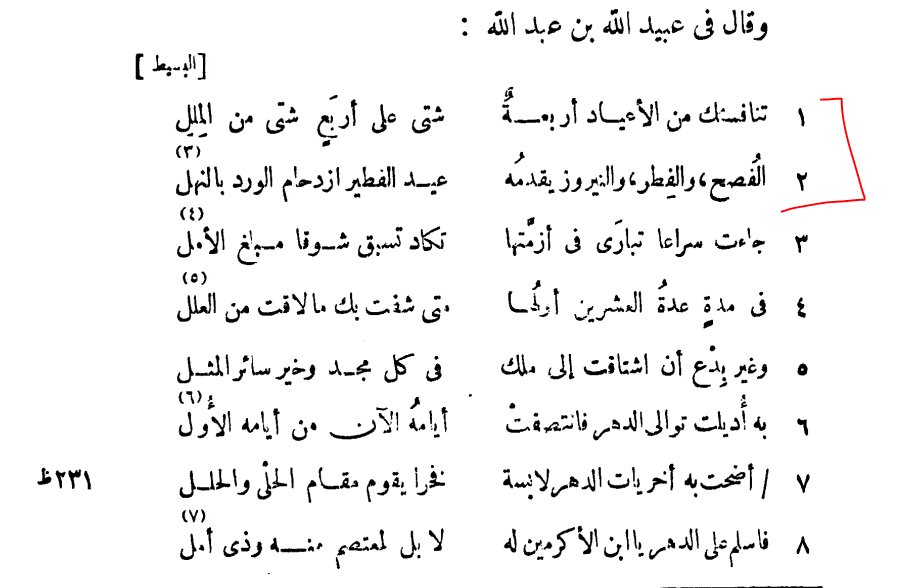
“Passover” here isʿĪd al-faṭīr, “the festival of unleavened bread.”
The word for Easter here, fiṣḥ (incorrectly vocalized in the text?), is cognate with the Hebrew word pesakh for Passover. Etymological reminder that Easter is sort of an appropriation of Passover.
The word for Easter here, fiṣḥ (incorrectly vocalized in the text?), is cognate with the Hebrew word pesakh for Passover. Etymological reminder that Easter is sort of an appropriation of Passover.
The coincidence of the four holidays is obviously kind of like our current Ramadan-Easter-Passover coincidence, but the similarity sadly pretty much ends there.
Different times.
Different times.
The “you” in the poem is its addressee, ʿUbayd Allāh ibn ʿAbd Allāh ibn Ṭāhir, an important Baghdad notable and patron of the poet. Ibn al-Rūmī goes on to praise him, saying all four holidays are eager to get to ʿUbayd Allāh.
I'm a bit puzzled by yaqdumuh in the Arabic, which seems to mean Passover preceded Nowruz, but Passover is never celebrated before the vernal equinox, to my understanding.
Just noticed the linguistic resemblance of ʿĪd al-faṭīr and ʿĪd al-fiṭr🤔
Dīwān, ed. Naṣṣār, p. 2011
Just noticed the linguistic resemblance of ʿĪd al-faṭīr and ʿĪd al-fiṭr🤔
Dīwān, ed. Naṣṣār, p. 2011
Loading suggestions...