

It’s early 2020.
Things are really starting to heat up for DeFi. The market just bounced hard in April from the COVID drop, with green pastures ahead.
The next few months are going to change the Ethereum ecosystem forever.
“DeFi summer” was about to begin…
(1/x)
Things are really starting to heat up for DeFi. The market just bounced hard in April from the COVID drop, with green pastures ahead.
The next few months are going to change the Ethereum ecosystem forever.
“DeFi summer” was about to begin…
(1/x)
Tx fees on Uniswap V1 are $1, and only around 50,000 addresses have traded on the DEX since its launch in late 2018.
ETH was sitting below $200, and DeFi had under $1B in total value locked.
This wouldn’t last long, as the market was about to be in for a shock.
ETH was sitting below $200, and DeFi had under $1B in total value locked.
This wouldn’t last long, as the market was about to be in for a shock.
It all started on June 16th.
Compound, a popular yield farming protocol launched their native gov token.
They began with a liquidity mining program providing high APY to both lenders and borrowers on the platform in the form of extra COMP tokens.
Compound, a popular yield farming protocol launched their native gov token.
They began with a liquidity mining program providing high APY to both lenders and borrowers on the platform in the form of extra COMP tokens.
This method would prove extremely successful, attracting hundreds of millions in deposits.
Everyone wanted a piece of COMP tokens.
The liquidity mining program began to attract so much demand, that it even increased the APY of all other tokens on the platform.
Everyone wanted a piece of COMP tokens.
The liquidity mining program began to attract so much demand, that it even increased the APY of all other tokens on the platform.
Users were lending + borrowing like never before to earn the new gov tokens.
Thanks to the frenzy, it wasn’t uncommon for yields to be changing several percentage points a min.
It didn’t take very long for traders to automate the process of swapping from the highest APY pools.
Thanks to the frenzy, it wasn’t uncommon for yields to be changing several percentage points a min.
It didn’t take very long for traders to automate the process of swapping from the highest APY pools.
This is where Yearn Finance came into the picture.
It was a protocol launched on July 17th, by Fantom developer Andre Cronje.
Yearn Finance acted as a shared vault for depositors, deploying capital to strategies automatically for the highest yield.
It was a protocol launched on July 17th, by Fantom developer Andre Cronje.
Yearn Finance acted as a shared vault for depositors, deploying capital to strategies automatically for the highest yield.
Andre Cronje would also take the concept of liquidity mining a step further, launching the “value-less” YFI token for Yearn Finance.
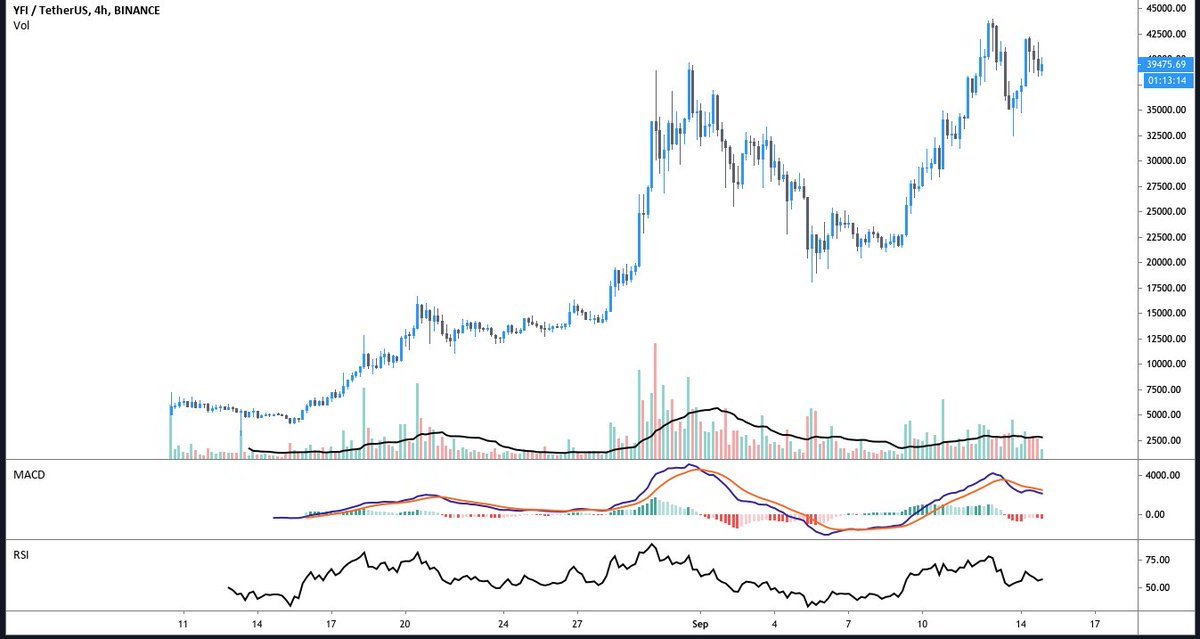
In a matter of weeks it had skyrocketed in value.
The YFI token began at $0, only to reach a mind-blowing $40,000+ just a few weeks later.
In a matter of weeks it had skyrocketed in value.
The YFI token began at $0, only to reach a mind-blowing $40,000+ just a few weeks later.
ETH was now starting to get some attention. By August/September of 2020, ETH was sitting just under $400.
Uniswap had 143,000 recorded traders on their DEX, 3 times the amount that they had just months ago.
TVL in DeFi had spiked to $10B.
Things were starting to get very real.
Uniswap had 143,000 recorded traders on their DEX, 3 times the amount that they had just months ago.
TVL in DeFi had spiked to $10B.
Things were starting to get very real.
Nobody could have predicted what happened next, though.
It was time for food tokens.
First was YAM. After 10 days of development, YAM launched liquidity mining for YAM tokens.
As if in true bull market territory, YAM smart contracts attracted $500M the first day of launch.
It was time for food tokens.
First was YAM. After 10 days of development, YAM launched liquidity mining for YAM tokens.
As if in true bull market territory, YAM smart contracts attracted $500M the first day of launch.
The party would shortly end after a critical bug was found in the token, and developers raced to save all the funds.
A proposal was deployed to fix the bug, but it was faulty.
Nothing could be done to fix the over-mint problem.
Subsequently, the YAM token fell 99.4% in price.
A proposal was deployed to fix the bug, but it was faulty.
Nothing could be done to fix the over-mint problem.
Subsequently, the YAM token fell 99.4% in price.
$500M was gone at the hands of a bug in a food token.
If you thought the story ended there, it doesn’t.
There was Kimchi, Hotdog, & many other food tokens which suffered a similar fate.
However, one food token turned out to be different. It’s name was Sushi.
If you thought the story ended there, it doesn’t.
There was Kimchi, Hotdog, & many other food tokens which suffered a similar fate.
However, one food token turned out to be different. It’s name was Sushi.
Sushi was unique. It was a fork of Uniswap smart contracts, with an added governance token given to liquidity providers.
This would help to incentivize liquidity on the DEX, and give governance powers to users of the protocol.
It’s important to remember…
This would help to incentivize liquidity on the DEX, and give governance powers to users of the protocol.
It’s important to remember…
Uniswap didn’t have a token at the time.
Chef Nomi built SUSHI at an aim to fix this problem, releasing the DEX in a massive vampire attack.
Essentially, LP’s on UNI were able to stake in farms to earn SUSHI tokens.
This liquidity would later be migrated to Sushiswap…
Chef Nomi built SUSHI at an aim to fix this problem, releasing the DEX in a massive vampire attack.
Essentially, LP’s on UNI were able to stake in farms to earn SUSHI tokens.
This liquidity would later be migrated to Sushiswap…
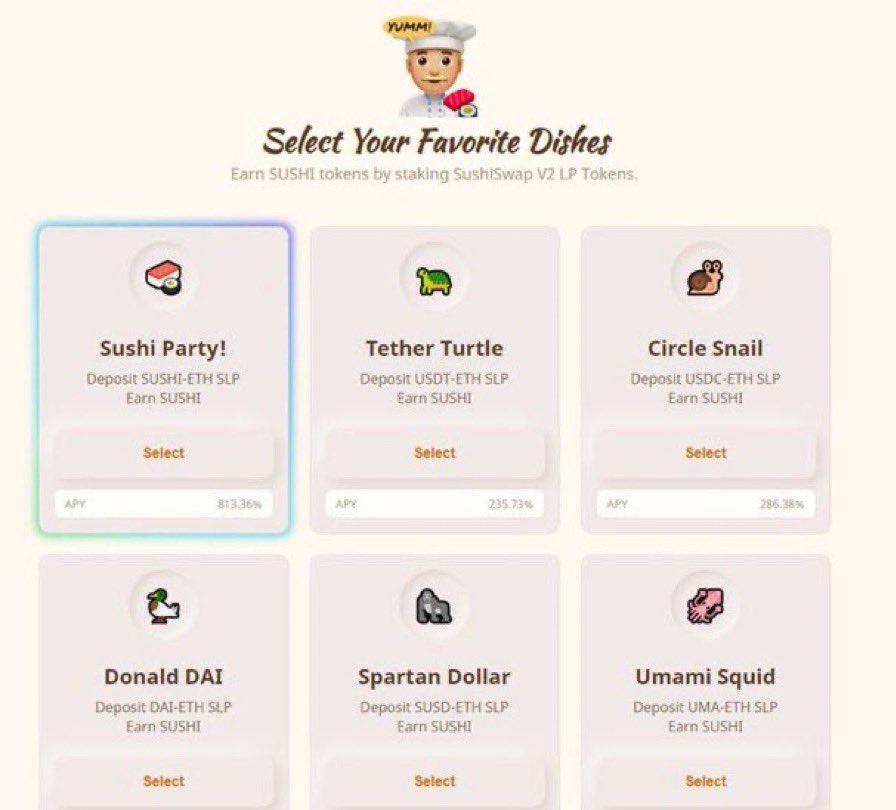
Allowing Sushiswap to effectively steal LP’s from Uniswap.
To many’s surprise, the plan was successful.
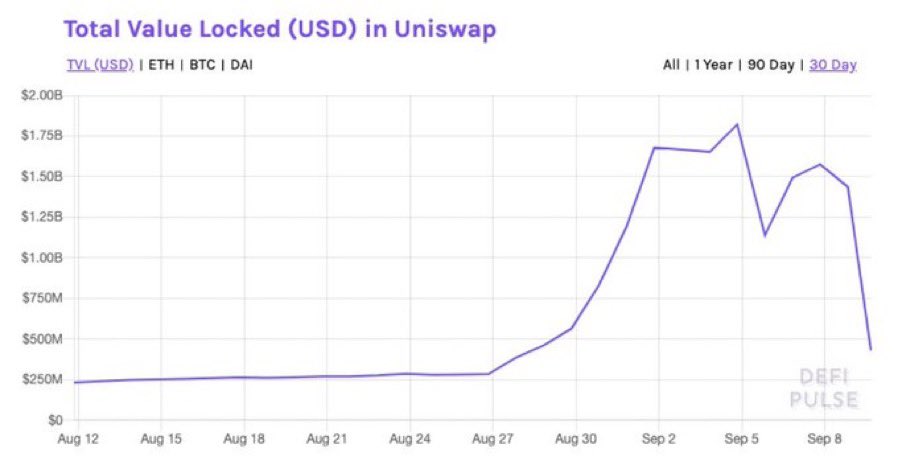
Just a few weeks after launch, the $800M vampire attack on Uniswap ensued.
Uniswap now had a new challenger in the arena, and they didn’t have a token.
To many’s surprise, the plan was successful.
Just a few weeks after launch, the $800M vampire attack on Uniswap ensued.
Uniswap now had a new challenger in the arena, and they didn’t have a token.
Things were looking great for Sushi.
Every token on Sushi pairs had absolutely exploded in value, and APY was 1000%+
But then all of a sudden, Chef Nomi “pulled the rug.”
The founder of Sushiswap had sold $14M worth of Sushi on the market with no warning.
Every token on Sushi pairs had absolutely exploded in value, and APY was 1000%+
But then all of a sudden, Chef Nomi “pulled the rug.”
The founder of Sushiswap had sold $14M worth of Sushi on the market with no warning.
The market went into absolute mayhem. Every token fell double digits, as users raced to get out of farms as quick as possible.
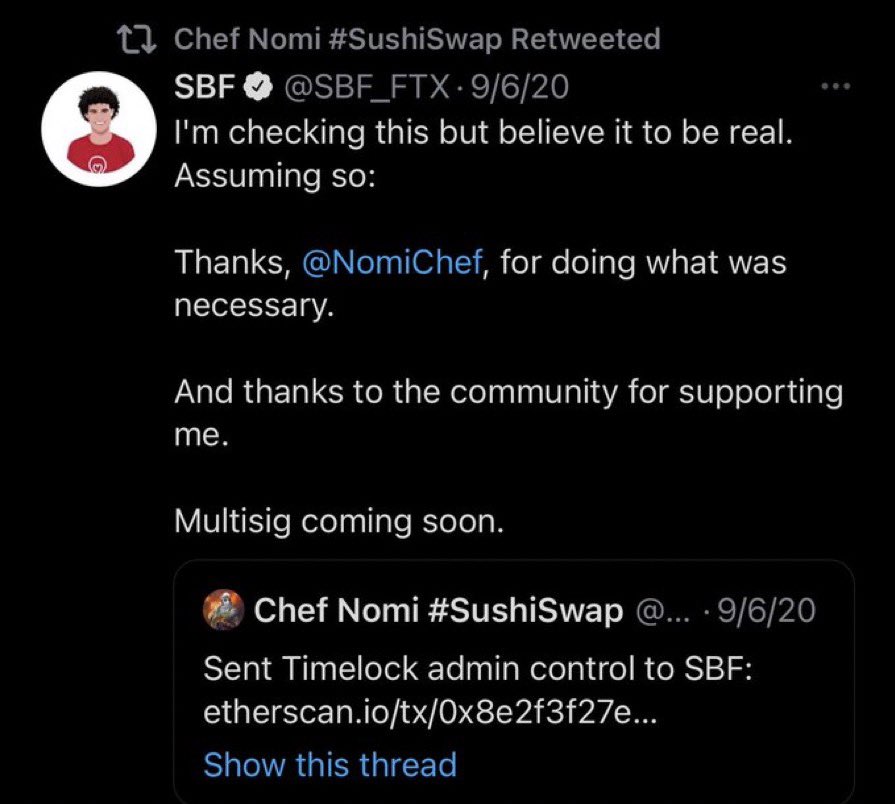
Community leaders including SBF were forced to take the lead & run Sushi.
Community leaders including SBF were forced to take the lead & run Sushi.
These events would later force the hand of Uniswap
It was clear they needed to do something to fight back against Sushi.
The answer came with a native token in September 2020.
UNI would actually turn out to be one of the largest airdrops in all of DeFi history.
It was clear they needed to do something to fight back against Sushi.
The answer came with a native token in September 2020.
UNI would actually turn out to be one of the largest airdrops in all of DeFi history.
In late 2020, ETH was sitting just under $500 still. The entire market was still recovering from the initial sushi dip.
However, the following months proved that there was no stopping the momentum.
ETH would go on to hit $4K four months later.
That’s 10x+ in less than a year.
However, the following months proved that there was no stopping the momentum.
ETH would go on to hit $4K four months later.
That’s 10x+ in less than a year.
I’ve explained this to point out the striking similarities between the DeFi saga, and the NFT saga.
The NFT bullrun hit us by surprise, bringing some blue chips, & hundreds of low-effort projects after them.
We had a small initial run up, but nothing compared to the real deal.
The NFT bullrun hit us by surprise, bringing some blue chips, & hundreds of low-effort projects after them.
We had a small initial run up, but nothing compared to the real deal.
The market showed the potential, and developers are now filling the gap.
Things are already moving in the right direction:
-BAYC recently airdropped APE tokens to all holders.
-LooksRare tried to switch things up + challenge OpenSea with a native token.
Things are already moving in the right direction:
-BAYC recently airdropped APE tokens to all holders.
-LooksRare tried to switch things up + challenge OpenSea with a native token.
It will happen even faster than it did with DeFi thanks to the network effects of web3 and NFTs at play.
Things can always change in an instant with crypto. So… Wen NFT summer?
Enjoy! 🥐
Things can always change in an instant with crypto. So… Wen NFT summer?
Enjoy! 🥐
Loading suggestions...