

Raunak sir has also given a basic idea how this industry functions & what are the things & data one needs to focus on when analyzing any chemical companies. (3/n)
Things covered in the video:
1) Industry Master sheet
2) Industry capital cycle and Investor fortune cycle.
3) Chemical industry (upstream & downstream).
4) Supply chain.(4/n)
1) Industry Master sheet
2) Industry capital cycle and Investor fortune cycle.
3) Chemical industry (upstream & downstream).
4) Supply chain.(4/n)
5) Size of the Industry
6) Value chain.
7) Success factors.
8) Challenges.
9)Lastly, they have shared some useful sources from where one can extract data about this industry. (5/n)
6) Value chain.
7) Success factors.
8) Challenges.
9)Lastly, they have shared some useful sources from where one can extract data about this industry. (5/n)
Now let's dig deeper and understand these points in detail:
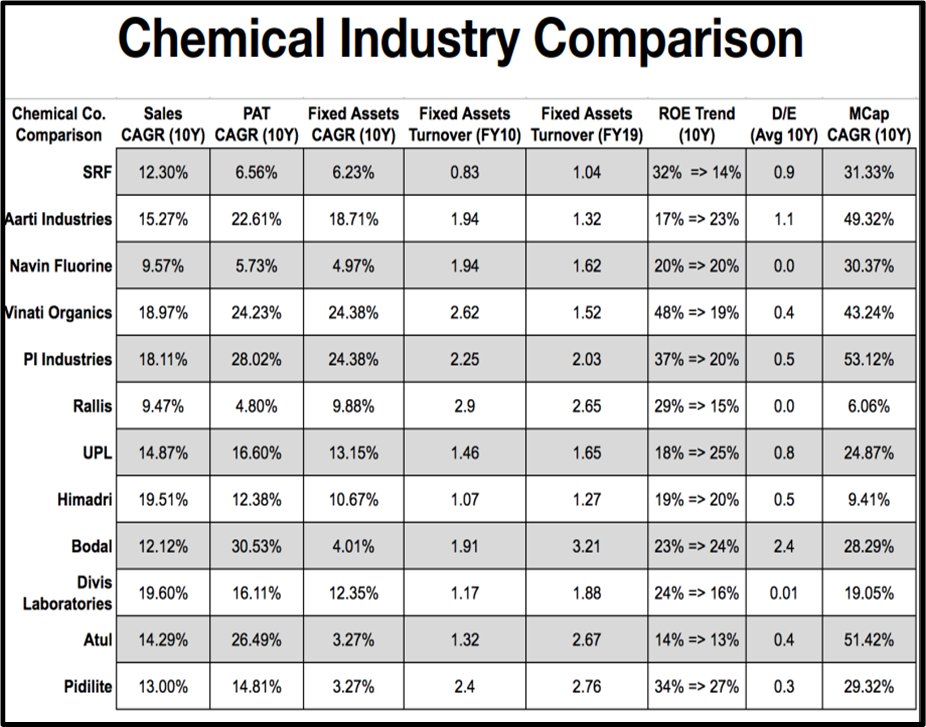
1) Industry Master sheet: In this point they explained past decade trend & returns of the company present in chemical industry through this chart. (6/n)
1) Industry Master sheet: In this point they explained past decade trend & returns of the company present in chemical industry through this chart. (6/n)
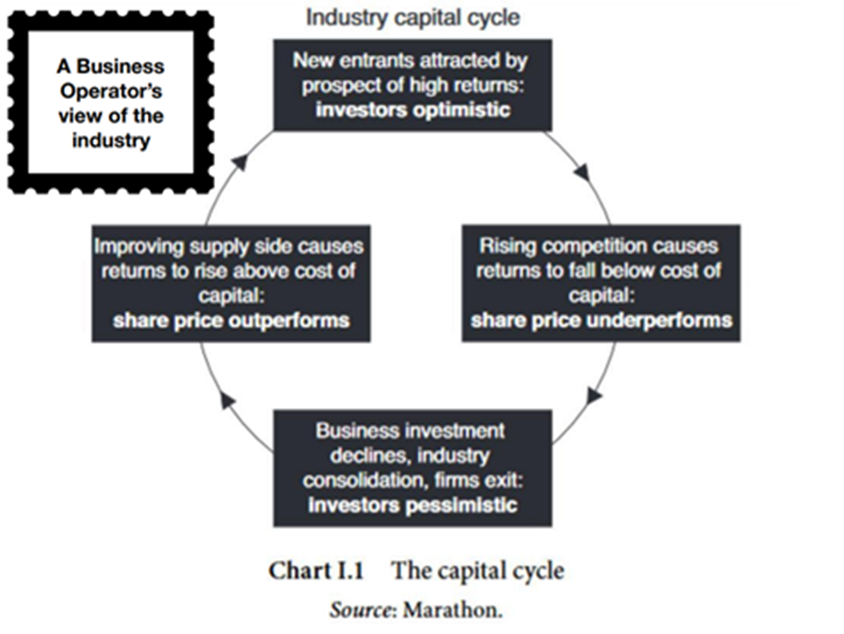
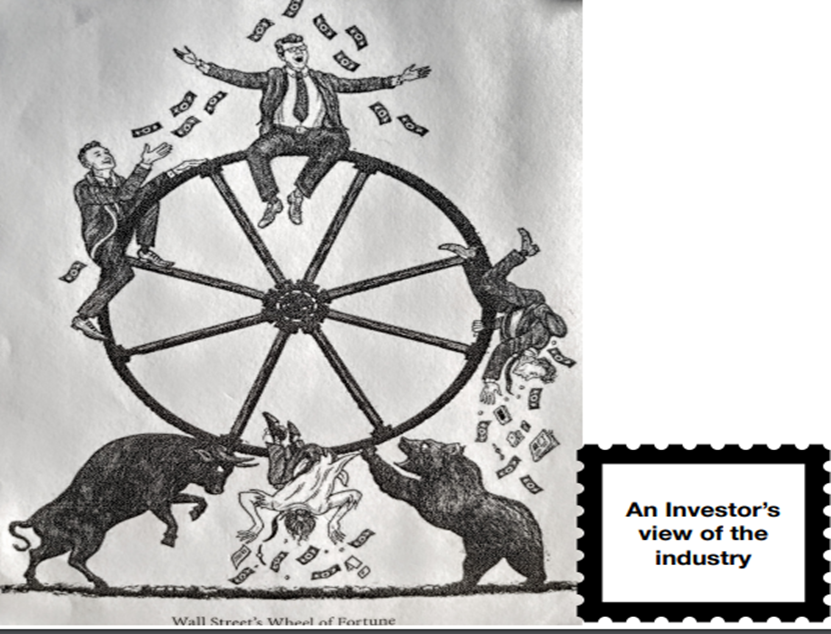
2) Industry capital cycle and Investor fortune cycle:
This point was explained with the help of 2 images taken from the book "Capital accounts" which comprises of annual letters of marathon asset management. (7/n)
This point was explained with the help of 2 images taken from the book "Capital accounts" which comprises of annual letters of marathon asset management. (7/n)
3) Chemical industry (upstream & downstream)
Base Minerals > Collide them in reactor > Intermediate stuff is formed > Processed again > Specialty chemical & then eventually at last we get consumer chemicals which is used in day to day life like shampoo, toothpaste etc.(8/n)
Base Minerals > Collide them in reactor > Intermediate stuff is formed > Processed again > Specialty chemical & then eventually at last we get consumer chemicals which is used in day to day life like shampoo, toothpaste etc.(8/n)
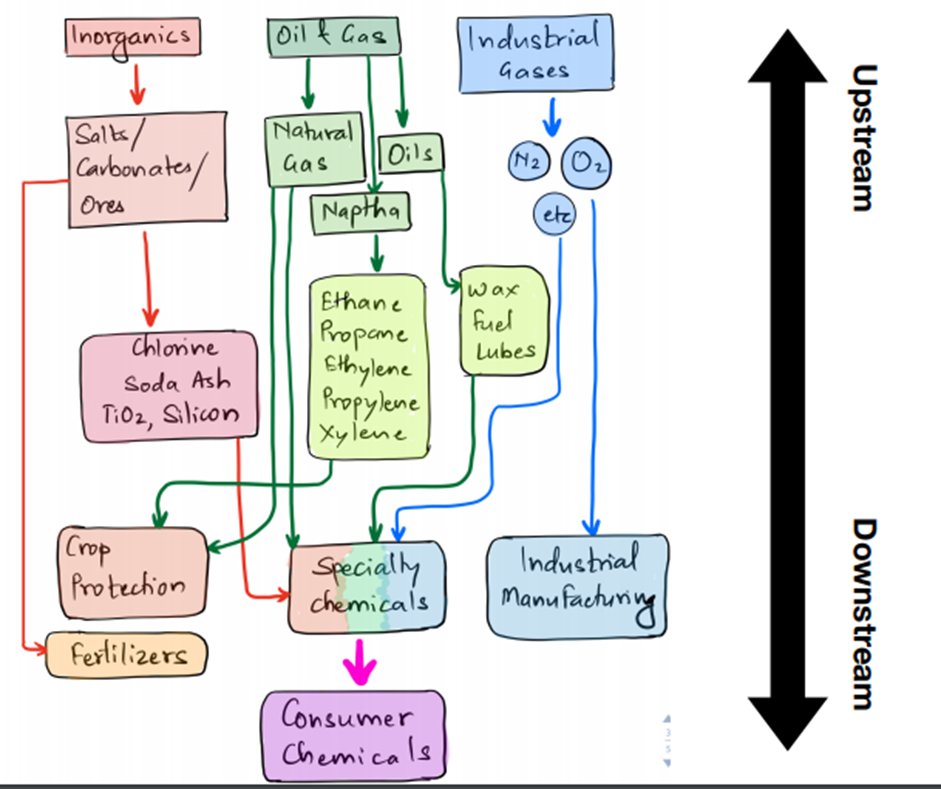
Going Feedstock to Consumer chemicals is known as “Downstream or forward integrating”. And companies going from consumer chemicals to raw material is known as “up stream or Backward integration”.
Value chain (in snapshot) (9/n)
Value chain (in snapshot) (9/n)
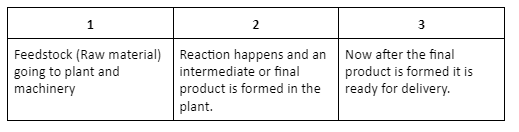
4) Supply chain:
a) Supplier supplies Feedstock.
b) Feedstock gets stored according to its chemical properties.
c) Feedstock then goes to the plant & after that reaction happens and a new intermediate or final chemical is formed. (10/n)
a) Supplier supplies Feedstock.
b) Feedstock gets stored according to its chemical properties.
c) Feedstock then goes to the plant & after that reaction happens and a new intermediate or final chemical is formed. (10/n)
d) Now as new intermediate/ Chemical is formed so it will be having new chemical composition. So the company has to make sure while transporting that chemical that it has proper storage and condition.
e) After transporting it is ready for the delivery. (11/n)
e) After transporting it is ready for the delivery. (11/n)
Note: For every chemical, there would be a unique and different supply chain and it would be complex to understand. (12/n)
5)Size of the Industry
Total size (chemical industry)=$3 trillion excluding pharma
Chemical industry can be bifurcated in 4 parts:
1.Inorganics mkt($482 Bn)
2.Organics mkt($582 Bn)
3.Polymers & intermediates mkt($800 Bn)
4.Functional Chemical mkt($773 Bn) (13/n)
Total size (chemical industry)=$3 trillion excluding pharma
Chemical industry can be bifurcated in 4 parts:
1.Inorganics mkt($482 Bn)
2.Organics mkt($582 Bn)
3.Polymers & intermediates mkt($800 Bn)
4.Functional Chemical mkt($773 Bn) (13/n)
6) Value Chain:
Feedstock > Bulk Ingredient > Specialty Ingredient > Final Application > Consumer
7) Success factors of globally diversified chemical business:- (14n)
Feedstock > Bulk Ingredient > Specialty Ingredient > Final Application > Consumer
7) Success factors of globally diversified chemical business:- (14n)
a) Ability to create new products or discover new applications from the same chemistry of products.
b) You need to grow in size so that you can produce in large quantities and can have a dominant position over the supplier.
c) Investing in Distribution and Branding properly(15/n)
b) You need to grow in size so that you can produce in large quantities and can have a dominant position over the supplier.
c) Investing in Distribution and Branding properly(15/n)
d) Lower cost labor & raw material availability
e) Shift of chemical manufacturing to Asia
8) Challenges:
a) Fragmented Industry structure.
b) Increasing supply chain complexity.
c) Compared to past yrs it has not been easy for the chemical industry to get a clean chit for:(16/n)
e) Shift of chemical manufacturing to Asia
8) Challenges:
a) Fragmented Industry structure.
b) Increasing supply chain complexity.
c) Compared to past yrs it has not been easy for the chemical industry to get a clean chit for:(16/n)
Setting up a chemical plant as the regulatory form has become very strict because of pollution & environmental problems.
d)In Indian chemical co. don't really have a R&D culture. They usually follow the process which is followed globally by other chemical co. (17/n)
d)In Indian chemical co. don't really have a R&D culture. They usually follow the process which is followed globally by other chemical co. (17/n)
9) Resource List
a)Ministry of chemicals & petrochemicals-Trade data
b)International trade data & public reports
c)Pricing data(bloomberg)
d)Co. disclosures & mgnt commentary
e)Consultant report(for overview)
f)Trade journals,Trade association data
On the ground learning (18/n)
a)Ministry of chemicals & petrochemicals-Trade data
b)International trade data & public reports
c)Pricing data(bloomberg)
d)Co. disclosures & mgnt commentary
e)Consultant report(for overview)
f)Trade journals,Trade association data
On the ground learning (18/n)
We explain detail investing frameworks through case studies around financial analysis, valuations & business models analysis on our forum & YouTube channel.
Forum: finnacleshahclasses.com
YouTube Playlist: youtube.com (19/n)
Forum: finnacleshahclasses.com
YouTube Playlist: youtube.com (19/n)
Readers on @MultipieSocial can read the same here: multipie.co
To continue your learning & fun with finance follow us on Instagram: instagram.com (20/n)
To continue your learning & fun with finance follow us on Instagram: instagram.com (20/n)
Loading suggestions...