

Jati endogamy is not the same as "caste discrimination" or "caste hierarchy."
Jatis are cultural groups. Jati endogamy is a form of cultural compatibility for marriage. This is not the same as discriminating against someone in the public sphere and does *not* connote hierarchy.
Jatis are cultural groups. Jati endogamy is a form of cultural compatibility for marriage. This is not the same as discriminating against someone in the public sphere and does *not* connote hierarchy.
Jati is a unit of multiculturalism.
Jatis allowed enormous cultural diversity to thrive in India over 1000s of years. Each jati could observe their own way of life without the imposed uniformity of European nationalism or monotheism.
It also allowed integration of outsiders.
Jatis allowed enormous cultural diversity to thrive in India over 1000s of years. Each jati could observe their own way of life without the imposed uniformity of European nationalism or monotheism.
It also allowed integration of outsiders.
This is coming from someone who pretty much broke all rules. I was in a live-in 25 years ago, married outside jati, divorced, have dated across ethnic and religious groups.
But I understand why in-jati marriage preference is a form of seeking compatibility in marriage.
But I understand why in-jati marriage preference is a form of seeking compatibility in marriage.
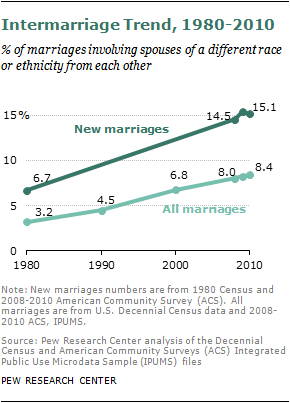
If you look at the US, over 90% of total marriages (and 85% of new marriages) happen within the same ethnic and racial group.
And this is up from only 3.2% of marriages in 1980 outside a racial or ethnic group.
As a comparison, in India about 11% are outside jati groups.
And this is up from only 3.2% of marriages in 1980 outside a racial or ethnic group.
As a comparison, in India about 11% are outside jati groups.
I need to write one. The literature is very confused. But there is literally nothing the creates a singular hierarchy.
You can read Nicholas Dirks' "Castes of the Mind." It doesn't go far enough but is a good start.
I haven't studied these groups.
But what explains the durability of jati, long after conversion? Even Goan Christians follow jati awareness 500 years after conversion.
A social institution that durable must provides value. What is the value of jati?
But what explains the durability of jati, long after conversion? Even Goan Christians follow jati awareness 500 years after conversion.
A social institution that durable must provides value. What is the value of jati?
As I see, jati provided the following values:
1. Unit of multiculturalism.
2. Knowledge transmission. Jatis were knowledge transmission system. This is why endogamy was important since there was male and female parts to knowledge that needed to come together for propagation.
1. Unit of multiculturalism.
2. Knowledge transmission. Jatis were knowledge transmission system. This is why endogamy was important since there was male and female parts to knowledge that needed to come together for propagation.
e.g. Chettiyars were bankers. A Chettiyar as young as 16 would set up a bank in a village, along with his wife. Each knew their part.
Chettiyar mothers would teach compound interest tables to a child by the time they were 6. Without the feminine role, transmission would stop.
Chettiyar mothers would teach compound interest tables to a child by the time they were 6. Without the feminine role, transmission would stop.
Indian society is not set up by "texts" nor is it determined by them. This is the other colonial fallacy,.
Europeans who colonized India fervently believed in the literal truth of the Bible. Like "Adam" and "Eve" existed, the world was 6000 years old.
Europeans who colonized India fervently believed in the literal truth of the Bible. Like "Adam" and "Eve" existed, the world was 6000 years old.
Indian society doesn't is not based on text. It is organic and adaptive.
British administrators tried to map the India they saw into texts like the Manusmriti. This made little sense.
Then they used European racial theory to map varna and jati and create the "caste system."
British administrators tried to map the India they saw into texts like the Manusmriti. This made little sense.
Then they used European racial theory to map varna and jati and create the "caste system."
Hint. Where did all these 3 study? By that time, "caste" had become a definite feature of the colonial study of India.
The British did not create the notions of jati or varna. But they created the notion of a "5000-yr static system." This is nonsense.
The British did not create the notions of jati or varna. But they created the notion of a "5000-yr static system." This is nonsense.
Not interested in "shoulds." It's funny that so many academics in India use terms like "social evil"—they can't understanding anything then.
Jati needs to be studied for what it is—a durable social structure with value, which explains its persistence.
Jati needs to be studied for what it is—a durable social structure with value, which explains its persistence.
When we see Jati as a Knowledge Transmission System, as a unit of culture, and a way to accommodate different groups, then we can study how it will change in modern times.
With the industrial modern education system, a lot of jati-based knowledge transmission has stopped.
With the industrial modern education system, a lot of jati-based knowledge transmission has stopped.
When current jati structures lose value, they would adapt and change over time to new structures.
What is the biggest hurdle for adaptability? The colonial state itself, which for the first time, created static lists of "castes", created fixed categories like SC/ST and OBC
What is the biggest hurdle for adaptability? The colonial state itself, which for the first time, created static lists of "castes", created fixed categories like SC/ST and OBC
Lol, Europe has retained diversity? Europe is a mess. Its multiculturalism is grafted back on after monotheism and a single national Church led to monoculture.
And a country there can't even deal with a 1 million Muslim minority. India has 200 million.
And a country there can't even deal with a 1 million Muslim minority. India has 200 million.
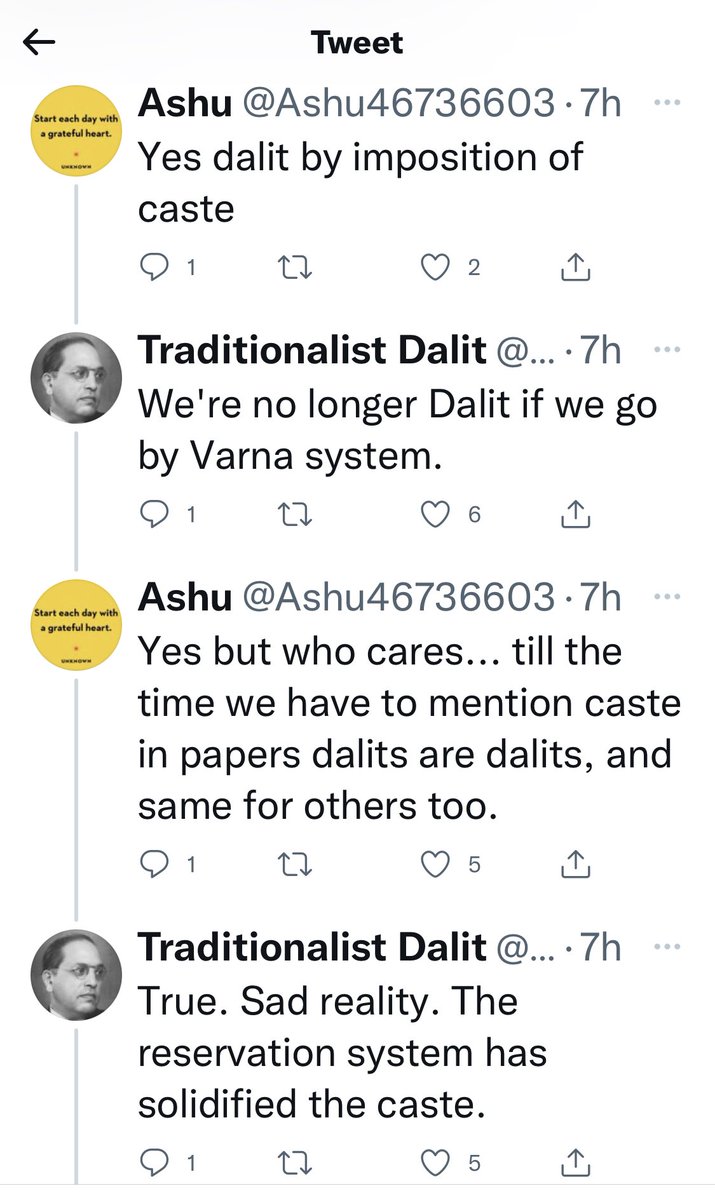
A conversation between two “Dalits.”
They realize they’re not Dalits by varna.
But the State forces them into the identity per lists the colonial state created which are static.
Imagine the change in society in 100 years yet we’re led to believe in “5000 yr static society.”
They realize they’re not Dalits by varna.
But the State forces them into the identity per lists the colonial state created which are static.
Imagine the change in society in 100 years yet we’re led to believe in “5000 yr static society.”
Loading suggestions...