

Financial Metrics every business owner should know:
1/ Break even
Your breakeven number tells you:
How many units of a product you need to sell before you make a profit
Your breakeven number tells you:
How many units of a product you need to sell before you make a profit
Example:
You own a bakery that sells loaves of bread
Your costs to run the bakery daily are:
• $100 for raw materials
• $500 for labor
• $100 for marketing
• Total = $700
If you sell each loaf of bread for $5,
How many do you need to sell before you break even each day?
You own a bakery that sells loaves of bread
Your costs to run the bakery daily are:
• $100 for raw materials
• $500 for labor
• $100 for marketing
• Total = $700
If you sell each loaf of bread for $5,
How many do you need to sell before you break even each day?
$700 / $5 = 140 loaves
You need to sell 140 loaves of bread before you make your first $1 in profit
You need to sell 140 loaves of bread before you make your first $1 in profit
2/ Profit Margin
Profit is calculated as:
• Sales
• Less
• All expenses
Profit is calculated as:
• Sales
• Less
• All expenses
Profit Margin:
Tells you how much of your sales are converted into profit
Another way to think about this:
Profit Margin tells you for every $1 in sales how much profit you made
Tells you how much of your sales are converted into profit
Another way to think about this:
Profit Margin tells you for every $1 in sales how much profit you made
To calculate your Profit Margin
You take profit and divide it by revenue which gives you a percentage (%)
This percentage (%) is your Profit Margin
You take profit and divide it by revenue which gives you a percentage (%)
This percentage (%) is your Profit Margin
Example:
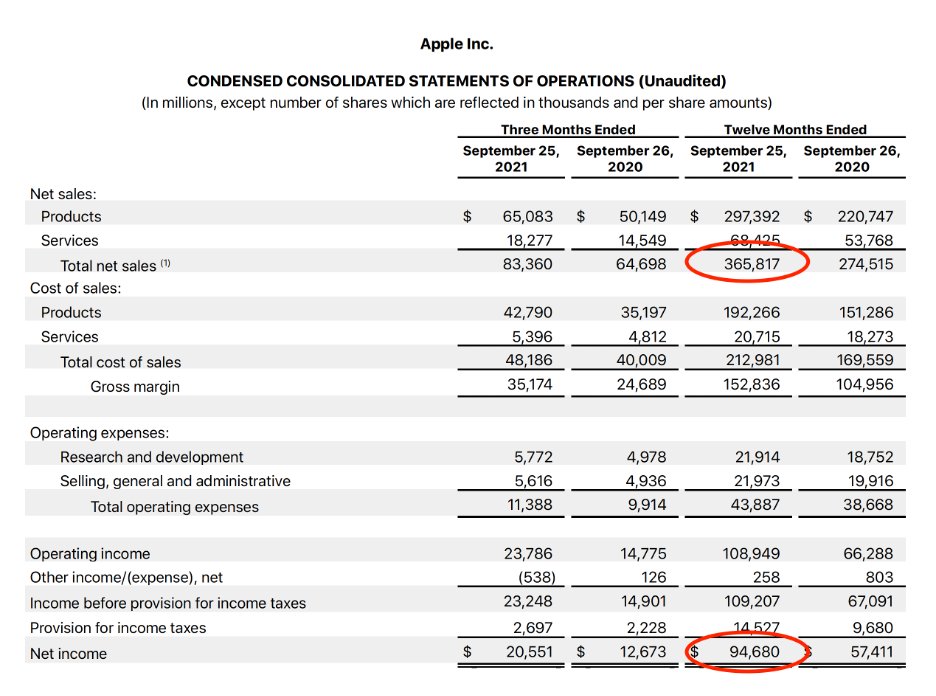
In 2021, Apple’s profit was $95 billion and its sales were $366 billion
If you calculate Apple’s profit margin, you get 26% = $95 billion / $366 billion
Another way to think about this:
For every $1 in sales Apple made, it made $0.26 in profit
In 2021, Apple’s profit was $95 billion and its sales were $366 billion
If you calculate Apple’s profit margin, you get 26% = $95 billion / $366 billion
Another way to think about this:
For every $1 in sales Apple made, it made $0.26 in profit
3/ Fixed Costs
Fixed costs are costs that you will have to pay for your business regardless of how well you do
Fixed costs are costs that you will have to pay for your business regardless of how well you do
Example:
You run a restaurant and pay rent of $5,000/month
If your sales are slow in the winter months, you still have to cover your rent of $5,000
If your sales are hot in the summer months, you pay the same rent of $5,000
You run a restaurant and pay rent of $5,000/month
If your sales are slow in the winter months, you still have to cover your rent of $5,000
If your sales are hot in the summer months, you pay the same rent of $5,000
Your rent cost stays the same no matter what happens to your business
This is a fixed cost!
This is a fixed cost!
4/ Variable Costs
Variable costs are costs that fluctuate based on your sales
If you sell more product, variable costs go up
If you sell less product, variable costs go down
Variable costs are costs that fluctuate based on your sales
If you sell more product, variable costs go up
If you sell less product, variable costs go down
Example:
If you run an eCommerce business, your largest variable cost is inventory
If you sell a lot of product, you will need to buy more inventory→ your costs increase
If you sell less product, you will need to buy less inventory → your costs decrease
If you run an eCommerce business, your largest variable cost is inventory
If you sell a lot of product, you will need to buy more inventory→ your costs increase
If you sell less product, you will need to buy less inventory → your costs decrease
5/ Gross Profit
(Not to be confused with Profit)
Gross Profit tells you how much revenue is left over after you pay for variable costs
It is calculated as:
• Sales
• Less
• Cost of Goods Sold
(Not to be confused with Profit)
Gross Profit tells you how much revenue is left over after you pay for variable costs
It is calculated as:
• Sales
• Less
• Cost of Goods Sold
Gross Profit covers the fixed costs of your business, and whatever is left over is Profit
Therefore, the higher the Gross Profit the better
Therefore, the higher the Gross Profit the better
Example:
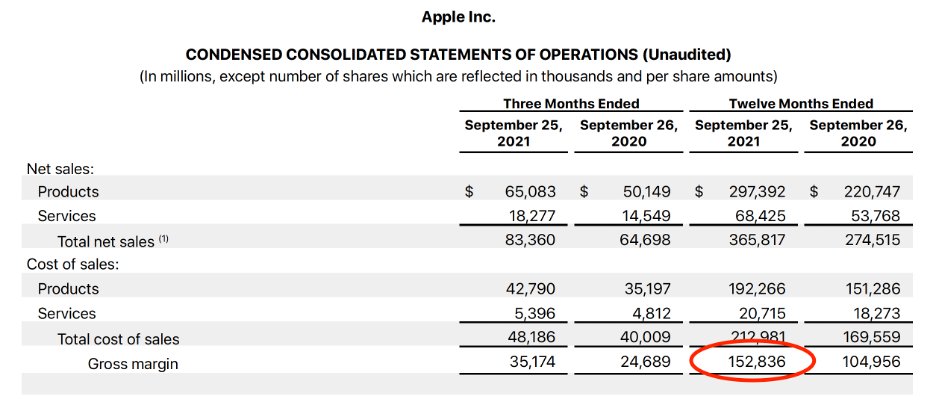
In 2021, Apple’s Gross Profit was $153 billion
That means Apple is left with $153 billion to pay for fixed costs and make a profit
In 2021, Apple’s Gross Profit was $153 billion
That means Apple is left with $153 billion to pay for fixed costs and make a profit
6/ Sales Growth
Revenue cures 99% of problems in every business
Your expenses are increasing?
→You need higher sales
Want to pay higher wages?
→You need higher sales
Want to make more profit?
→You need higher sales
Revenue cures 99% of problems in every business
Your expenses are increasing?
→You need higher sales
Want to pay higher wages?
→You need higher sales
Want to make more profit?
→You need higher sales
Every business is evaluated on how it’s growing
And there is no better metric to evaluate growth than Sales Growth
And there is no better metric to evaluate growth than Sales Growth
Sales growth can be measured:
• Week over Week
• Month over Month
• Year over Year
Really anytime line – take your pick
• Week over Week
• Month over Month
• Year over Year
Really anytime line – take your pick
Example:
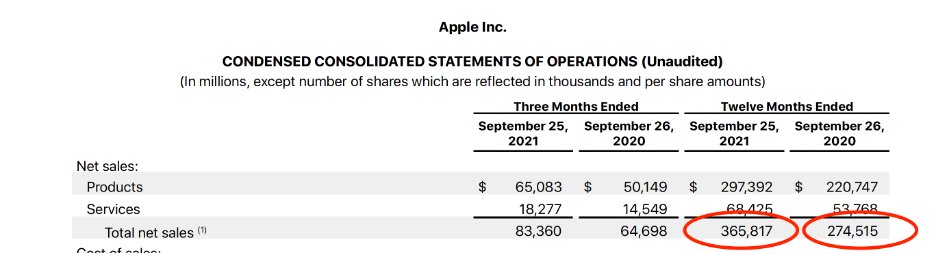
Apple’s revenue in 2021 grew by 33% to $366 billion from $275 billion in 2020
Apple’s revenue in 2021 grew by 33% to $366 billion from $275 billion in 2020
7/ ARPU
ARPU stands for Average Revenue Per User
It tells you how much revenue you make from every single customer
This is typically calculated on a monthly basis
ARPU stands for Average Revenue Per User
It tells you how much revenue you make from every single customer
This is typically calculated on a monthly basis
If you want higher revenue, the easiest way to get that is to raise your prices
Price increases will increase ARPU
Price increases will increase ARPU
Example:
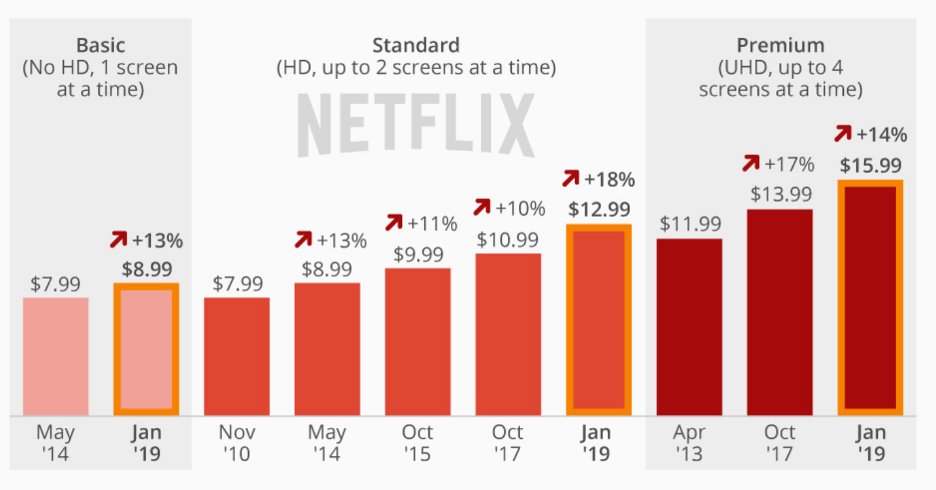
In 2019, Netflix increased its monthly price for the premium plan from $13.99 to $15.99
The effect of this was:
Netflix had a higher ARPU and therefore, higher revenue
In 2019, Netflix increased its monthly price for the premium plan from $13.99 to $15.99
The effect of this was:
Netflix had a higher ARPU and therefore, higher revenue
8/ Burn Rate
If you run a startup that has raised money from investors, knowing your burn rate is critical
Your burn rate tells you how much money you’re spending over a certain period
If you run a startup that has raised money from investors, knowing your burn rate is critical
Your burn rate tells you how much money you’re spending over a certain period
If your burn rate is too high,
You have to bring it under control by reducing expenses or increasing sales
You have to bring it under control by reducing expenses or increasing sales
To calculate burn rate:
Look at the cash balance of your business on the first day of the month, and look at your cash balance at the end of the month
If your cash balance decreased, that’s how much cash you burned during the month
Look at the cash balance of your business on the first day of the month, and look at your cash balance at the end of the month
If your cash balance decreased, that’s how much cash you burned during the month
Example:
Fast raised $125 million in November 2020
In March 2022, Fast shut down
Fast raised $125 million in November 2020
In March 2022, Fast shut down
Simple math would tell you that it blew through $125 million over 17 months
That means its burn rate was around $7 million per month
The company's burn rate got out of control and it had to shut down
That means its burn rate was around $7 million per month
The company's burn rate got out of control and it had to shut down

If you want to learn more about the difference between profit margin and gross margin
Check out this video:
youtube.com
Check out this video:
youtube.com
TL;DR
Financial metrics to know:
• Break-even
• Profit Margin
• Fixed Costs
• Variable Costs
• Gross Margin
• Sales Growth
• ARPU
• Burn Rate
Financial metrics to know:
• Break-even
• Profit Margin
• Fixed Costs
• Variable Costs
• Gross Margin
• Sales Growth
• ARPU
• Burn Rate
If you learned something new in this thread, retweet it!
Let's learn together and follow @AliTheCFO
I tweet about:
• Finance
• Business
• Personal Growth
Let's learn together and follow @AliTheCFO
I tweet about:
• Finance
• Business
• Personal Growth
Loading suggestions...