
Politics
Military
Geopolitics
Analysis
world affairs
Military Analysis
Conflict Studies
Conflict Reporting

1/ Analyzing Breakthrough Operations in the Donbas. Today I take a little closer look at the state of operations along the line of operations ranging from Izium to Popasna in east Ukraine to gain a better understanding of what it will take to achieve a decisive breakthrough.
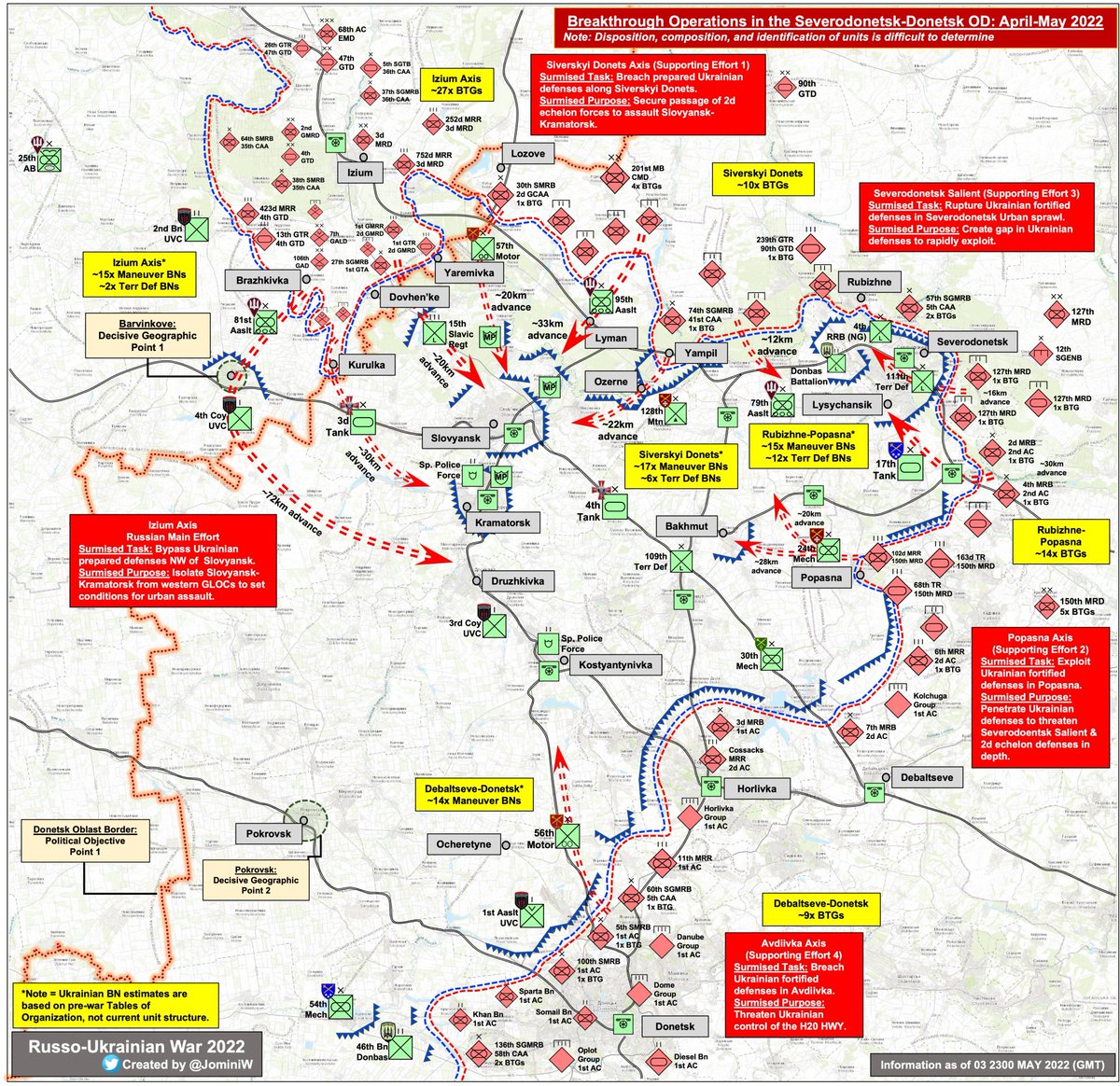
2/ This small study utilizes data, discussions, & insights from the following sources & is indebted to their amazing work: @HN_Schlottman, @TheStudyofWar, @Militarylandnet, @AggregateOsint, @HelloMrBond, @War_Mapper, @KofmanMichael, @dupuyinstitute, among many others.
3/ This is not a prediction, but a brief analysis of what seems to be the overall direction of operations by the Russian military in what is clearly the decisive terrain in east Ukraine – the convex line running from Izium through Siverskyi Donets to the Severondontsk Salient.
4/ I have been stressing since March 14 this portion of the Donbas front is the key to ultimate victory or defeat in the east. I still hold to this assessment. I think it is even more so now in the wake of Russia’s decisive defeat in the Battle for Kyiv.
5/ There has been a lot of discussion lately, both online and in the media, of the trajectory of Russian operations and what they may accomplish. May 9 is seen as an important waypoint for Russia, whether this is an actual deadline is debatable. youtu.be
6/ Let us look at the balance of forces currently engaged in the Severodonetsk-Donetsk OD & their likely mission set. The most recent geolocation data places at least 60x BTGs in the Severodonetsk-Donetsk OD. 51x BTGs are arrayed from Izium to Popsana.

7/ Of the known Ukrainian forces in the Severodonetsk-Donetsk OD, pre-war tables of organization allocate 61x Maneuver Battalions & 20x Territorial Defense Battalions in the Donbas. 37x Maneuver & all 20x Territorial Defense Battalions are currently arrayed from Izium to Popsana.
8/ The number of Ukrainian BNs have likely changed due to attrition. However, these numbers give us a picture of the balance of forces. @HN_Schlottman has gone a step further and done some great work on a general estimate of force composition for the OD.
9/ Russia has struggled, and continues to struggle, with properly resourcing & sustaining their war effort, but the Russian military clearly sees the Severodonetsk-Donetsk OD, in particular the Siverskyi Donets line, as decisive terrain to control.
10/ To do this Russia has to accomplish the integration & synchronization of the preponderance of their forces in time & space through strategic movement, successively, upon decisive points & key points of communication without compromising their own.
11/ Here is a model of what this would look like. Key to successfully obtaining integration & synchronization of mass in time & space is the ability to arrange forces & combat multipliers (aviation, artillery, cyber, ADA, engineers, etc.) at the proper time with ample energy.
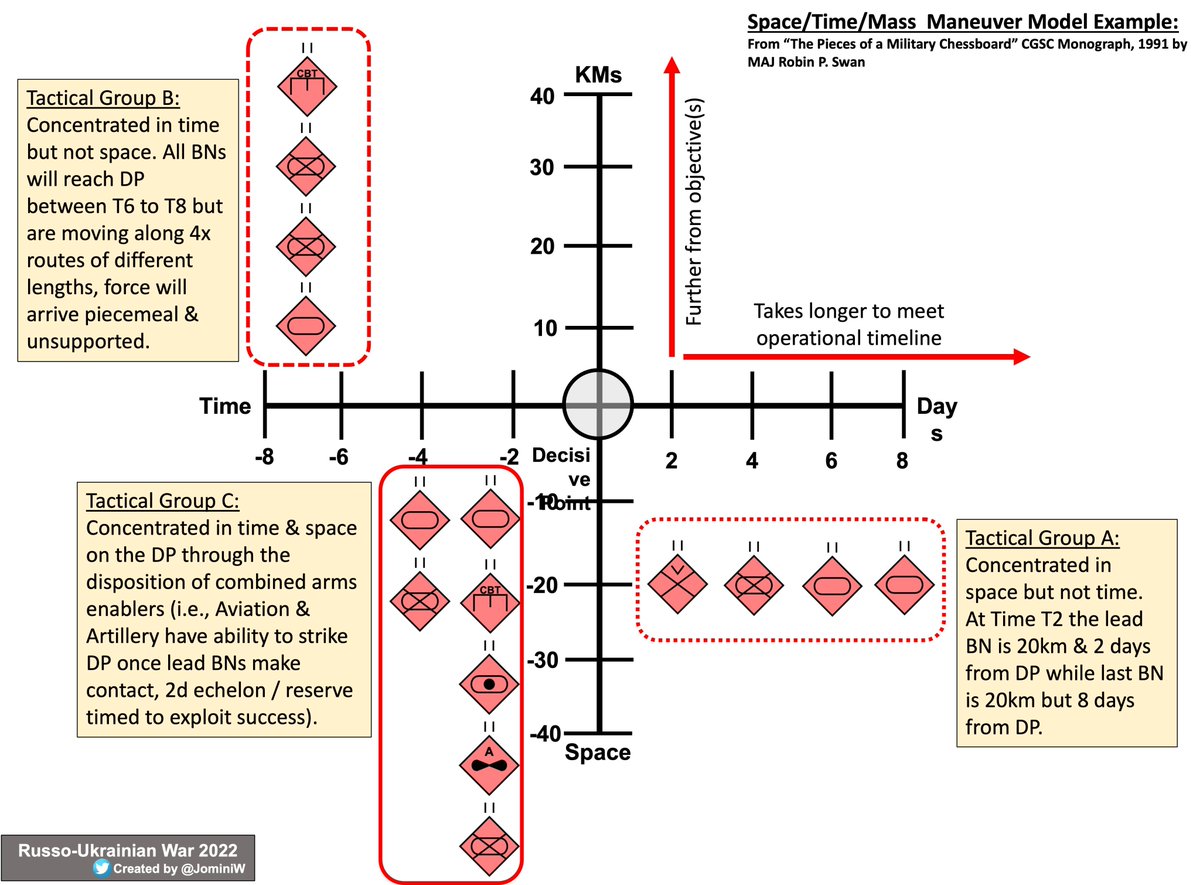
12/ This last part is the crucial element of combined arms maneuver. Here is the same graphic but arrayed with what I surmise is the Russian operational plan. April 24 is my mark on the wall for when general large-scale offensive operations began in earnest in the Donbas.
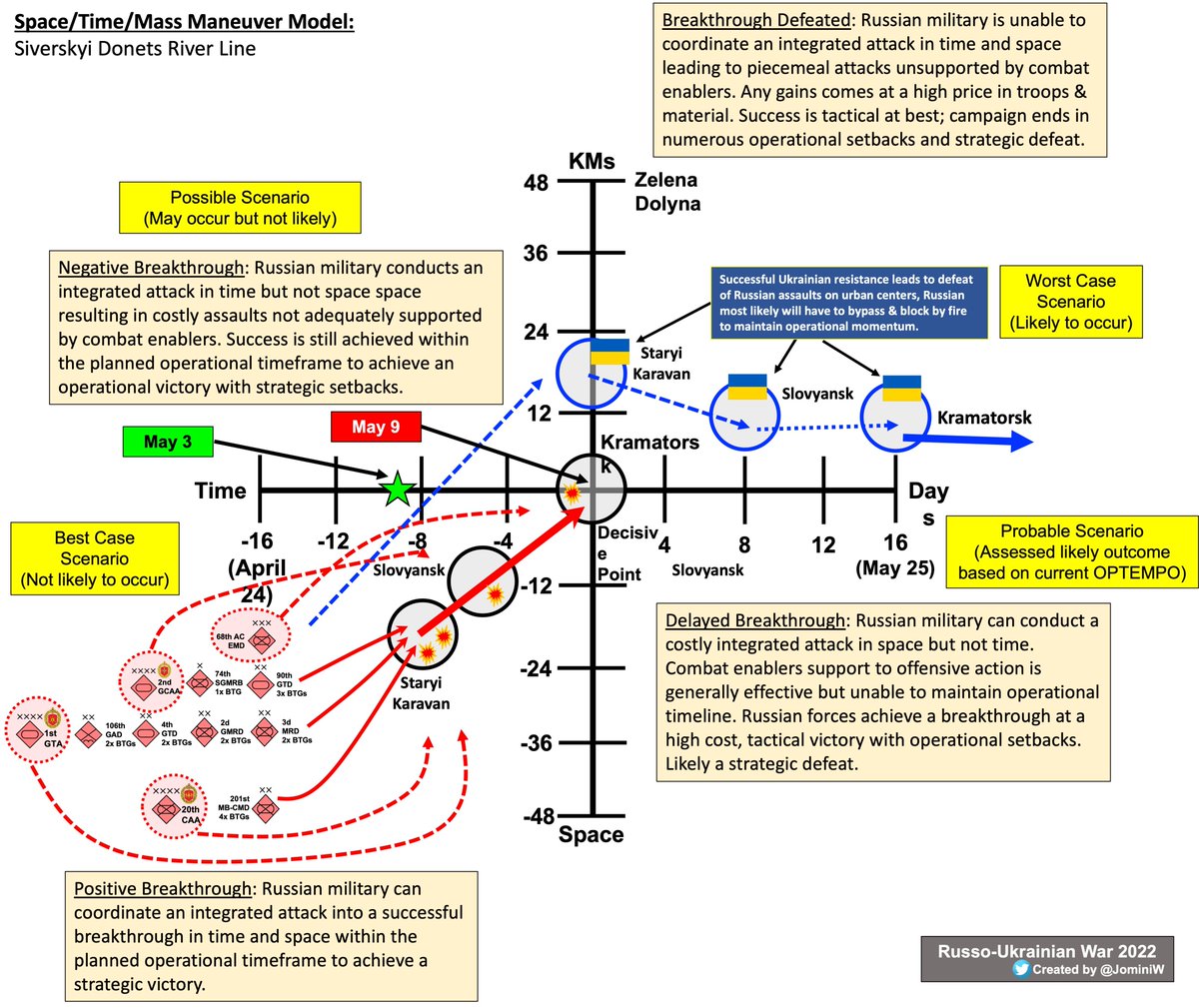
13/ Using May 9 as a key date for the Kremlin to declare some sort of “victory”, Russian forces only had 16 days to reach their operational objectives. As you can see, if May 9 is indeed a mark on the wall to measure Russian success, they are way behind the power curve.
14/ It is not likely at this point for Russia to achieve some sort of positive or negative breakthrough by May 9, if this is indeed a key date in Russian operational planning. Still Russia is gaining ground through slow incremental advances.
15/ Russian forces have marginally improved at conducting large-scale operations with forces moving along mutually supporting routes of advance, employing for effective recon by force techniques to engage & maneuver against Ukrainian defenses supported by air & artillery.

16/ Though poor morale, logistical issues, manpower shortages, poor leadership still plague Russian operations, the immediate obstacle to their success is the Ukrainian military & resolve. This more than anything else, is what is slowing Russian progress. #SlavaUkraini
17/ Ukraine has reinforced and fortified prepared defensive positions. These points are capable of withstanding prolonged air & artillery strikes. With excellent morale and leadership, it will be difficult for Russian forces to breach their defenses.
18/ Here is a look at division opposed rates of advance against fortified, prepared, and hasty defenses based on historical combat data from the @dupuyinstitute. As you can see, historical daily advance rates for mechanized forces against intense resistance is slow.

19/ Let us now look at a variant of the space/time/mass maneuver model. This is aligned with a traditional Russian doctrinal template advancing along multiple axes to split defenders into separate or isolated groups to be destroyed in detail while striking deep into secure areas.
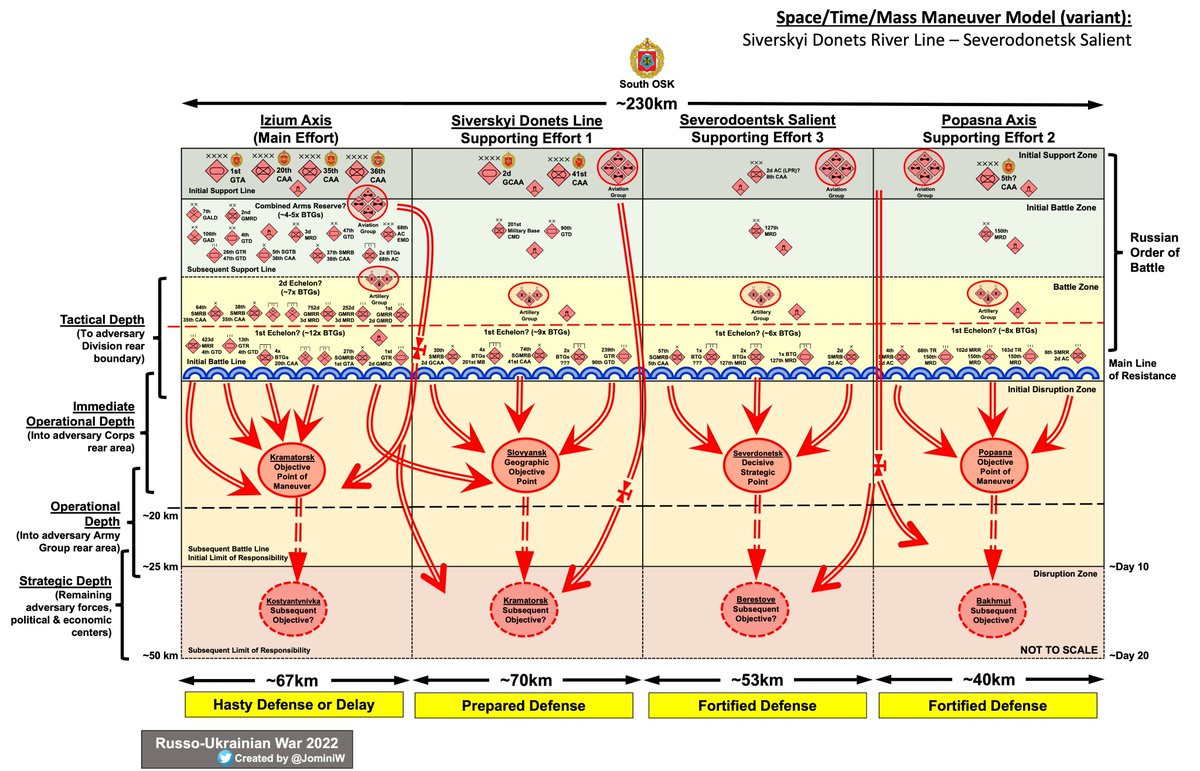
20/ Again, if May 9 is/was a target date for Russian forces in this OD, they should uniformly at or approaching the 20km line indicated in this graphic. Russian forces are not near this point. The grueling pace of Russian daily advances are consistent with HERO historical data.
21/ Russia is underperforming when it comes to their ability to achieve a meaningful breakthrough, even along the Izium Axis where they should be making bigger gains. These trends support the assessment in thread post 11, Russia may achieve a delayed breakthrough by late May.
22/ Here is one more data point to support this, using data from @HN_Schlottman
@HelloMrBond inputted into a modified QJM model from Trevor Dupuy’s “Understanding War: History & Theory of Combat” at the @dupuyinstitute.
@HelloMrBond inputted into a modified QJM model from Trevor Dupuy’s “Understanding War: History & Theory of Combat” at the @dupuyinstitute.
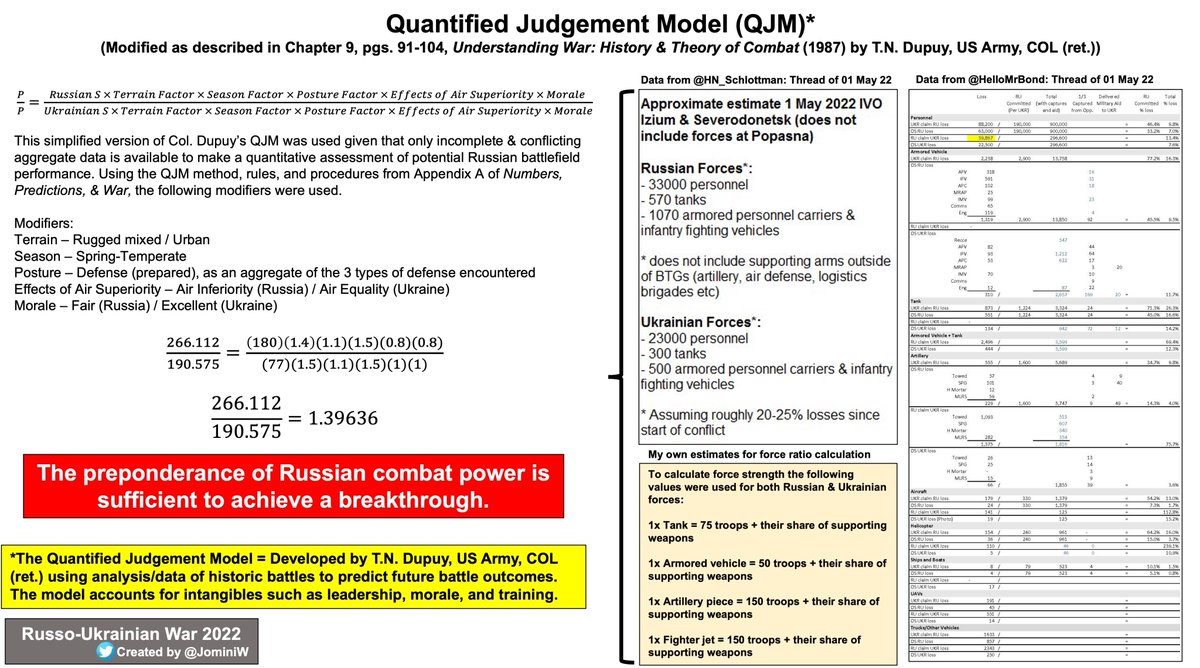
23/ Even though the QJM shows Russia has an advantage in combat power and should be able to achieve a breakthrough there is a lot working against this effort. As noted at the top of this thread the Ukrainians have a greater number of maneuver BNs to blunt advances.
24/ Still we could see a situation that ends up like this by late May/early June if Russian forces are able to continue to make incremental progress. This would be the best situation the Russians could hope for now. Reaching this point will culminate what force they have left.
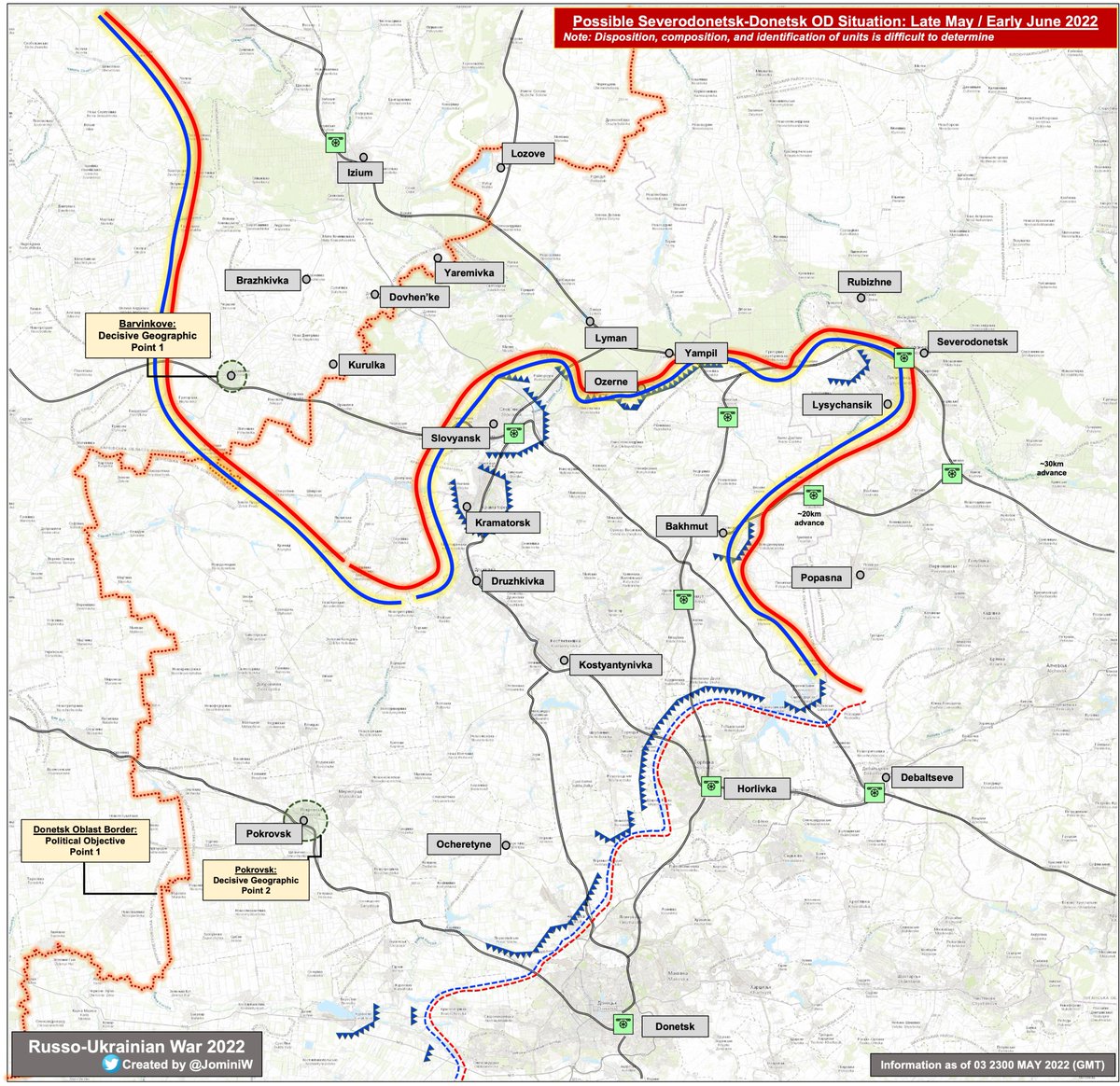
25/ The Summer may see a long-drawn-out siege of the urban cluster ranging from Kramatorsk to Lysychansk. Either way there is still a lot of bloody hard fighting to go before either side has a definitive battlefield advantage in the Donbas. It will be a long summer. END
Loading suggestions...