
Education
Self-improvement
Psychology
Mental Health
Personal Development
Decision Making
Decision-making
Mental Models

Most people suck at decision-making.
Let's change that.
Here are 15 of the best decision-making mental models I've found 🧵
Let's change that.
Here are 15 of the best decision-making mental models I've found 🧵
The Inside-Outside View
We have a natural tendency to favour the inside view—our own independent solution to a problem that incorporates all of our hidden biases.
To make better decisions, we should favour the outside view—one that incorporates the best available data.
We have a natural tendency to favour the inside view—our own independent solution to a problem that incorporates all of our hidden biases.
To make better decisions, we should favour the outside view—one that incorporates the best available data.

Ladder of Inference
Describes the thinking process we go through—often subconsciously—to get from a fact to a decision or action.
To make better decisions, we should move slowly and deliberately from the bottom of the ladder to the top of the ladder.
h/t (image) - @amrancz
Describes the thinking process we go through—often subconsciously—to get from a fact to a decision or action.
To make better decisions, we should move slowly and deliberately from the bottom of the ladder to the top of the ladder.
h/t (image) - @amrancz

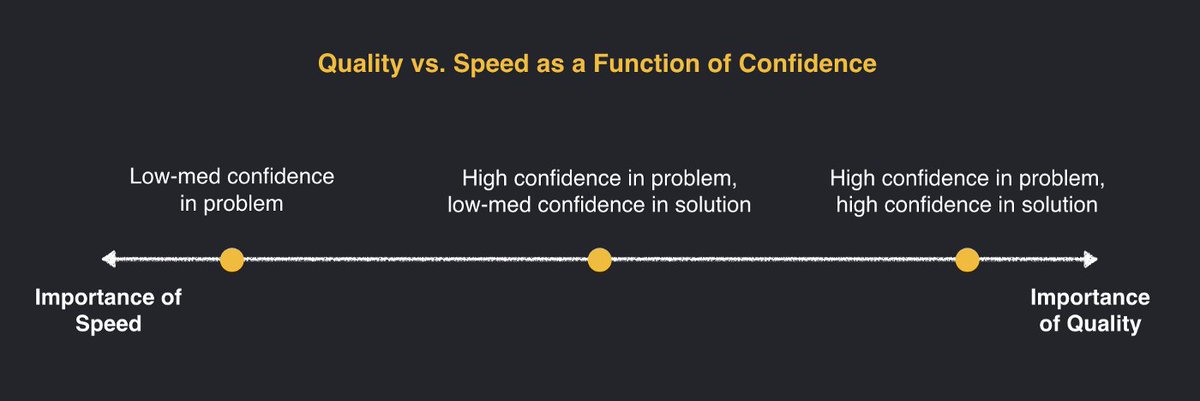
@amrancz Confidence Determines Speed vs. Quality
The more confidence you have in the importance of a problem and your understanding of its solution, the more you should focus on quality.
However, if you need to learn more, move fast and break things.
h/t - @BrandonMChu
The more confidence you have in the importance of a problem and your understanding of its solution, the more you should focus on quality.
However, if you need to learn more, move fast and break things.
h/t - @BrandonMChu
@amrancz @BrandonMChu Devil’s Advocate Position
The antidote to confirmation bias.
It involves forcing yourself to view a decision from the opposite viewpoint or finding people who disagree with you.
It forces you to create a more compelling argument.
Don't take my word for it:
The antidote to confirmation bias.
It involves forcing yourself to view a decision from the opposite viewpoint or finding people who disagree with you.
It forces you to create a more compelling argument.
Don't take my word for it:

@amrancz @BrandonMChu Pre-Mortem
Involves assuming that your decision has failed and working backwards to determine what the potential causes were.
This process has multiple benefits:
• Removes overconfidence and irrational optimism
• Reveals blind spots
• Simplifies thinking
h/t @KleInsight
Involves assuming that your decision has failed and working backwards to determine what the potential causes were.
This process has multiple benefits:
• Removes overconfidence and irrational optimism
• Reveals blind spots
• Simplifies thinking
h/t @KleInsight

@amrancz @BrandonMChu @KleInsight Post-Mortem
Regardless of success or failure, this can be used to drive continuous improvement in your decision-making.
Here, you ask:
• What went well?
• What went poorly?
• What can be improved next time?
With the answers, future decisions will be better informed.
Regardless of success or failure, this can be used to drive continuous improvement in your decision-making.
Here, you ask:
• What went well?
• What went poorly?
• What can be improved next time?
With the answers, future decisions will be better informed.
@amrancz @BrandonMChu @KleInsight Decision Trees
These are tree-like graphs with the branches showing results of possible choices for a given decision or action.
The decision tree allows options to be compared against each other, for both risk and return.
They're particularly helpful for financial decisions.
These are tree-like graphs with the branches showing results of possible choices for a given decision or action.
The decision tree allows options to be compared against each other, for both risk and return.
They're particularly helpful for financial decisions.

@amrancz @BrandonMChu @KleInsight Information Overload
Information overload is when you have too much information at hand.
This causes decisions to take too long.
It also leads to 'analysis paralysis' where your decision-making suffers paralysis because you over-analyze the body of information available.
Information overload is when you have too much information at hand.
This causes decisions to take too long.
It also leads to 'analysis paralysis' where your decision-making suffers paralysis because you over-analyze the body of information available.
@amrancz @BrandonMChu @KleInsight Analysis Paralysis
It's the paradox of choice: having too many good options slows us down because the best one isn't clear.
Remember: by not making a choice, you are actually making a choice: the status quo.
A model to cope with this: reversible vs. irreversible decisions.
It's the paradox of choice: having too many good options slows us down because the best one isn't clear.
Remember: by not making a choice, you are actually making a choice: the status quo.
A model to cope with this: reversible vs. irreversible decisions.
@amrancz @BrandonMChu @KleInsight Reversible vs. Irreversible Decisions
Irreversible decisions are 'one-way doors.'
They must be made slowly and deliberately.
Reversible decisions are 'two-way doors.'
These decisions can and should be made quickly.
Irreversible decisions are 'one-way doors.'
They must be made slowly and deliberately.
Reversible decisions are 'two-way doors.'
These decisions can and should be made quickly.
@amrancz @BrandonMChu @KleInsight Luck Razor
If stuck with 2 equal options, pick the one that feels like it will produce the most luck later down the line.
Should I stay in tonight or should I go and meet this interesting stranger?
Choose to increase your surface area of luck when you have the choice.
If stuck with 2 equal options, pick the one that feels like it will produce the most luck later down the line.
Should I stay in tonight or should I go and meet this interesting stranger?
Choose to increase your surface area of luck when you have the choice.
@amrancz @BrandonMChu @KleInsight Make Proud Decisions for Your 80-Year Old and 10-Year Old Self
Your 80-year-old self helps you makes decisions you won't regret when you're old.
Your 10-year-old self reminds you to stay foolish and have some fun along the way.
h/t - @SahilBloom
Your 80-year-old self helps you makes decisions you won't regret when you're old.
Your 10-year-old self reminds you to stay foolish and have some fun along the way.
h/t - @SahilBloom
@amrancz @BrandonMChu @KleInsight @SahilBloom Minimize Unforced Errors
A concept from tennis, 'unforced error' is a metaphor for any situation where an avoidable mistake is made.
The first goal of decision-making should always be to minimize unforced errors.
How?
Sound judgement and decision making techniques.
A concept from tennis, 'unforced error' is a metaphor for any situation where an avoidable mistake is made.
The first goal of decision-making should always be to minimize unforced errors.
How?
Sound judgement and decision making techniques.
@amrancz @BrandonMChu @KleInsight @SahilBloom Outcome Blind
The biggest mistake when judging performance is only looking at the outcome.
Instead, we should focus on the process used.
It's possible to win with a bad decision making process (luck) or lose with a good process.
What's important is knowing the 'Why.'
The biggest mistake when judging performance is only looking at the outcome.
Instead, we should focus on the process used.
It's possible to win with a bad decision making process (luck) or lose with a good process.
What's important is knowing the 'Why.'
@amrancz @BrandonMChu @KleInsight @SahilBloom 10/10/10 Rule
We're all guilty of making decisions without thinking about long term consequences.
To avoid this, ask:
• How will I feel about this 10 minutes from now?
• 10 months from now?
• 10 years from now?
This helps clarify the decision that results in a win/win/win.
We're all guilty of making decisions without thinking about long term consequences.
To avoid this, ask:
• How will I feel about this 10 minutes from now?
• 10 months from now?
• 10 years from now?
This helps clarify the decision that results in a win/win/win.
@amrancz @BrandonMChu @KleInsight @SahilBloom That's 15 of the best decision-making models I've found.
Tell me, what would you add?
If you enjoyed this thread:
1. Follow me @_alexbrogan for more mental models, concepts, and frameworks
2. RT the tweet below to share this with others who might enjoy it :)
Tell me, what would you add?
If you enjoyed this thread:
1. Follow me @_alexbrogan for more mental models, concepts, and frameworks
2. RT the tweet below to share this with others who might enjoy it :)
If you like improving your thinking, you will love my weekly newsletter.
I share mental models (weekly), high-quality links to the best content I find (monthly), and exclusive subscriber resources (a few times per year).
You can join here: getrevue.co
I share mental models (weekly), high-quality links to the best content I find (monthly), and exclusive subscriber resources (a few times per year).
You can join here: getrevue.co
Loading suggestions...