
A brief guide to Shakespeare's use of prosody.
It's how the Immortal Bard controls your attention, (and therefore your emotions).
It's how the Immortal Bard controls your attention, (and therefore your emotions).

Two bits of terminology first.
The iamb:
A short syllable followed by a long syllable. (da-DUM)
It could be one word or two.
(from a poem by Lord Byron)
The iamb:
A short syllable followed by a long syllable. (da-DUM)
It could be one word or two.
(from a poem by Lord Byron)
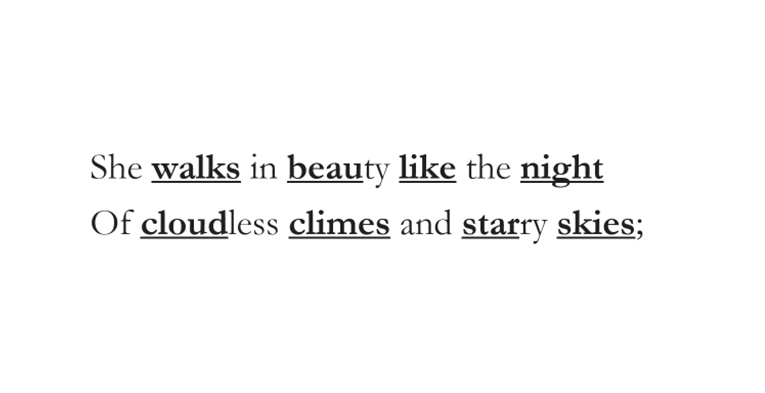
You'll notice that iambs really fly off the tongue.
Shakespeare generally used iambic pentameter.
Penta = five. Hence, in lines of five iambs.
From Shakespeare's Much Ado About Nothing ->
Shakespeare generally used iambic pentameter.
Penta = five. Hence, in lines of five iambs.
From Shakespeare's Much Ado About Nothing ->
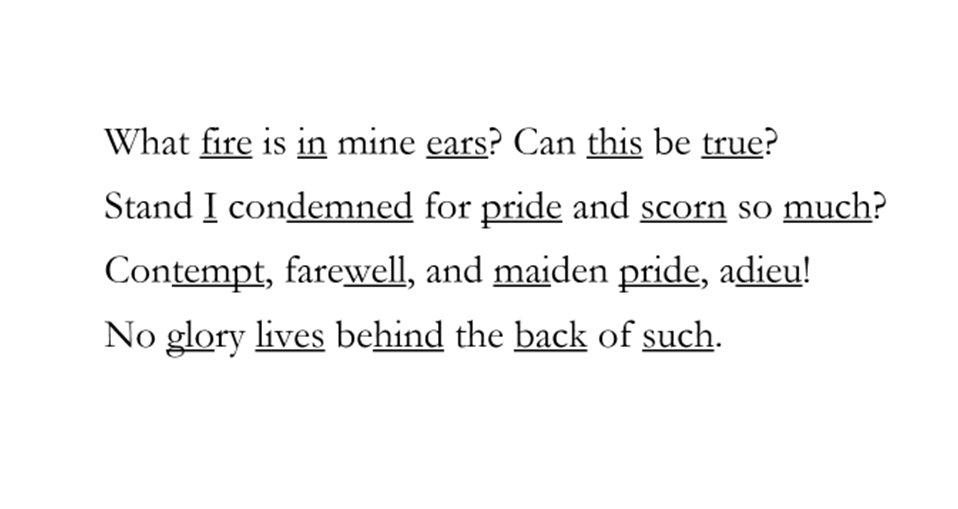
It's what Shakespeare (and the majority of English poets since Chaucer) stuck to.
It flows. It has rhythm. It's memorable.
Now read this, keeping in mind the iambic rhythm:
(From King Lear)
It flows. It has rhythm. It's memorable.
Now read this, keeping in mind the iambic rhythm:
(From King Lear)
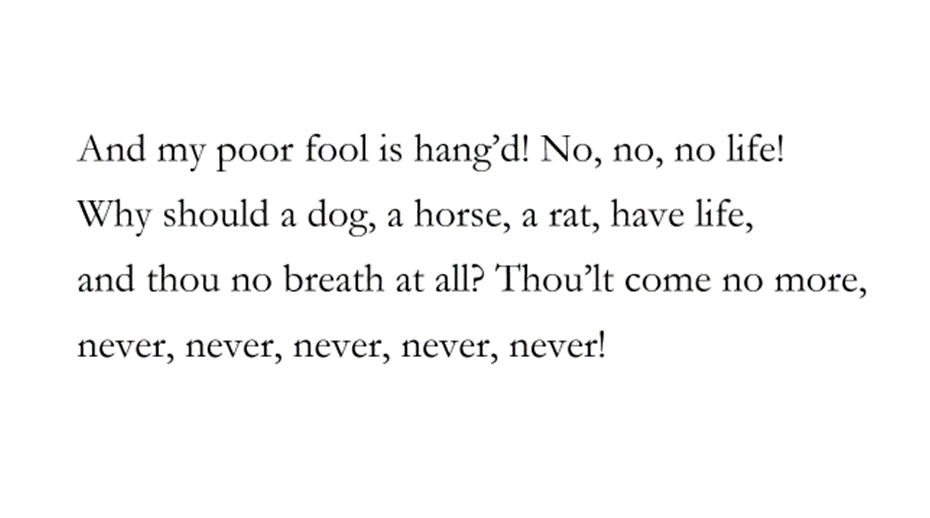
I'm guessing you read it out loud to yourself.
And that you stumbled on "No, no, no life!" and the final "never, never..."
What was going on there?
Shakespeare used a trochee.
And that you stumbled on "No, no, no life!" and the final "never, never..."
What was going on there?
Shakespeare used a trochee.
The trochee is the opposite of the iamb.
Stressed syllable followed by unstressed.
The most famous example is this, from Macbeth.
(Here Shakespeare is writing in tetrameter = lines of four trochees)
Stressed syllable followed by unstressed.
The most famous example is this, from Macbeth.
(Here Shakespeare is writing in tetrameter = lines of four trochees)
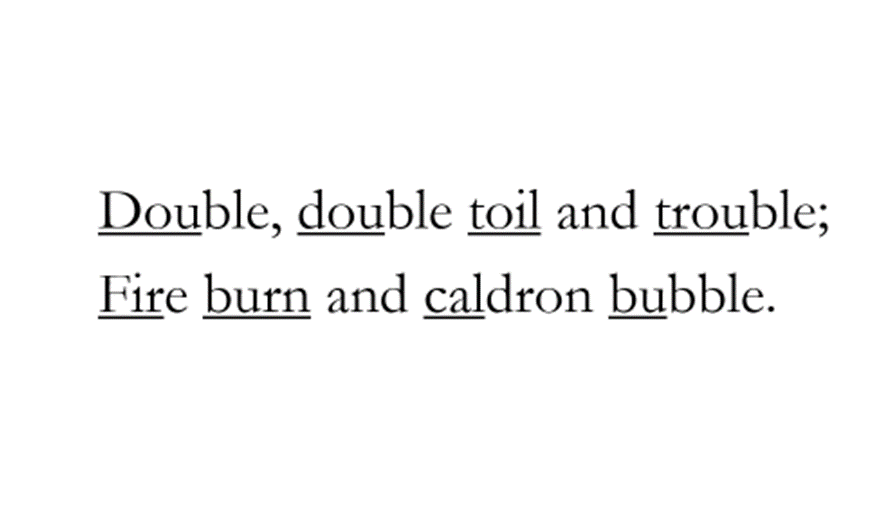
You can't read it like an iamb. It doesn't work.
So that's the trochee and the iamb. You know that they flow differently.
Let's see how Shakespeare combines the iamb and trochee to control pace.
(Changes in or lack of rhythm underlined.)
Macbeth's final soliloquy ->
So that's the trochee and the iamb. You know that they flow differently.
Let's see how Shakespeare combines the iamb and trochee to control pace.
(Changes in or lack of rhythm underlined.)
Macbeth's final soliloquy ->
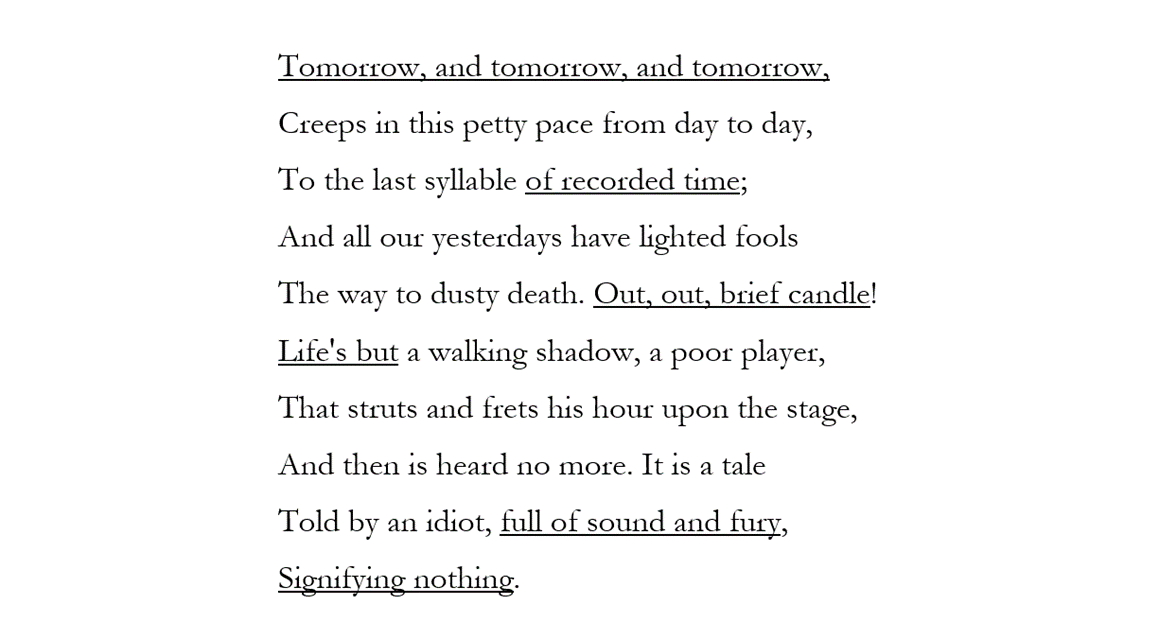
There's so much going on here, but most of all you'll notice the mix of iambs and trochees.
Shakespeare did this in moments of high drama.
Combining metrical feet slows and controls the pace. You can't read it quickly.
And it forces you to stress particular words.
Shakespeare did this in moments of high drama.
Combining metrical feet slows and controls the pace. You can't read it quickly.
And it forces you to stress particular words.
"Tomorrow, and tomorrow, and tomorrow," sets you up for something big.
When Shakespeare has been using iambic pentameter and then breaks it - he's got your attention.
"Signifying nothing."
Ouch. All sense of rhythmic flow has gone. Intentionally.
The words hit you hard.
When Shakespeare has been using iambic pentameter and then breaks it - he's got your attention.
"Signifying nothing."
Ouch. All sense of rhythmic flow has gone. Intentionally.
The words hit you hard.
And THAT is prosody: the art of rhythm in language.
Shakespeare used it to guide the voice, attention, and emotion of his audience.
Shakespeare used it to guide the voice, attention, and emotion of his audience.
Lessons:
Shakespeare knows the rulebook inside out.
And after mastering the technical art of poetry, he can use all its tricks - even breaking them sometimes - to play with his audience.
That is the power of poetry.
And proof that poetry is a complex, objective skill.
Shakespeare knows the rulebook inside out.
And after mastering the technical art of poetry, he can use all its tricks - even breaking them sometimes - to play with his audience.
That is the power of poetry.
And proof that poetry is a complex, objective skill.
That doesn't mean there's only one way to write poetry, nor that the rules can't change.
But it does mean poets should study prosody.
Before you write free verse, try writing in metre.
Learn the rules, play with them, and then maybe break them.
But it does mean poets should study prosody.
Before you write free verse, try writing in metre.
Learn the rules, play with them, and then maybe break them.
Loading suggestions...