
.:The word Khudā is synonymous with the word Allāh:.
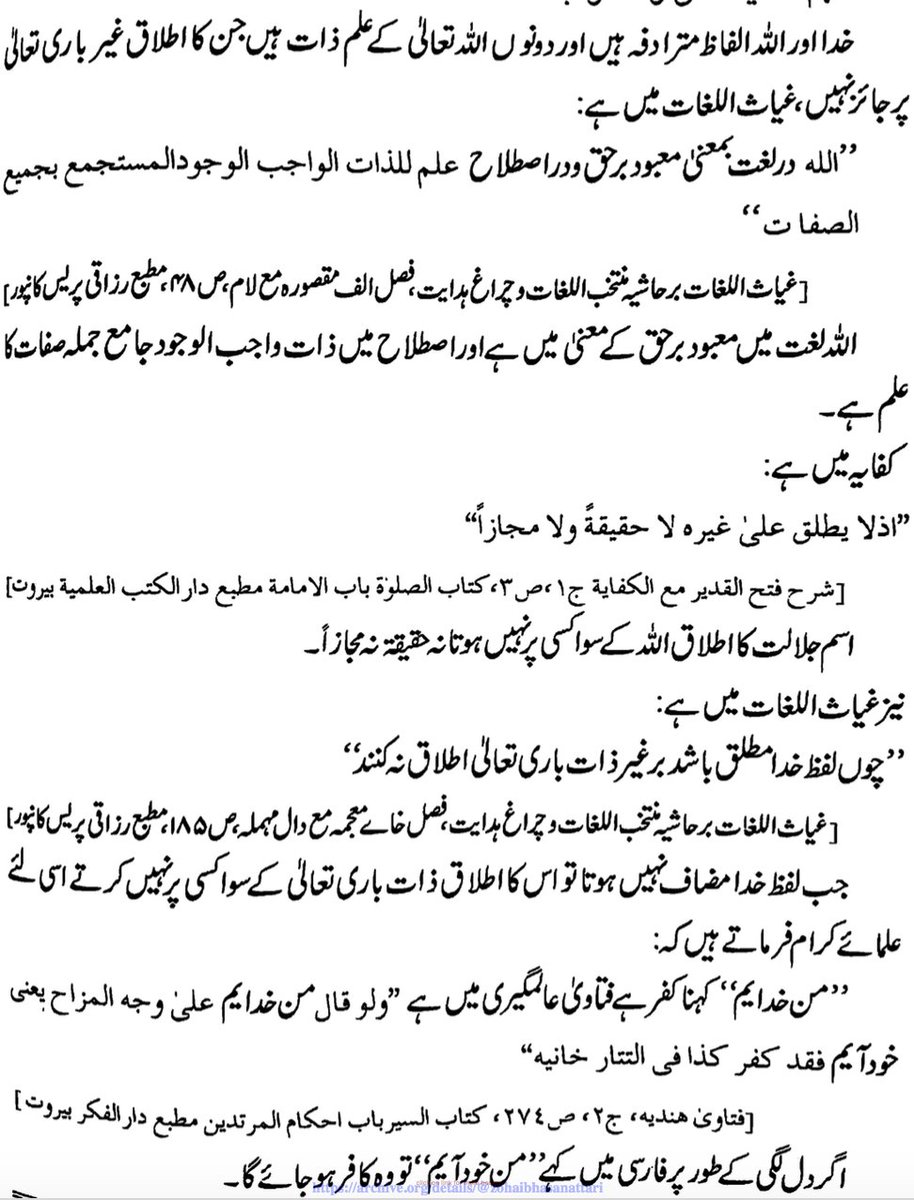
“Khudā and Allāh are synonyms, and both are specific nouns for Allāh táālā whose application upon other than the Creator [bārī táālā] is not permissible.
“Khudā and Allāh are synonyms, and both are specific nouns for Allāh táālā whose application upon other than the Creator [bārī táālā] is not permissible.
It is in Giyāth al-Lughāt:
‘In language Allāh means the true deity, and in terminology it means, Noun for the Essence [dhāt] that is Necessarily Existent [wājib al-wujūd], combining all Attributes.’
‘In language Allāh means the true deity, and in terminology it means, Noun for the Essence [dhāt] that is Necessarily Existent [wājib al-wujūd], combining all Attributes.’
It is in Kifāyah:
‘It [i.e. the word Allāh] is not applied upon other than He; neither literally nor metaphorically.’
‘It [i.e. the word Allāh] is not applied upon other than He; neither literally nor metaphorically.’
Also, it is in Giyāth al-Lughāt:
‘Since the word Khudā is absolute [muţlaq], it cannot be applied upon other than the Essence of the Creator.’
For this reason the scholars state that saying, ‘I am Khudā’, is kufr.
‘Since the word Khudā is absolute [muţlaq], it cannot be applied upon other than the Essence of the Creator.’
For this reason the scholars state that saying, ‘I am Khudā’, is kufr.
It is in Fatāwā Áālamgīrī:
‘If he said, “I am Khudā”, in jest, then he has committed kufr, it is as such in Tatārkhāniyyah.’
‘If he said, “I am Khudā”, in jest, then he has committed kufr, it is as such in Tatārkhāniyyah.’
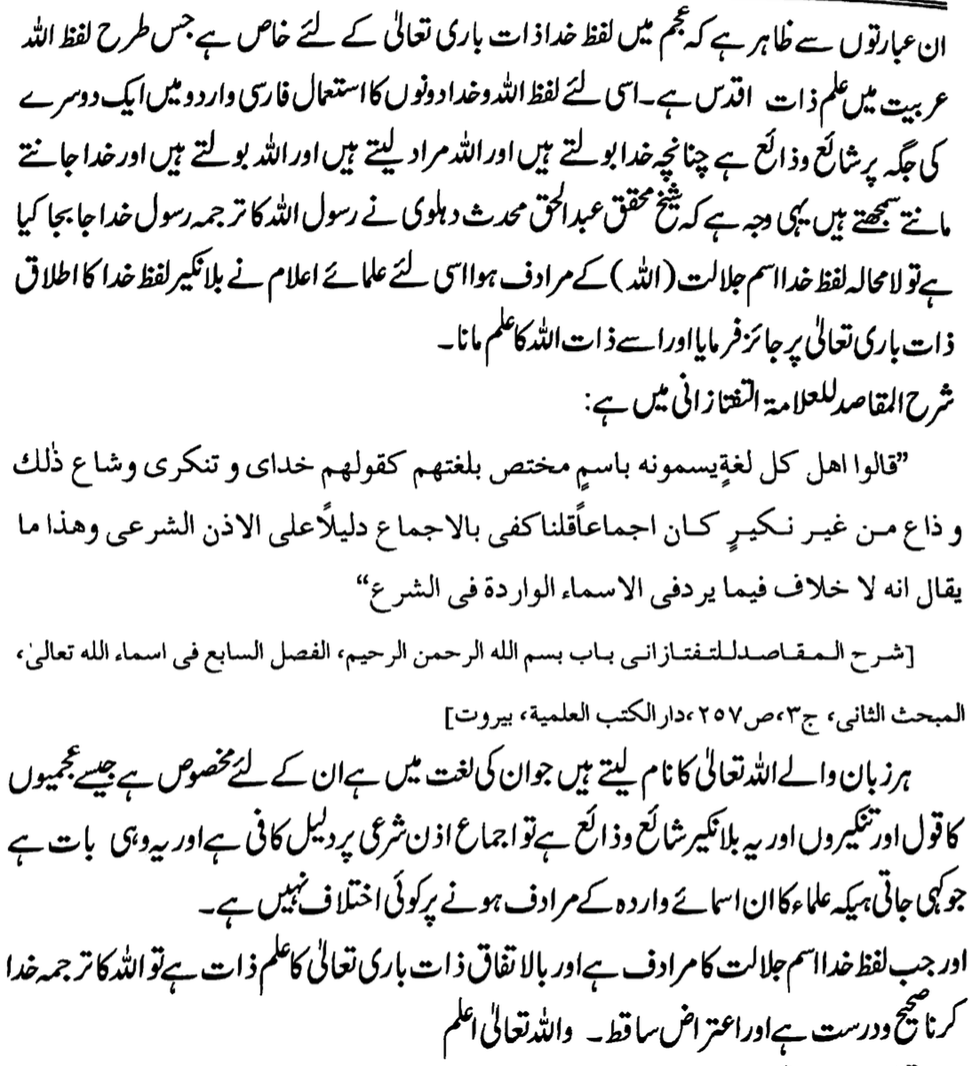
From these passages it is apparent that among the non-Arabs [ájam], the word Khudā is specific to the Essence of the Creator, just as the word Allāh is a specific noun for the Sacred Essence [dhāt e aqdas] in Arabic.
For this reason the word Allāh and Khudā are both used interchangeably in Persian and Urdu, accordingly they say Khudā and intend Allāh, and they say Allāh and understand Khudā,
this is the reason that Shaykh Muĥaqqiq Ábd al-Ĥaqq Muĥaddith al-Dihlawī translated RasūlAllāh as Rasūl-i-Khudā in numerous places, and so certainly the word Khudā is a synonym of Allāh, for this reason the eminent scholars have, without objection,
declared it permissible to apply the word Khudā for the Essence of the Creator and considered it a specific noun for the Essence of Allāh.
It is in Sharĥ al-Maqāşid of Állāmah Taftāzānī:
‘They said, the people of every language name Him with a name specific to their language such as their saying Khudā, and Tengri, and that spread without any objection as a consensus [ijmāá].
‘They said, the people of every language name Him with a name specific to their language such as their saying Khudā, and Tengri, and that spread without any objection as a consensus [ijmāá].
We said: Consensus is sufficient as a proof of permission in the Sharīáh, and this is what is said that there is no difference regarding that which is synonymous to the Names transmitted in the Sharīáh.’
When Khudā is a synonym for Allāh and is a specific noun for the Essence of the Creator by agreement, then to translate Allāh as Khudā is correct and the objection is futile.”
— Tāj al-Sharīáh Muftī Muĥammad Akhtar Riđā Khān al-Ĥanafī al-Qādirī al-Baraylawī [1362–1439 AH / 1943–2018 CE], Fatāwā Tāj al-Sharīáh, 1/196-197
Loading suggestions...