

A successful British film was opposed and banned in Bombay, Madras and Bengal. A thread on forgotten piece of India's anti colonial struggle (1/10)

‘The Drum’ had been one of the most successful British films of the technicolor era, released in 1938. It made grand business across all the major cities of Great Britain and USA (2/10)

The film features Sabu Dastagir in his second role, as the teenage Prince Azim, forced into hiding after his father, the ruler of a peaceful fictional kingdom in northwest India, was assassinated by his merciless brother (3/10)

The prince was then rescued and protected by a heroic British officer. He ended up fighting with the colonialists against his malicious and fundamentalist uncle claiming the throne (4/10)
However, in India, it was perceived as a major propaganda film by the British empire to justify their rule over racially inferior Indians and vitriolic attitude against the fabric of communal harmony in North West Frontier (5/10)
The Pathans were portrayed as cruel, manipulative, treacherous and set in fundamentalist ideologies, as opposed to the British, who were gallant and willing to sacrifice to protect the innocents against the tyrants (6/10)
The film’s Islamophobic and anti-India propaganda brought hundreds of working-class Muslim young people out into the streets of Bombay led by a group called Muslim Naujawans, alongside several film critics and writers (7/10)
Two of India’s earlier film journalists Baburao Patel and K.A. Abbas, led the campaign, published several patriotic articles, sent telegrams to Indian ministers and even made a tour of Hollywood (8/10)
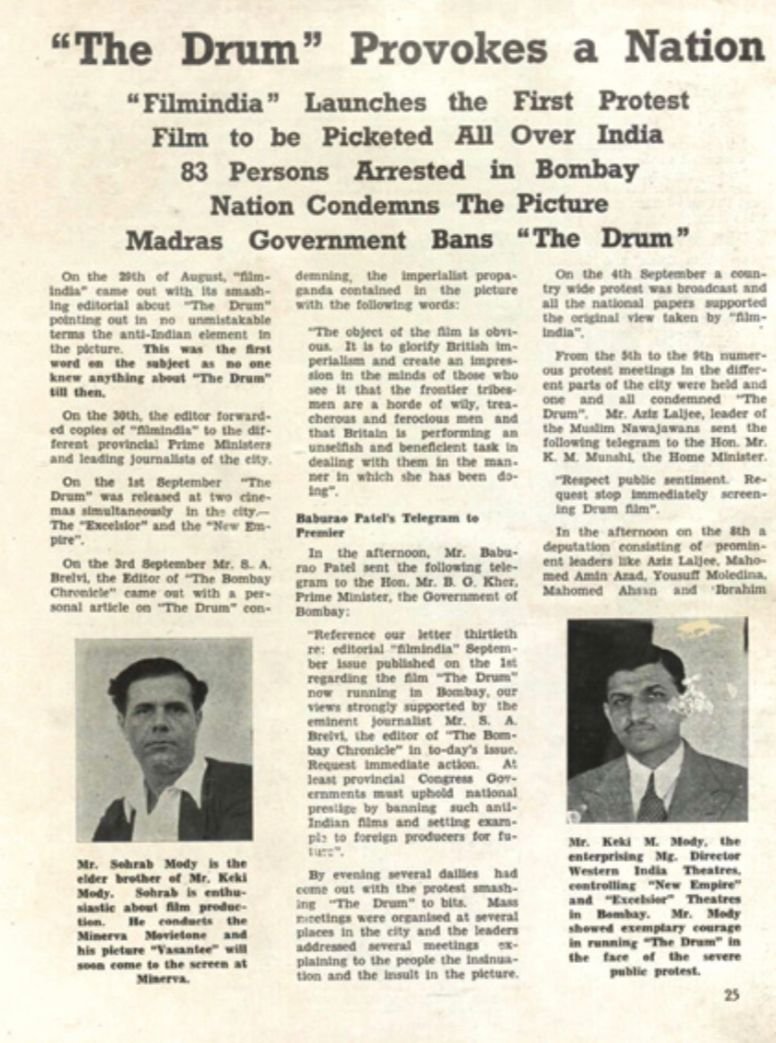
The agitation spread to Madras, down the coastal Konkan area and to Bengal that had a substantial Muslim population and a strong nationalist sentiment. Khān Abdul Ghaffār Khān also raised his voice demanding a ban (9/10)
In Bombay, protestors picketed at the theatre entrances, which led to police violence and arrests, bringing uptown Bombay to a virtual halt for a week. Eventually the film was banned in Bombay, Madras and Bengal (10/10)
Source: Censored Itineraries of a Lost Communistic Film and Creating Cinema's Reading Publics/ Debashree Mukherjee. Economic and Political Weekly/Anu Kumar. Imdb.com, Wikimedia

And on the topic of Sabu Dastagir, here is one of our earlier threads on his fascinating journey to the silver screen
Loading suggestions...