
I found this post extremely engaging! I really appreciate @RichardHanania's self-awareness.
richardhanania.substack.com
Some takeaways:
richardhanania.substack.com
Some takeaways:
@RichardHanania 1) He claims that instinctive morality is based on ego-gratification.
What about me makes me special, unique, or better than those around me? The absence or reversal of those traits will be what tends to outrage me.
I think this might just be true.
What about me makes me special, unique, or better than those around me? The absence or reversal of those traits will be what tends to outrage me.
I think this might just be true.
@RichardHanania 2) Hanania: "Wokeness draws particular ire because, while it may not be the most harmful set of beliefs that has ever existed, it is certainly in the running for most clearly false and intellectually indefensible."
I don't actually know that this is true.
I don't actually know that this is true.
@RichardHanania It seems to me like the original core of wokeness was that the experience of being black in America is really different than the experience of being white, in ways that are both unfair and overlooked.
@RichardHanania Then there are a bunch of patently false claims, and sloppy or motivated causality on top of that.
But the simple core seems like it is broadly correct?
But the simple core seems like it is broadly correct?
@RichardHanania But he continues "I’m convinced that if aliens not subject to any kind of Social Desirability Bias with regards to our species came to earth and could investigate the intellectual merits of different human beliefs, gender blank slatism would be close to the first...
@RichardHanania ...thing they would dismiss."
Which does sound about right to me.
Which does sound about right to me.
@RichardHanania 3) Hanania: "It would be better if more members of the governing class saw themselves as part of the truth-seeker tribe rather than that of 'individuals with degrees who write a large number of grammatical sentences with references.' "
I think this is missing an important point.
I think this is missing an important point.
@RichardHanania It isn't just that this class of people could be thinking of themselves as truth seekers instead of intellectuals. I think that would be less __carving reality at the joints__.
@RichardHanania Psychologically AND materially, there's a crucial difference is between people who succeed by convincing others that they're worthy, vs people who succeed by being right and/or building something that works.
And academics are universally in the first category.
And academics are universally in the first category.
@RichardHanania The actual selection pressures on academics are for passing tests and attaining prestige markers. They, fundamentally, get rewarded and funded on the basis of that game, and are rewarded for discovering truth ONLY insofar as it contributes to passing tests or attaining prestige.
@RichardHanania Speaking perhaps less charitably, academics are rent seekers who spend years accumulating degrees and publications to allow them access to the resource flows of the major grant-makers.
@RichardHanania It isn't in their class interest to challenge the system by pointing out that the "Studies people", as Hanania calls them, are churning out nonsense, because drawing attention to that might entail a re-evaluation of their own status.
@RichardHanania I think that to some extent (I'm not sure how much), there's a tacit collusion between the Woke sociologist and the academic mathematician.
@RichardHanania The mathematician, however much his process is seeking truth, is basically playing a puzzle game that's fun for him, that doesn't clearly produce societal value, on the government's dime.
@RichardHanania And even most scientists who are working on something of practical relevance (eg Hanania's quantum computing researcher) are not producing immediate, legible value, or they could be working in industry instead.
@RichardHanania Working in academia is sort of a bargain: if you attain some markers of intellectual eminence, you can work on things that are interesting to you, and society will fund you, without looking too closely at if what you're doing is valuable.
@RichardHanania So in this sense, the job of an academic IS to be an "individual with degrees who writes a large number of grammatical sentences with reference", not to be a truth-seeker.
@RichardHanania 4) Overall, I really appreciate someone owning that their political stances are rooted in their aesthetics instead of utilitarian logic.
People's aesthetics ARE central to their sense of a good life, a good society, and a good world.
People's aesthetics ARE central to their sense of a good life, a good society, and a good world.
@RichardHanania And if we could have political discourse that foregrounds that people have aesthetic differences, I (optimistically) hope that that would put us in a better position to resolve many of our political disagreements because we can more cleanly factor out collective problem...
@RichardHanania ...solving, based on the facts of the situation, from our aesthetic judgments, which we don't insist are, or expect to be universal.
It gives us space to say "this is good for me and my community, but it might not be for you or yours."
It gives us space to say "this is good for me and my community, but it might not be for you or yours."
@RichardHanania And then we can find compromises, or even better, have different jurisdictions do different things.
slatestarcodex.com
slatestarcodex.com
@RichardHanania (People sometimes refer to these this thing as "value differences", but I think that is extremely misleading. It evokes the wrong thing.
@RichardHanania Conservatives and Liberals, if you scratch down a few layrers are almost always optimizing for very similar "fundamental values": everyone wants freedom and justice and happiness and flourishing.
But they have very different aesthetics of a good society
But they have very different aesthetics of a good society
@RichardHanania It impedes progress when everyone adopts a mode of talking as if their opinions are grounded in rational utilitarian logic, when in reality that's mostly rhetoric for opinions arrived at by other means.
Doing that is the OPPOSITE of revealing one's cruxes.
Doing that is the OPPOSITE of revealing one's cruxes.
@RichardHanania It make sense why people would do this. It is much more defensible to say "I want this policy this because the arguments point in this direction" than "I want this policy because I have an illegible aesthetic preference, no reason more than that"
slatestarcodex.com
slatestarcodex.com
@RichardHanania But I think the maneuver of acting as if one reasoned out conclusions that they actually arrived at by other means is one underappreciated cause of why the discourse is so terrible.
@RichardHanania If statements like this one were commonplace in the discourse, maybe we could make more progress.
Because this isn't rhetorical posturing. It's revealing one's true reasons, and therefore the things that can update.
Because this isn't rhetorical posturing. It's revealing one's true reasons, and therefore the things that can update.
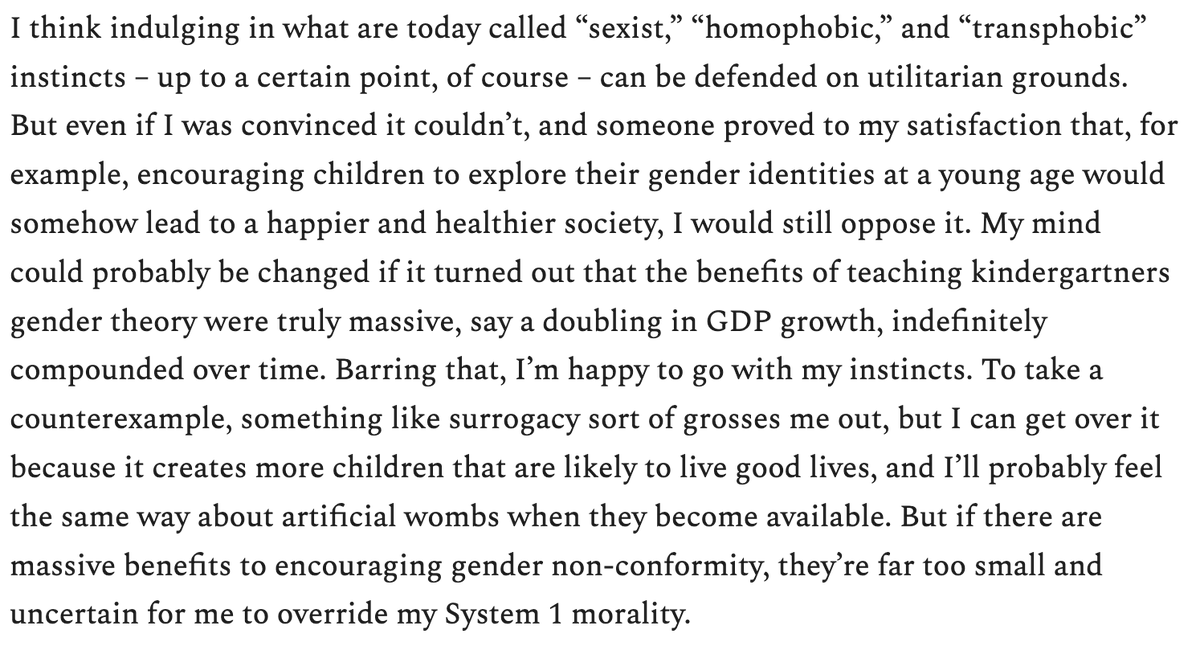
@RichardHanania And it makes space for others around you to voice their aesthetics as well.
@RichardHanania (Admittedly, this depends on a core prerequisite: enough reflectivity that one doesn't take one's instinctive emotional reactions as facts about the world, about the fundamental non-person-specific goodness or badness.
@RichardHanania You need to be able to take your emotional reactions as object enough, that you can think "I'm disgusted by X, but that doesn't necessarily mean that other people shouldn't do X.
But that that sort of reflection was also embodied in Hanania's statement above.)
But that that sort of reflection was also embodied in Hanania's statement above.)
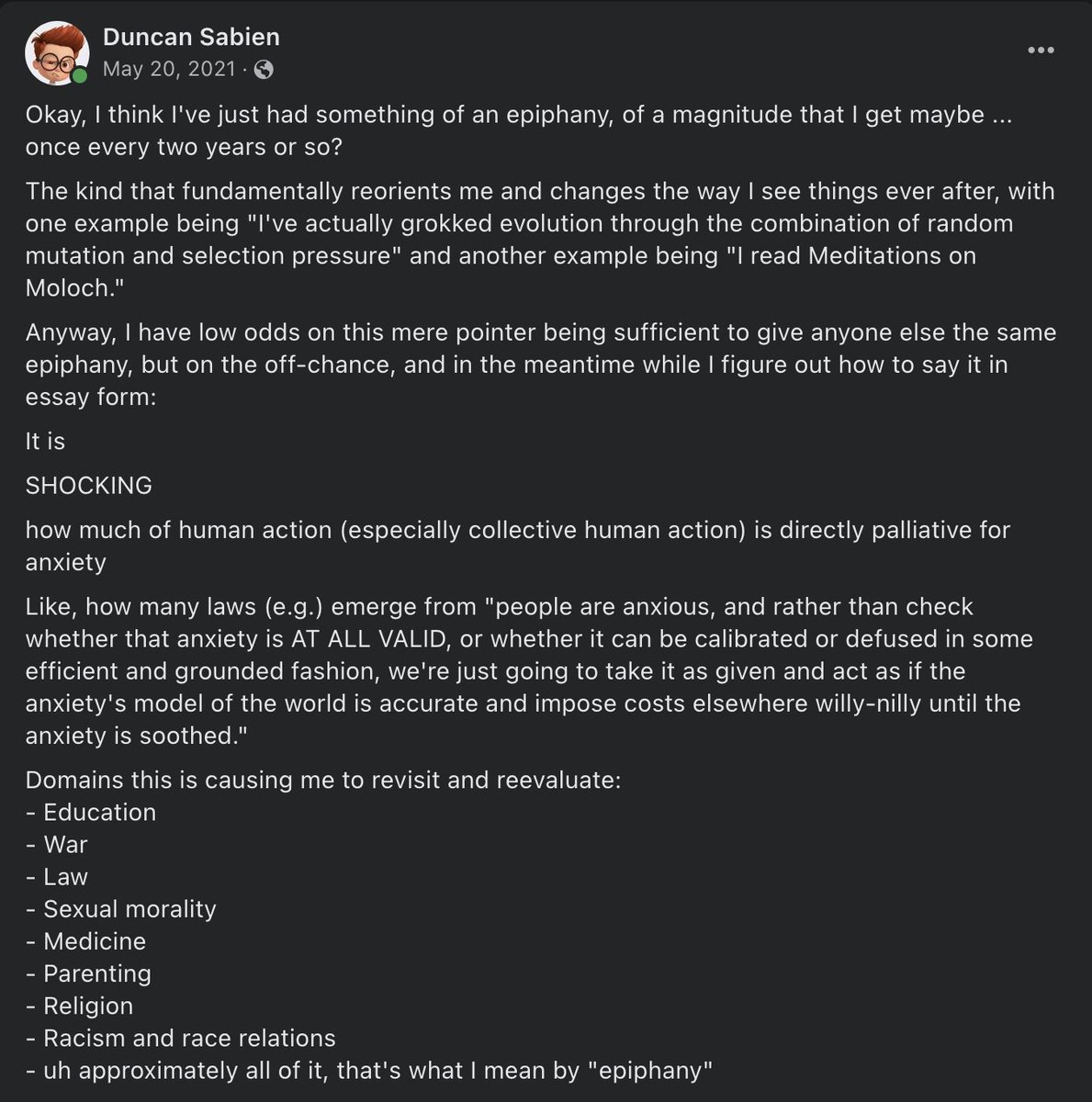
@RichardHanania Yay for self-awareness!
@RichardHanania [[@threadreaderapp unroll]]
Loading suggestions...