

Many of my friends who work at Corporate culture are fed up with their work life, one question they keep asking me is how much money do I need to retire and live comfortably? Here’s a short thread 🧵
We wanted to live the life to the fullest, travel around the world, spend more time with the loved ones, go on road trip with friends often. But to do that we should set a target of retirement corpus, once we achieve that we can retire.
How much that corpus should be?
How much that corpus should be?
The 4% Rule:
Willian Bengen in 1994 published a research paper that revolutionized the financial industry. As per his research, if you can withdraw an amount worth 4% of your portfolio every year, then for 30 years you can continue to withdraw without running out of money.
Willian Bengen in 1994 published a research paper that revolutionized the financial industry. As per his research, if you can withdraw an amount worth 4% of your portfolio every year, then for 30 years you can continue to withdraw without running out of money.
To figure out retirement corpus I need, here’s the calculation. Say my monthly expenditure is around 1 lac a month, then my annual spending is 12 lacs. As per William, I need to have a corpus of 25 times of my annual spending, so I should have 25 x 12 lacs, which is 3 Crores.
Considering if the corpus is invested in 50-50 debt n equity fund, Even if the withdrawal amount keeps increasing 3% every year considering inflation, still it would not run out of money.

NIFTY Next 50 index has delivered an annualized return of 17.2% as compared to 12.2% of NIFTY 50. So if we invest in both the index funds, average returns would be 14% which is much higher than our withdrawal percentage of 4%. Our corpus would continue to grow.
The Cross-over point rule:
There is another way to determine when you can retire. Vicki Robin and Joe Dominguez in their book Your Money or Your Life discussed a concept called the Crossover Point.
There is another way to determine when you can retire. Vicki Robin and Joe Dominguez in their book Your Money or Your Life discussed a concept called the Crossover Point.
This is the point When your monthly income cross your monthly expenses, which grants the financial freedom.
For example, if your monthly expense is 1 lac, once your investment can pay you more than 1 lac a month, then you have reached your crossover point.
For example, if your monthly expense is 1 lac, once your investment can pay you more than 1 lac a month, then you have reached your crossover point.
How do we find the amount of money required to reach this crossover point. Let’s call this amount as Crossover assets.
Crossover assets = Monthly Expenses / Monthly Returns
Crossover assets = Monthly Expenses / Monthly Returns
Let’s consider our investment portfolio generates 4% annual returns, so if we divide that then monthly returns will be 4%/12 = 0.33%. Our monthly expense is 1 lacs, so to get crossover assets, 1 lac divided by 0.33% which is 3 crores.
But if we can make just 12% per year, which is 1% per month, then the retirement corpus required is just 1 Crore which is 3 times lesser than what we say in 4% rule. This is mainly because the rate of our investment return we considered is 12%.

It’s not about Money:
Retirement is not just about having shitloads of money, sitting in Hawai beach and having a sip of beer. Kevin O’Leary from Shark Tank once said about his retirement after selling his first company at the age of 36.
Retirement is not just about having shitloads of money, sitting in Hawai beach and having a sip of beer. Kevin O’Leary from Shark Tank once said about his retirement after selling his first company at the age of 36.
“I retired for three years. I was bored out of my mind. Working is not just about money. People don’t understand this very often until they stop working. Walk defines who you are. It provides a place where you are social with people.
It gives you interaction with people all day long in an interesting way. It even if you live longer and is very, very good for brain health”
The moment you stop working, it takes away your identify. You will be in a lonely world. For a year or two, you many enjoy your early retirement life, but then your mind wanders.
When a founder sells his startup, there is a higher probability that he might end up as a serial entrepreneur. Once an entrepreneur you are always an entrepreneur, people always want to get occupied with something that makes them happy and exciting.
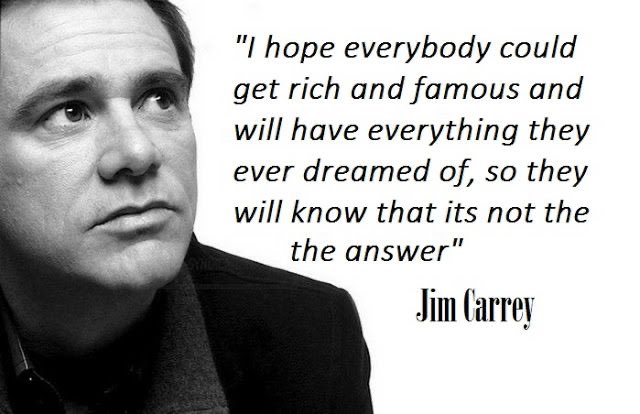
So you should not need to figure out how much you need to retire early, you need to figure out what are you going to do after you retire. Or else you might be utterly disappointed once you reach the other end of the spectrum. Jim Carrey really summed it up well.
I have learnt the above information from the book “Just Keep Buying” by Nick Maggiulli @dollarsanddata. Here’s the link to detailed article squareoff.in
Loading suggestions...