
Short 🧵 on mālikī Imām at-Talamanki's stance in regards to tashbīh and sifāt
The followers of kalām are still under the illusion that affirming attributes (haqiqatan), and without distorting the meaning, must necessitate tashbīh
This, despite ʾaʾimma clearly stating otherwise
The followers of kalām are still under the illusion that affirming attributes (haqiqatan), and without distorting the meaning, must necessitate tashbīh
This, despite ʾaʾimma clearly stating otherwise
The ʾaʾimma referred to in the initial tweet are the likes of Isḥāq bin Rāhwayh, adh-Dhahabī, Ibn Baṭṭah, Ibn khuzayma, Abū Naṣr al-Sijzī, Ibn Shaqla and others
However, at-Talamanki's assessment is rather an interesting one aswell as he relates this to the arabic language
However, at-Talamanki's assessment is rather an interesting one aswell as he relates this to the arabic language
He starts of by mentioning the consensus among the believers that Allāh is above His throne while citing 57:4 (and He is with you wherever you are) as to indicate that despite Him being above as He wills, He is still close to us as nothing escapes His knowledge
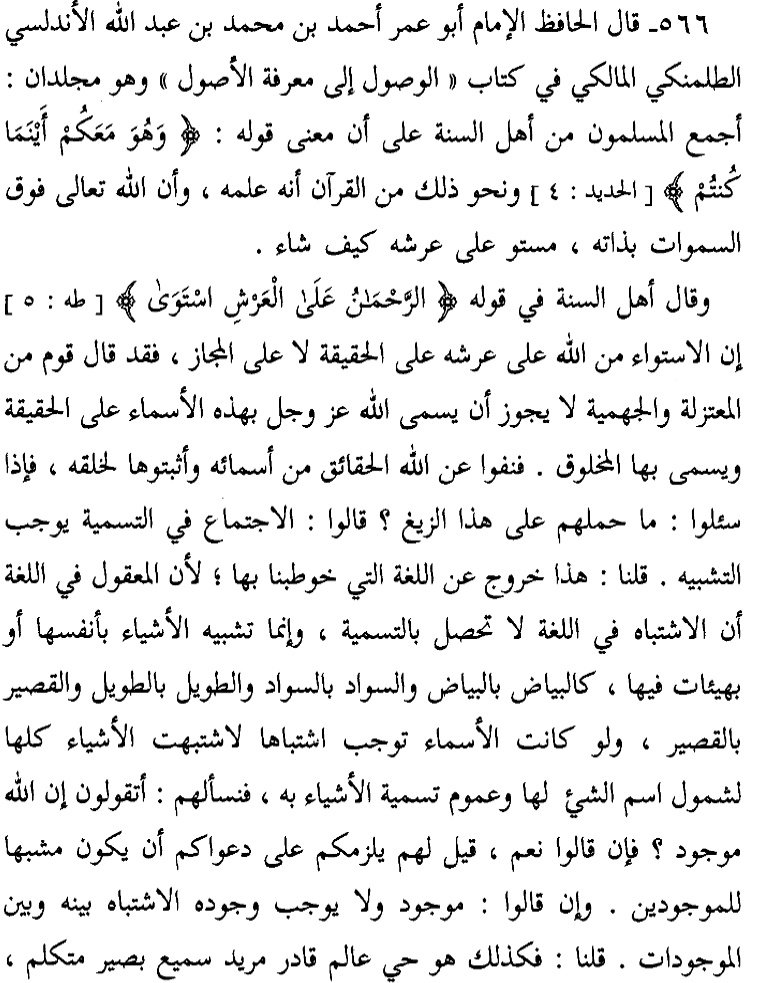
To which he added that this attribution of istiwāʾ i.e. ascension is one, according to ahl as-sunnah, of a real 'attribute' rather than something figuratively
He cited the following verse 20:5 to strengthen his position: "The Most Merciful [who is] above the Throne established"
He cited the following verse 20:5 to strengthen his position: "The Most Merciful [who is] above the Throne established"
He then said:"Some from the muʿtazilites and jahmiyyah said it's impermissible to name Allāh as such in a real sense and (they'd) rather name His creation as such. Therefore negating these realities from Allāh and (solely) affirming them for the creation"
He continued by saying: "If they were to be, then, asked what led them to such a devation then they'd say: 'Concurrence in this necessitates tashbīh'
(To which) we say: "This is a departure from the very language (arabic) with which we have been addressed with"
(To which) we say: "This is a departure from the very language (arabic) with which we have been addressed with"
This, because tashbīh only, reasonably that is, occurs when one delves into the essence instead of solely using the 'linguistical terminology'
Such would be the case with resembling (the color) white with white, black with black, (or) short with short and tall with tall
Such would be the case with resembling (the color) white with white, black with black, (or) short with short and tall with tall
He continued: "Had it actually been that solely using (linguistic) names would result to tashbīh, then by definition everything would have been similar (in its essence) as everything falls under the label of a thing (shay)"
To which he concluded: "If we, then, would ask them if Allāh exists, and they'd answer with yes then we would then argue that they then have to follow their own principle (i.e. remain consistent) in this (by believing that linguistic similarity necessitates tashbīh)
"If they then argue that the existence of Allāh is dissimilar to the existence of His creation then likewise we shall argue the same as He is: Alive, Knowing, Speaking, Hearing, Seeing and this does not necessitate tashbīh due to others having similar (to a degree) attributes"
Loading suggestions...