

🧵The Corpus Juris Civilis of the Emperor Justinian I: A Brief Summary of Some Civil Laws in the Byzantine Empire – Criminal law and punishments 👨⚖️
Continuing with the series on Justinian’s Corpus Juris Civilis, we will now look at some laws concerning crime and punishment.
While many modern/liberal Christians tend to oppose harsh penalties for certain crimes, Christians in antiquity did not & were in fact supportive of harshness against criminals, including applying the death penalty.
Concerning “public prosecutions”, the “Institutiones” states that some crimes are capital crimes and others are not. Book 3, Title XVIII states that death can be inflicted by “water and fire”. Other penalties could be “deportation” and “hard labour” (#link2H_4_0102" target="_blank" rel="noopener" onclick="event.stopPropagation()">gutenberg.org).

1. One capital crime was, of course, treason. The penalty was death.

2. So too were ADULTERY and HOMOSEXUALITY. The crime of “seducing virgins” without the use of “violence” was punished with “flogging” and “relegation”; however, if the criminal was “of reputable condition”, the punishment was “confiscation of half his fortune”.

See below for more laws from the “Novellae” concerning homosexuality (#6).
3. The death penalty also applied to assassins, “poisoners”, practitioners of “magic”, and those who “publicly sell deadly drugs”.
3. The death penalty also applied to assassins, “poisoners”, practitioners of “magic”, and those who “publicly sell deadly drugs”.

4. The crimes of “parricide” (killing a parent) & infanticide were to be punished w/ death, but not by “sword” or “fire”. Rather, the perp would be “sewn up in a sack with a dog, a cock, a viper, & an ape” (!) & then thrown into the sea. Talk about "cruel & unusual punishment"!

5. The crime of forgery had different penalties depending on whether the criminal was a slave or a free person. If a slave, the penalty was death. If a free man, the penalty was “deportation”.

6.Coming back to homosexuality, we already saw that it was punished with death. This is emphasized again in the “Novellae”. Book 77 states that those who “commit crimes contrary to nature” (i.e., homosexuality) (see also Book 141) are to be killed.
The same was applied for those who “utter blasphemous words”. They too are to be killed (droitromain.univ-grenoble-alpes.fr).
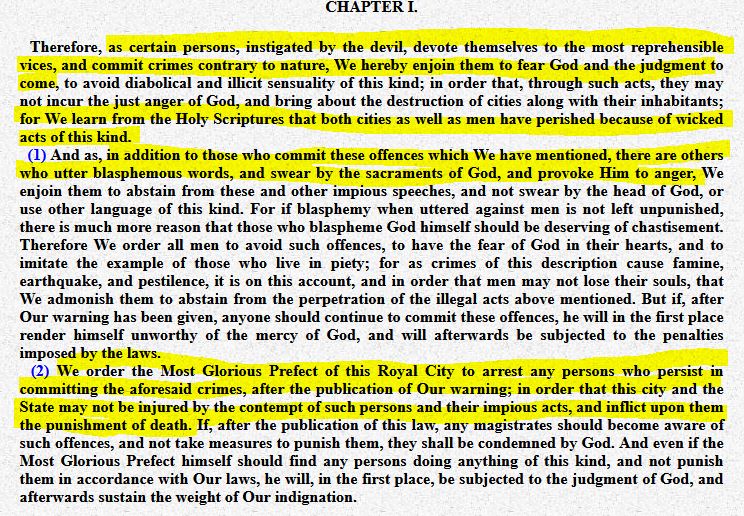
Thus, “freedom of speech” or “expression” were not recognized as “human rights” by Christians. Neither were sexual acts like adultery & homosexuality. Isn't it interesting and convenient how different modern Christianity has become?
This concludes the thread on criminal laws. In the final thread, I will provide some miscellaneous laws concerning topics like slavery, taxation of provinces, etc., insha’Allah.
Loading suggestions...