

Let's talk about on-page SEO and how I structure content.
I'm not an "expert" on this, but what I'm doing is working, and I've been following this exact format for over 2 years.
It resulted in 521,700 sessions last month.
Here's exactly what I do…
I'm not an "expert" on this, but what I'm doing is working, and I've been following this exact format for over 2 years.
It resulted in 521,700 sessions last month.
Here's exactly what I do…

NOTE: my site is almost entirely informational posts and I have a TON of "how-to" posts so I'll model my example off of that…
Let's use "Honda Won't Start" as our keyword.
I always title my post, and make the URL the exact keyword.
So, something like: "Honda Won't Start (Avoid Doing THIS!) "
I always title my post, and make the URL the exact keyword.
So, something like: "Honda Won't Start (Avoid Doing THIS!) "
I'll then intro the post with about 50 - 60 words of content.
This section is simply stating the problem and then letting the reader know you have the answer.
I end my "intro" with a Table of Contents that is "hidden" (the reader has to click "expand" to see the ToC)
This section is simply stating the problem and then letting the reader know you have the answer.
I end my "intro" with a Table of Contents that is "hidden" (the reader has to click "expand" to see the ToC)
I follow this up with my first heading, an H2.
In most cases, the H2 is my exact keyword.
So "Honda Won't Start".
Under the H2 is my 50 word Featured Snippet, all in bold text.
In most cases, the H2 is my exact keyword.
So "Honda Won't Start".
Under the H2 is my 50 word Featured Snippet, all in bold text.
So at this point:
1. The reader knows they are in the right place because you described their exact problem
2. They know you have a solution
3. You gave them the solution
1. The reader knows they are in the right place because you described their exact problem
2. They know you have a solution
3. You gave them the solution
I strongly believe this format builds a great deal of trust with your reader.
They know you respect them and aren't wasting their time.
They become invested in what you have to say and they read-on (I have an average time on page of 7 min 12 sec).
They know you respect them and aren't wasting their time.
They become invested in what you have to say and they read-on (I have an average time on page of 7 min 12 sec).
You might think, "well if I given them the answer right away, why would they keep reading?"
The reality is, in 90+% of cases, 50 words NEVER truly answers the question.
That requires depth, which I give them…
The reality is, in 90+% of cases, 50 words NEVER truly answers the question.
That requires depth, which I give them…
Now I add 5-10 H3s under my H2 of all the possible solutions.
So,
-Check battery life
-Make sure the gas tank is full
-Check the oil....
And of course under each H3 is a detailed write up of that solution, with pictures wherever applicable/useful.
So,
-Check battery life
-Make sure the gas tank is full
-Check the oil....
And of course under each H3 is a detailed write up of that solution, with pictures wherever applicable/useful.
I'll then add a few additional closely related/relevant H2s.
So maybe: "Things to avoid doing when your Honda won't start"
With more H3s under that...
etc.
So maybe: "Things to avoid doing when your Honda won't start"
With more H3s under that...
etc.
And finally I always end with a "Conclusion" H2.
This section is important and is often overlooked.
Your conclusion should FULLY summarize your entire post.
In theory it should be able to stand alone.
Use bullets!
This section is important and is often overlooked.
Your conclusion should FULLY summarize your entire post.
In theory it should be able to stand alone.
Use bullets!
Google will often take a section of my Conclusion for the Featured Snippet.
So don't waste a golden opportunity by finishing up lazy!
So don't waste a golden opportunity by finishing up lazy!
The conclusion looks something like:
"It's incredibly frustrating when you go to start your Honda, but it' won't start. Luckily there are several proved fixes:
-Solution 1
-Solution 2
-Solution 3
-Solution 4
-Solution 5"
"It's incredibly frustrating when you go to start your Honda, but it' won't start. Luckily there are several proved fixes:
-Solution 1
-Solution 2
-Solution 3
-Solution 4
-Solution 5"
I always create a custom featured image.
Featured images are often picked up in the SERPs and can help tremendously with CTR (click through rates).
If you see a photo that clearly depicts your problem, you're probably going to click on the post!
Featured images are often picked up in the SERPs and can help tremendously with CTR (click through rates).
If you see a photo that clearly depicts your problem, you're probably going to click on the post!
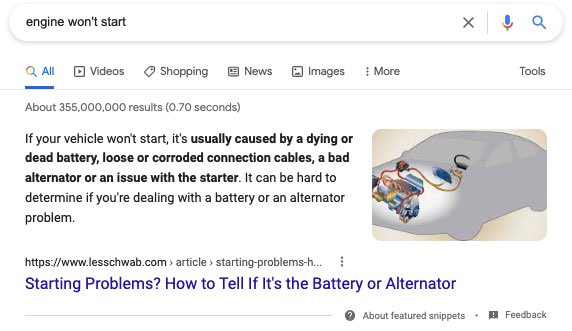
(Note: I got in the habit of adding the exact keyword as the alt text for the Featured Image. No idea how big an impact this has, but I'm not going to stop doing it 😂)
Finally I go through the post and add relevant external and internal links. Usually a few of each for every single post.
Always use credible, relevant sources for external links. Have your links open in a new page.
You don’t want readers leaving your site!
Always use credible, relevant sources for external links. Have your links open in a new page.
You don’t want readers leaving your site!
Internal linking have always been fairly easy for me because I write most of my content so it’s not hard to remember what relevant posts of mine might be useful.
That's it. Pretty simple. Not overly complex.
Keep in mind there are many other ways to go about structuring your content, this way happens to be working wonders for me.
Keep in mind there are many other ways to go about structuring your content, this way happens to be working wonders for me.
PS: no I don't worry at all about the amount of times I used my keyword, or that I am using related keywords.
I mean I care of course, but if you do a great job writing the content, all of that will take care of itself!
If it doesn't, you probably didn't cover the topic well
I mean I care of course, but if you do a great job writing the content, all of that will take care of itself!
If it doesn't, you probably didn't cover the topic well
Loading suggestions...