
1) Even after 22 grand slam titles, the most in history, Rafa Nadal does not claim he is the greatest tennis player of all time.
Why? 🧵 stray-reflections.com
Why? 🧵 stray-reflections.com
2) “Because the moment I did, it would be all over. I’d be finished.”
And that, Nadal maintains, is the secret of his success.
And that, Nadal maintains, is the secret of his success.
3) “Look,” he says, “it’s also true that there are guys right at the very top who are super arrogant and are super sure of themselves.”
There isn’t only one way, clearly.
There isn’t only one way, clearly.
4) “But my way is this: when you believe that things are going to go your way just because you are who you are and because you are very good, that’s when you start to get careless, when you stop working hard, when you stop fighting for every point.”
5) “You lose your intensity and while things may go well for a while, because you’ve built up a positive momentum, it won’t last.”
6) “You drop your guard when you stop having doubts about yourself.
I’ve always had doubts.
I’ve never believed that I am very good, nor do I believe it now.”
I’ve always had doubts.
I’ve never believed that I am very good, nor do I believe it now.”
7) Nadal nurtured this mentality from an early age under the guidance of his uncle, Toni.
When he won the Spanish under-12s national championship, Toni read out a list of the title’s previous twenty-five winners.
Most of them did not go on to become world-class players.
When he won the Spanish under-12s national championship, Toni read out a list of the title’s previous twenty-five winners.
Most of them did not go on to become world-class players.
8) “So, Rafael, don’t get too excited about today’s victory,” he warned.
“There’s still a long, hard road ahead.”
“There’s still a long, hard road ahead.”
9) Winning his first Grand Slam at 19, as Nadal did at the French Open in 2005, was a special moment.
Rather than shower him with praise, Toni told Nadal that he was fortunate to win. His opponent had played a stronger game.
Rather than shower him with praise, Toni told Nadal that he was fortunate to win. His opponent had played a stronger game.
10) The next day, Toni left him a handwritten note outlining what he needed to improve if he ever wanted to win another major tournament.
11) “Toni was tough on me right from the start,” Nadal says.
“He demanded a lot of me, pressured me hard. He’d use rough language, he’d shout a lot, he’d frighten me. If I saw I’d be alone with him when I arrived for training, I’d get a sinking feeling in my stomach.”
“He demanded a lot of me, pressured me hard. He’d use rough language, he’d shout a lot, he’d frighten me. If I saw I’d be alone with him when I arrived for training, I’d get a sinking feeling in my stomach.”
12) But Nadal learned to endure and even enjoy the suffering.
“If he hadn’t made me play without water that day, singled me out for harsh treatment in that group of little kids, if I hadn’t cried as I did at the injustice and abuse, maybe I would not be the player I am today.”
“If he hadn’t made me play without water that day, singled me out for harsh treatment in that group of little kids, if I hadn’t cried as I did at the injustice and abuse, maybe I would not be the player I am today.”
13) Toni always stressed the importance of endurance.
“If you don’t learn that lesson,” Nadal admits, “you’ll never succeed as an elite athlete. That was what Toni taught me.”
“If you don’t learn that lesson,” Nadal admits, “you’ll never succeed as an elite athlete. That was what Toni taught me.”
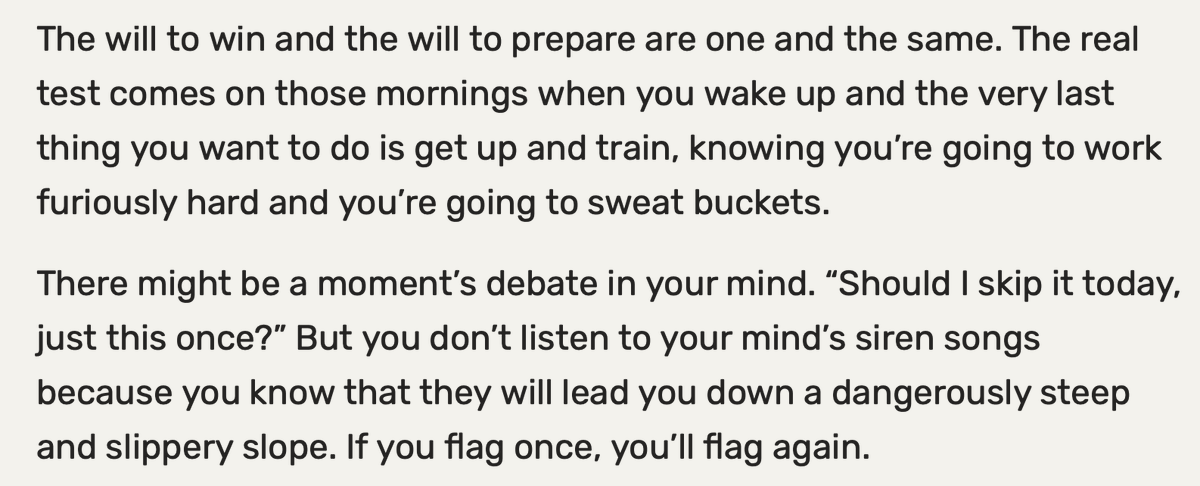
14) According to Nadal, the will to win and the will to prepare are one and the same.
15) “The numbers now say that you’re the best male Grand Slam player of all time. Do you feel like the best player of all time?” a reporter asks Nadal after winning.
“No,” responds Nadal. “I’m not going to change my point of view.”
Damn. 🏆
“No,” responds Nadal. “I’m not going to change my point of view.”
Damn. 🏆
Loading suggestions...