

COVID-19: Infection can reactivate cancer causing viruses
A study found that COVID-19 viral encoded proteins and some anti-COVID-19 drugs can induce reactivation of Kaposi’s sarcoma-associated herpesvirus (KSHV) ( nature.com ). H/T: @EnemyInAState 🧵1/
A study found that COVID-19 viral encoded proteins and some anti-COVID-19 drugs can induce reactivation of Kaposi’s sarcoma-associated herpesvirus (KSHV) ( nature.com ). H/T: @EnemyInAState 🧵1/
KHSV is one of the major human oncogenic viruses that belongs to the γ-herpesvirus subfamily and has two alternating life-cycle programs following primary infection in host cells. 2/
These are the latent phase where viral genomes persist but do not replicate and produce new virions where only a few latency-associated genes are expressed. In the lytic phases, almost all viral genes are expressed, followed by replication and release of mature virions. 3/
Both the viral latent and lytic KHSV proteins play a pivotal role in the initiation and progression of virus-associated cancers ( frontiersin.org ). 4/
Looking at the COVID-19 virus, both the spike (S) and nucleocapsid (N) proteins caused lytic reactivation in transfected cells and significantly increased the production of mature KSHV virions. 5/
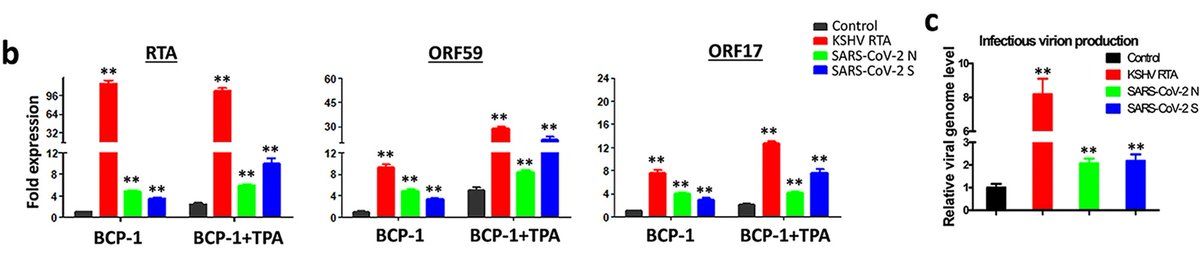
Their data indicates that COVID-19 virus has the potential to reactivate KSHV in latently infected cells through interaction with the ACE2 receptor. 6/
The study also looked at various drugs used for COVID-19 treatment (Azithromycin, Chloroquine diphosphate, Hydroxychloroquine sulfate, Nafamostat mesylate, Remdesivir, and Tocilizumab). 7/
It was found that Azithromycin (an antibiotic) and Nafamostat mesylate (a synthetic serine protease inhibitor) also induced reactivation. Both drugs promoted the production of mature virions. 8/
The seroprevalence of KSHV infection in the general population of the USA is less than 10% but in most of sub-Saharan Africa is more than 50%. 9/
There is a high prevalence of early childhood KSHV infection in some areas (can be transmitted through saliva) and KS has become one of the most common overall childhood cancers through central, eastern, and southern regions of Africa. 10/
The researchers conclude, "Our data indicate that those KSHV+ patients especially in endemic areas, exposure to COVID-19 or undergoing treatment may have increased risks to develop virus-associated cancers, even after they have fully recovered from COVID-19." 11/
Another study looked at reactivation of various herpes viruses after COVID-19 infection ( ncbi.nlm.nih.gov ). 12/
Patients with post-COVID manifestations presented with reactivations of:
42.6% = Epstein–Barr virus (EBV)
32.5% = EBV + Human Herpesvirus 6 (HHV6)
25.0% = HHV6
13/
42.6% = Epstein–Barr virus (EBV)
32.5% = EBV + Human Herpesvirus 6 (HHV6)
25.0% = HHV6
13/
Compared to controls, patients with virus reactivation presented with more frequent:
- fever
- headache
- psycho-neurological disorders
- pulmonary abnormalities
- myalgia
- activation of liver enzymes
- elevated CRP and D-dimer
- suppressed cellular immune response
14/
- fever
- headache
- psycho-neurological disorders
- pulmonary abnormalities
- myalgia
- activation of liver enzymes
- elevated CRP and D-dimer
- suppressed cellular immune response
14/
"Preliminary results indicate a likely involvement of reactivated herpes virus infections, primarily EBV infections in severe COVID-19 and the formation of the post-COVID syndrome." 15/
"Patients with the post-COVID syndrome and reactivation of EBV and HHV6 infections are at high risk of developing various pathologies, including rheumatologic diseases." 16/
Loading suggestions...