

ONDC is India’s plan to KILL the monopoly in e-commerce!
It’ll combine startups, big companies & local shops,
ONDC ⇒ Paytm + Google + Dunzo + Meesho + Flipkart + Amazon + kirana stores
But, what exactly is ONDC? And, how does it work?
Let’s find out! 🧵
It’ll combine startups, big companies & local shops,
ONDC ⇒ Paytm + Google + Dunzo + Meesho + Flipkart + Amazon + kirana stores
But, what exactly is ONDC? And, how does it work?
Let’s find out! 🧵
1/ What is ONDC?
ONDC = Open Network for Digital Commerce
Is a government of India initiative to connect all the e-commerce players into one network.
Rationale
Retail market = $1tr
Online retail market = $55bn, 5% of total market
ONDC wants to expand this beyond 5%.
(contd)
ONDC = Open Network for Digital Commerce
Is a government of India initiative to connect all the e-commerce players into one network.
Rationale
Retail market = $1tr
Online retail market = $55bn, 5% of total market
ONDC wants to expand this beyond 5%.
(contd)
How is ONDC similar to UPI?
ONDC is built on the success of UPI.
UPI is a network => banks + sellers + users. It is then plugged into
- payment platforms - GPay, PhonePe
- apps! - Paytm, Swiggy
ONDC similarly connects different e-commerce players into one network.
(contd.)
ONDC is built on the success of UPI.
UPI is a network => banks + sellers + users. It is then plugged into
- payment platforms - GPay, PhonePe
- apps! - Paytm, Swiggy
ONDC similarly connects different e-commerce players into one network.
(contd.)
Let's see how the ONDC model is different from the regular platform model
A) Platform model
Suppose, you use a platform like Amazon to buy a product online.
USER = You
PLATFORM = Amazon
SELLER = Retailer selling his product on Amazon
(contd.)
A) Platform model
Suppose, you use a platform like Amazon to buy a product online.
USER = You
PLATFORM = Amazon
SELLER = Retailer selling his product on Amazon
(contd.)
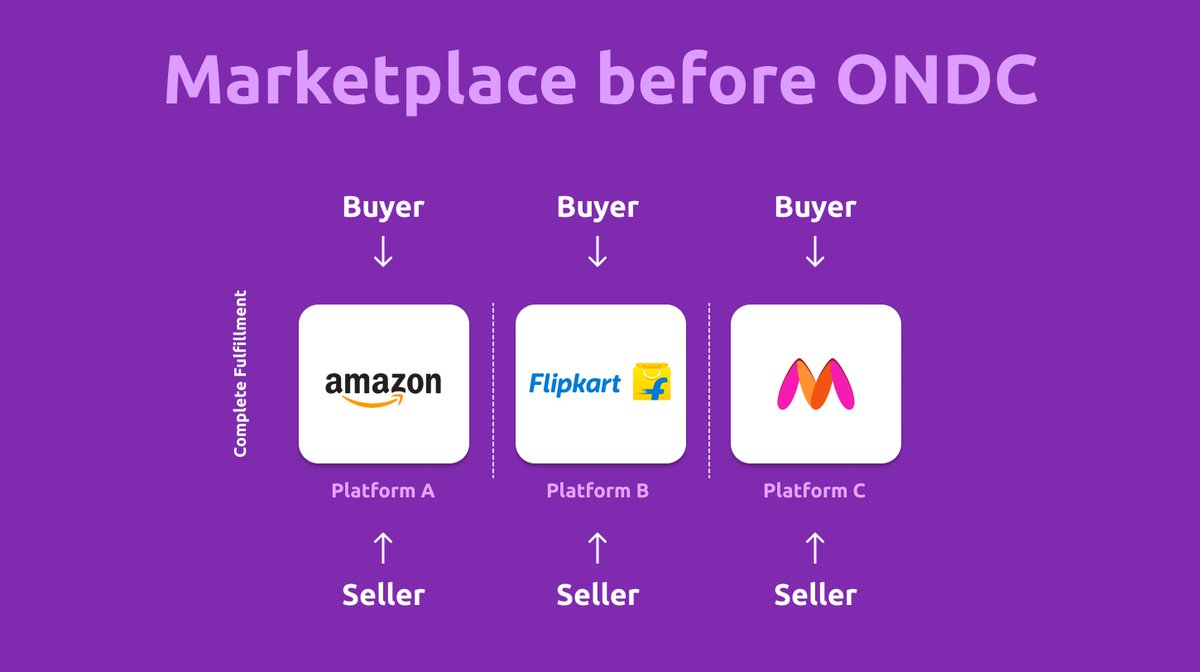
Here, the USER is connected with the SELLER via Amazon, a PLATFORM. So, all the steps like
- Discovering the product
- Order placement
- Shipping and Delivery
are fulfilled by Amazon.
So, this interaction happens in isolation and is enabled by a platform.
(contd.)
- Discovering the product
- Order placement
- Shipping and Delivery
are fulfilled by Amazon.
So, this interaction happens in isolation and is enabled by a platform.
(contd.)
B) ONDC model
ONDC breaks this platform dependency by creating a network that will onboard different players like
➝ Platforms - Amazon, Flipkart, Paytm, Swiggy
➝ Sellers - Retail stores and restaurants present on platforms
➝ Logistics - Dunzo, Goodwill
(contd.)
ONDC breaks this platform dependency by creating a network that will onboard different players like
➝ Platforms - Amazon, Flipkart, Paytm, Swiggy
➝ Sellers - Retail stores and restaurants present on platforms
➝ Logistics - Dunzo, Goodwill
(contd.)
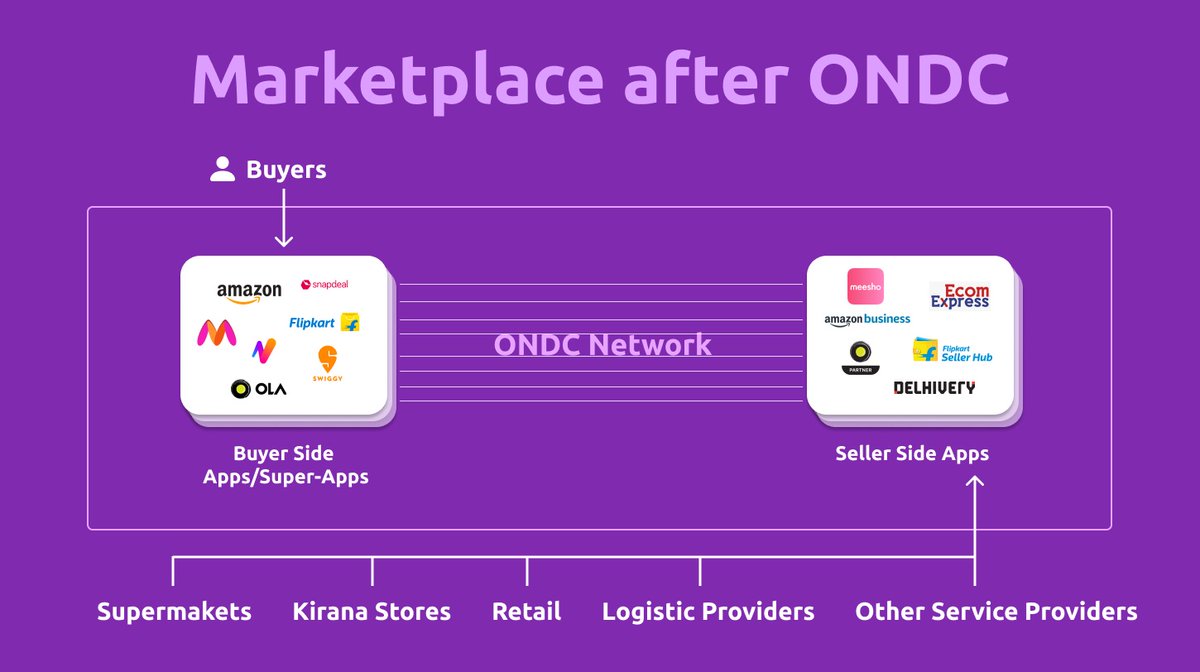
Now, once all these e-commerce players are onboarded on the network, ONDC does 2 things:
1) Unbundles their functions
2) Enables interoperability
Confusing, right? Let me explain in more detail.
In the previous example Amazon was performing a few different functions:
(contd.)
1) Unbundles their functions
2) Enables interoperability
Confusing, right? Let me explain in more detail.
In the previous example Amazon was performing a few different functions:
(contd.)
1. Brings the user
2. Onboards the seller
3. Connects them
4. Handles all the order details
5. Delivers the product
Now with ONDC, all these functions
➝ Unbundled - different parties fulfil different steps
➝ Interoperability - these parties all work together
(contd.)
2. Onboards the seller
3. Connects them
4. Handles all the order details
5. Delivers the product
Now with ONDC, all these functions
➝ Unbundled - different parties fulfil different steps
➝ Interoperability - these parties all work together
(contd.)
So for example,
- function 1 (get users) ➝ Amazon
- functions 2, 3, 4 (onboarding seller & handling the order) ➝ local retailer on say, E-Samudaay
- function 5 (delivery) ➝ Dunzo
I'll explain this more with an example.
But, let's first understand what ONDC is not!
(contd)
- function 1 (get users) ➝ Amazon
- functions 2, 3, 4 (onboarding seller & handling the order) ➝ local retailer on say, E-Samudaay
- function 5 (delivery) ➝ Dunzo
I'll explain this more with an example.
But, let's first understand what ONDC is not!
(contd)
2/ Is it a Super App?
Since ONDC is essentially "hosting" all these functions you are bound to wonder if it's actually a new Super App!
Well, the answer is NO!
- It's not a Super App
- Or, a platform
- Or, even an application
- It's not a mediator either
(contd.)
Since ONDC is essentially "hosting" all these functions you are bound to wonder if it's actually a new Super App!
Well, the answer is NO!
- It's not a Super App
- Or, a platform
- Or, even an application
- It's not a mediator either
(contd.)
Similar to UPI ONDC is simply facilitating interaction between different parties.
And, like UPI, it can be embedded into apps like Paytm.
So, when you open Paytm, you can access all the sellers on the ONDC network and not just the ones affiliated with Paytm!
And, like UPI, it can be embedded into apps like Paytm.
So, when you open Paytm, you can access all the sellers on the ONDC network and not just the ones affiliated with Paytm!
3/ So, in practice how will ONDC work?
1) Users usually have 2-3 popular apps like Paytm, Amazon, and Flipkart on their phones.
2) Say you log into Paytm to buy bread & 2 options appear
- local Kirana store - Rs. 40 (no delivery)
- BlinkIt - Rs. 120 (with delivery)
(contd.)
1) Users usually have 2-3 popular apps like Paytm, Amazon, and Flipkart on their phones.
2) Say you log into Paytm to buy bread & 2 options appear
- local Kirana store - Rs. 40 (no delivery)
- BlinkIt - Rs. 120 (with delivery)
(contd.)
3) You choose the Kirana store and now you need to choose a delivery service.
4) You go with Dunzo - Delivery rate = Rs. 30.
5) Total order = Rs. 70
6) Now, Dunzo's delivery guy picks up the bread from kirana store and delivers it to you.
(contd.)
4) You go with Dunzo - Delivery rate = Rs. 30.
5) Total order = Rs. 70
6) Now, Dunzo's delivery guy picks up the bread from kirana store and delivers it to you.
(contd.)
So, here:
Paytm ➝ brings the user
Kirana store ➝ provides the product
Dunzo ➝ delivers the product
All, three parties work in sync and the value created is also distributed accordingly.
But, what problems does ONDC aim to solve?
Well, let's get into it!
Paytm ➝ brings the user
Kirana store ➝ provides the product
Dunzo ➝ delivers the product
All, three parties work in sync and the value created is also distributed accordingly.
But, what problems does ONDC aim to solve?
Well, let's get into it!
4/ Goals
1) The main goal is to expand the market and onboard more mom & pop stores online
In the next 5 years, the aim is to increase
- GMV = INR 4.5 lakh crores ➝ INR 7.5 lakh crores
- Total retailers = INR 20 lakhs ➝ INR 40 lakhs
- Buyers = 9 Cr ➝ 20 Cr
(contd.)
1) The main goal is to expand the market and onboard more mom & pop stores online
In the next 5 years, the aim is to increase
- GMV = INR 4.5 lakh crores ➝ INR 7.5 lakh crores
- Total retailers = INR 20 lakhs ➝ INR 40 lakhs
- Buyers = 9 Cr ➝ 20 Cr
(contd.)
2) Remove dependency on players like Amazon and Flipkart that cover the majority of the e-commerce market share.
This will allow retailers to go online on their own terms without adhering to marketplace rules set by big players and still reach a huge volume of users.
(contd.)
This will allow retailers to go online on their own terms without adhering to marketplace rules set by big players and still reach a huge volume of users.
(contd.)
3) Take the power away from aggregators like Amazon, who often replicate popular products to sell under its own retail brand.
4) Help niche retailers get discovered quickly online without having to worry about setting up a delivery/logistics system and attracting customers.
4) Help niche retailers get discovered quickly online without having to worry about setting up a delivery/logistics system and attracting customers.
5/ So, will ONDC be the next UPI?
UPI was a resounding success.
In 5 years, the volume of transactions via UPI went from 2.38 lakhs in 2016 to 10 lakh crores in 2022!
ONDC is basically UPI on steroids and it leverages the same systems that make UPI so successful.
(contd.)
UPI was a resounding success.
In 5 years, the volume of transactions via UPI went from 2.38 lakhs in 2016 to 10 lakh crores in 2022!
ONDC is basically UPI on steroids and it leverages the same systems that make UPI so successful.
(contd.)
But, ONDC aims to deal with big players like Amazon, Flipkart, Zomato, and Paytm who all want to maximise their own profits.
These large players will bring in the bulk of users and can afford competitive prices and discounts.
So, they clearly have some advantages.
(contd.)
These large players will bring in the bulk of users and can afford competitive prices and discounts.
So, they clearly have some advantages.
(contd.)
It's still unclear how participating in a large-scale system like ONDC will change these companies.
On top of that, we are also not sure how ONDC plans to list products for a search query.
Ultimately, one product will be ranked higher than others in the results.
(contd.)
On top of that, we are also not sure how ONDC plans to list products for a search query.
Ultimately, one product will be ranked higher than others in the results.
(contd.)
So, for a small retailer will ONDC become a larger, more impossible landscape they have to compete in?
There are a lot of questions that'll only be answered after the pilot run is over.
We are waiting to learn more & see if ONDC actually changes e-commerce for the better!
There are a lot of questions that'll only be answered after the pilot run is over.
We are waiting to learn more & see if ONDC actually changes e-commerce for the better!
If you liked what you read,
1) Give us a follow
2) Retweet the first tweet :)
1) Give us a follow
2) Retweet the first tweet :)
Loading suggestions...