

1/n Important Thread!
The Islamic world needs to introspect and draw serious lessons from past.
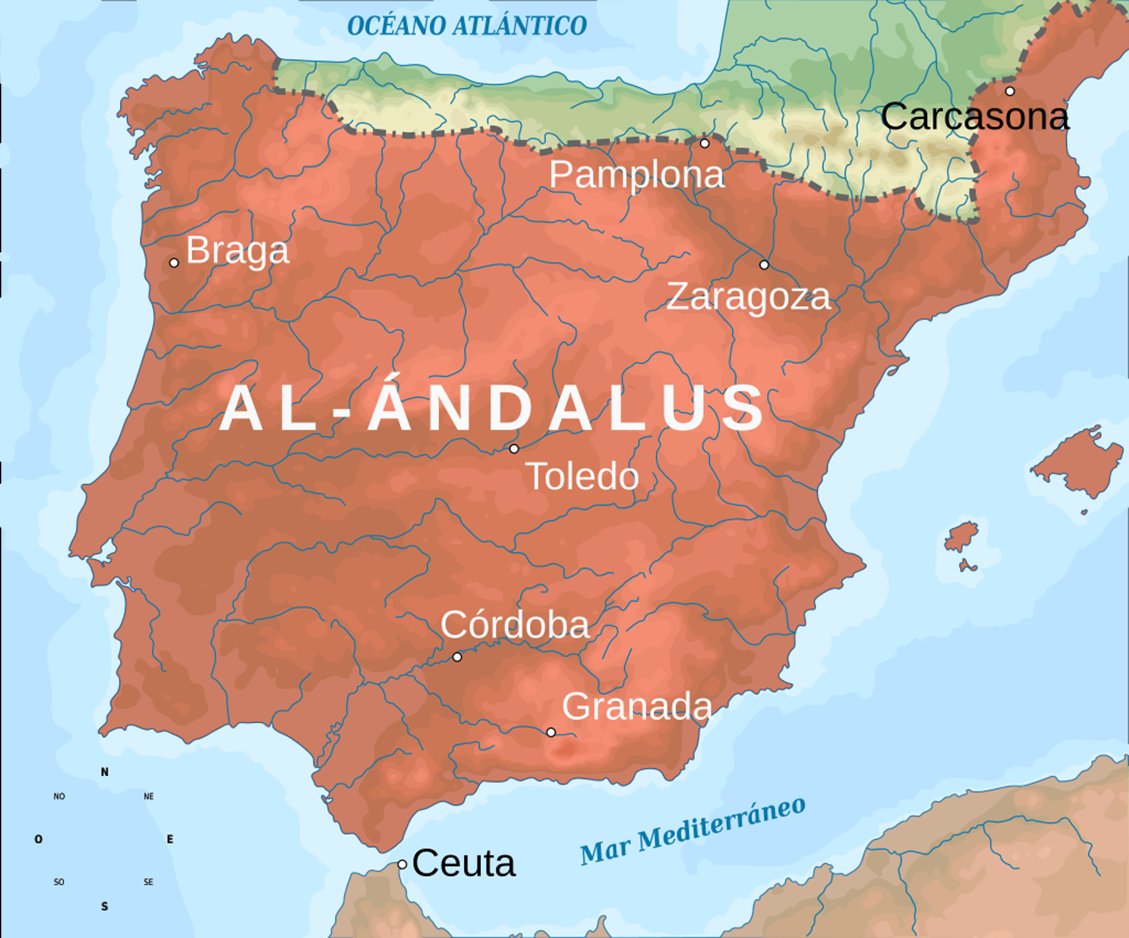
The Muslim Population fell from 5.5 Millions to 0.5-0.6 Millions between 12th to end of 15th Century in Iberian Peninsula (Al-Andalus).
The Islamic world needs to introspect and draw serious lessons from past.
The Muslim Population fell from 5.5 Millions to 0.5-0.6 Millions between 12th to end of 15th Century in Iberian Peninsula (Al-Andalus).
2/n Most of the Islamist including the likes of Owaisi brothers live with the myth that Islamic forces have never been given bloody nose, but the case of Al-Andalus gives a different story.
Let's look at the tale briefly.
Let's look at the tale briefly.
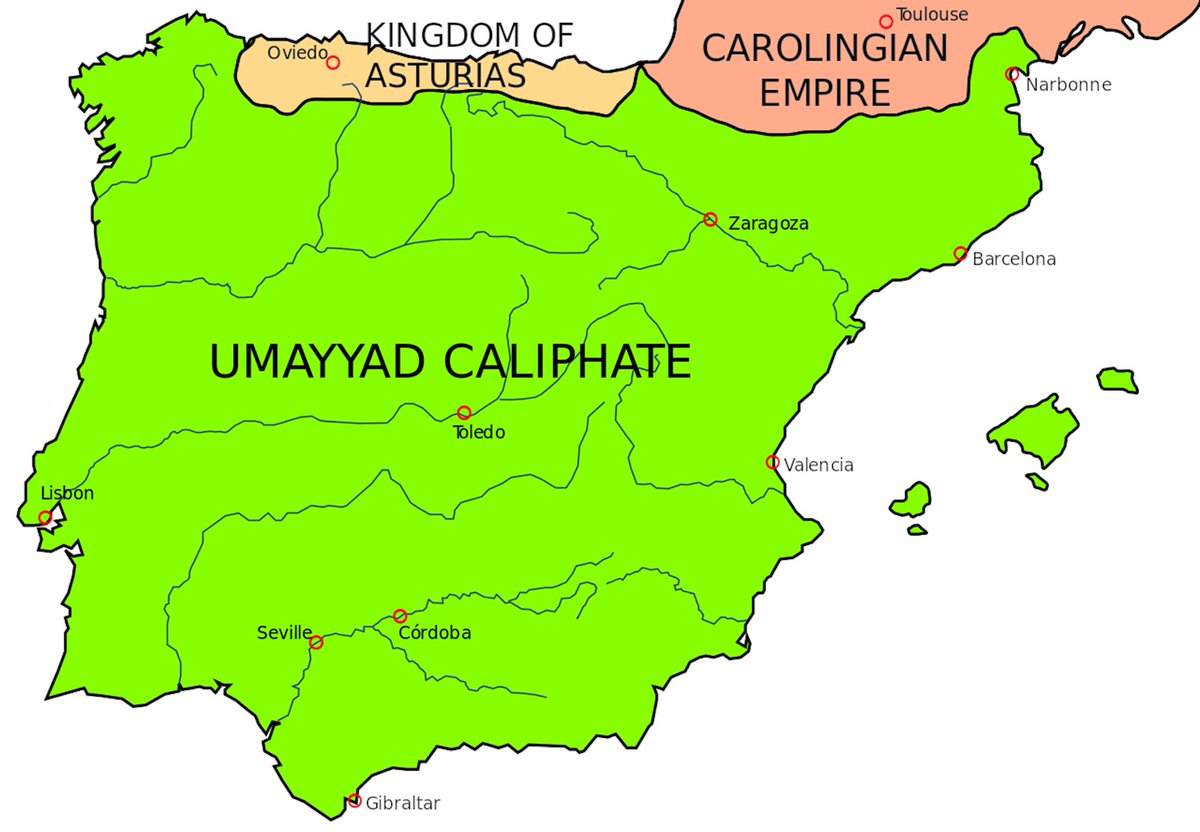
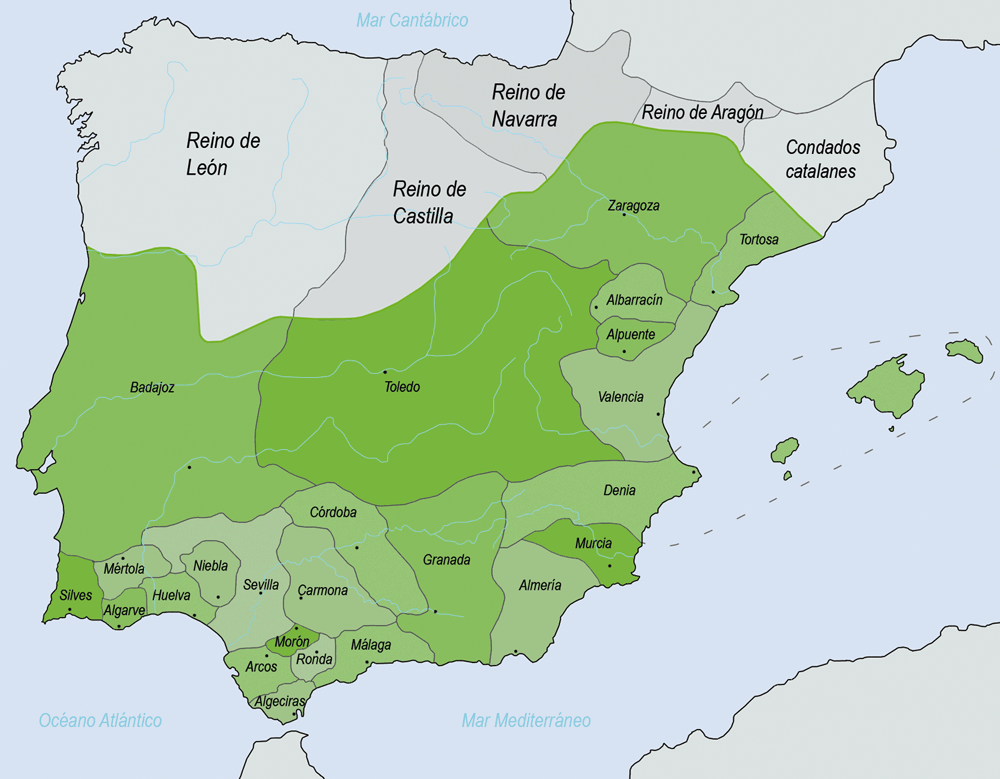
3/n Muslim army of Moors from North Africa under the leadership of Tariq ibn-Ziyad invaded in 711 AD& conquered most of the Iberian Peninsula ( Visigothic Christian Kingdom) by 719 AD, bringing under Islamic rule.
Source: "Cordova" The Catholic Encyclopaedia. Vol. 4
Source: "Cordova" The Catholic Encyclopaedia. Vol. 4

4/n The Iberian Peninsula was called Al-Andalus by its Muslim rulers.
With the deposition of Umayyad caliphs in Damascus (750 AD) the dynasty relocated to Córdoba.
With the deposition of Umayyad caliphs in Damascus (750 AD) the dynasty relocated to Córdoba.
5/n And Iberia began the governance of sharīʿa which had:
A) Capital punishment for Blasphemy and apostasy.
B)A Muslim's offspring by default is a Muslim & shall be guilty of apostasy if they proclaim any faith.
Source:Handbook of Leaving Religion, Ch-7, Christine Schirrmacher
A) Capital punishment for Blasphemy and apostasy.
B)A Muslim's offspring by default is a Muslim & shall be guilty of apostasy if they proclaim any faith.
Source:Handbook of Leaving Religion, Ch-7, Christine Schirrmacher
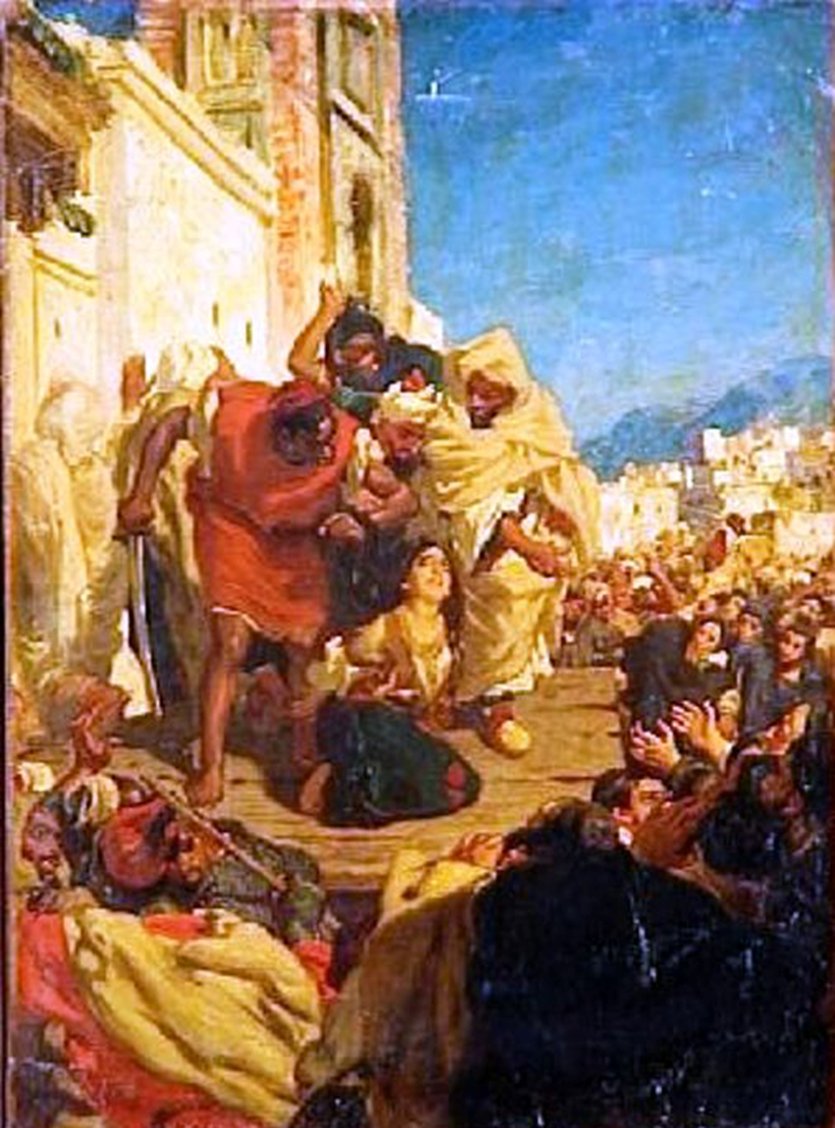
6/n Death penalty existed for blasphemy or apostasy.
Source: Christian Martyrs Under Islam: Religious Violence and the Making of the Muslim World by Christian C. Sahner, pg 1-28
Source: Christian Martyrs Under Islam: Religious Violence and the Making of the Muslim World by Christian C. Sahner, pg 1-28
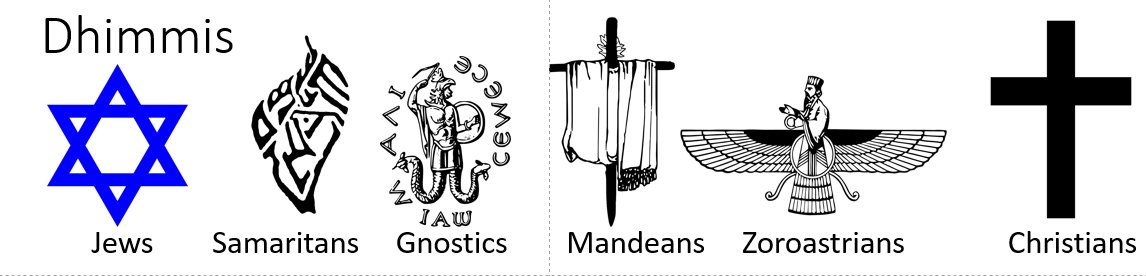
7/n Dhimmis under Caliphate were subjected to the status of being inferior than Muslims.
They could retain churches and property on condition of paying jizya and kharaj for each & this kept increasing from time to time by the Caliph.
They could retain churches and property on condition of paying jizya and kharaj for each & this kept increasing from time to time by the Caliph.
8/n Sources for 7/n:
A)Islam and Dhimmitude: Where Civilizations Collide, by Bat Yeʼor, Baṯ Ye'ôr, Bat, pg 33-80
B)The Jews of Arab Lands by Norman A. Stillman, Pg 22-28
C)A History of the Crusades, Volume 1 by Steven Runciman, pg 20-37
A)Islam and Dhimmitude: Where Civilizations Collide, by Bat Yeʼor, Baṯ Ye'ôr, Bat, pg 33-80
B)The Jews of Arab Lands by Norman A. Stillman, Pg 22-28
C)A History of the Crusades, Volume 1 by Steven Runciman, pg 20-37
9/n Dhimmis were prohibited from public display their faith & the violation was considered an act of blasphemy punishable by death penalty.
Facing the persecution many Christians fled either to the Christian kingdoms in Northern Spain or took refuge in the monasteries of Sierras.
Facing the persecution many Christians fled either to the Christian kingdoms in Northern Spain or took refuge in the monasteries of Sierras.
10/n Seeing no options left, few converted to Islam in order to avoid Jijya, and with time the number of Christians in Al-Andalus shrunk to very small percent.
Source: Manuel Osuna Garcia. "Cordova." The Catholic Encyclopaedia. Vol. 4
Source: Manuel Osuna Garcia. "Cordova." The Catholic Encyclopaedia. Vol. 4
11/n Rebellions against the atrocities by the caliph had begun a routine practice.
In 807 AD, Amrus ibn Yusuf crushed a rebellion in Tudela wherein around 700 city notable Christians were massacred in a ditch.
In 807 AD, Amrus ibn Yusuf crushed a rebellion in Tudela wherein around 700 city notable Christians were massacred in a ditch.
12/n The executions began a prolonged tension not only between Muslims and Christians.
As a retort Abd al-Rahman-II (822-852 AD)ordered the detention of the Christian Clerics of Córdoba.
Soon the rebellion began to subside the clergies were released in 851 AD.
As a retort Abd al-Rahman-II (822-852 AD)ordered the detention of the Christian Clerics of Córdoba.
Soon the rebellion began to subside the clergies were released in 851 AD.
13/n Source for 12/n : Christian Martyrs in Muslim Spain by Kenneth Baxter Wolf, Chapter-1
But things again changed 1851 onward.
Again the protests against the Islamic imposition resumed and the Emir again thought of using Christian Leaders to control it.
But things again changed 1851 onward.
Again the protests against the Islamic imposition resumed and the Emir again thought of using Christian Leaders to control it.
14/n This time, they were not imprisoned but instructed to craft strategy to contain the dissenters.
The choice was clear that either Christians stop the public dissent or lose jobs, face economic hardships and face other harassment.
The choice was clear that either Christians stop the public dissent or lose jobs, face economic hardships and face other harassment.
15/n Abd-al Rahman-II died in 852 AD and his son Muhammad-I took his place. He removed all Christian Office bearers from the Royal Appointments.
Sources:
A)Christian Martyrs in Muslim Spain by Kenneth Baxter Wolf, Chapter-1
Sources:
A)Christian Martyrs in Muslim Spain by Kenneth Baxter Wolf, Chapter-1
16/n B)The Martyrs of Córdoba: Community and Family Conflict in an Age of Mass Conversion By Jessica A. Coope, pg 33
Between 850-59 AD, 48 Christian Monks were martyred (decapitated) in Córdoba for announcing their apostasy publicly and blaspheming against the prophet.
Between 850-59 AD, 48 Christian Monks were martyred (decapitated) in Córdoba for announcing their apostasy publicly and blaspheming against the prophet.
17/n Source: Christian Martyrs in Muslim Spain by Kenneth Baxter Wolf, Chapter-2
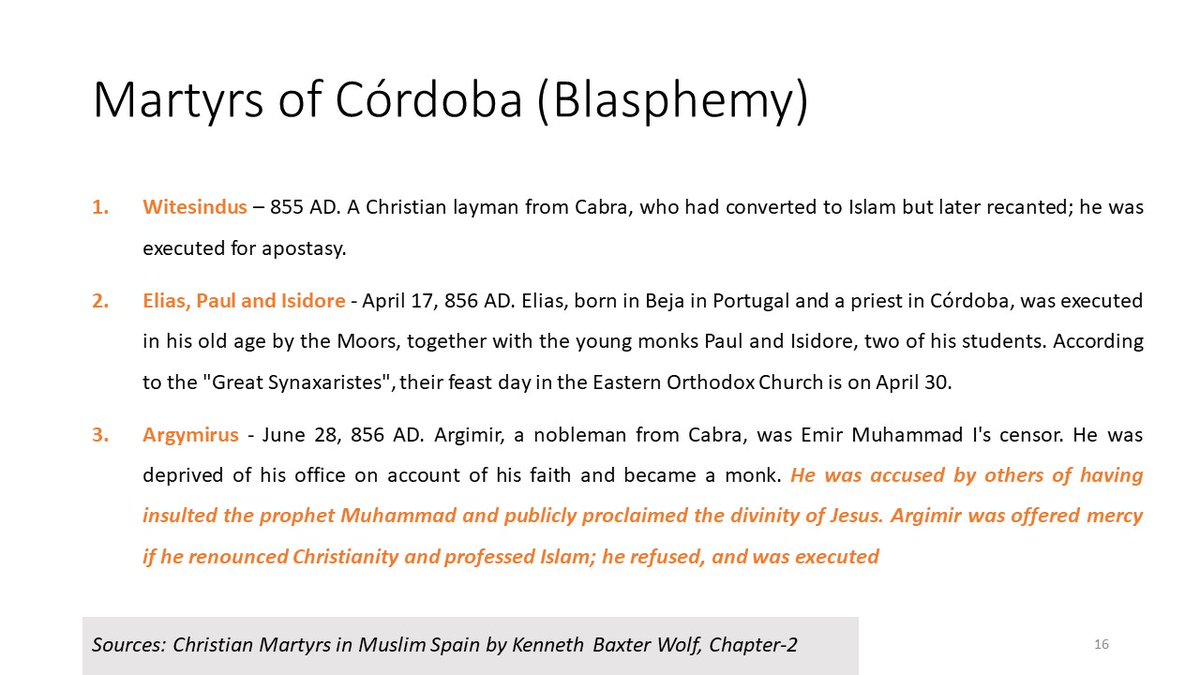
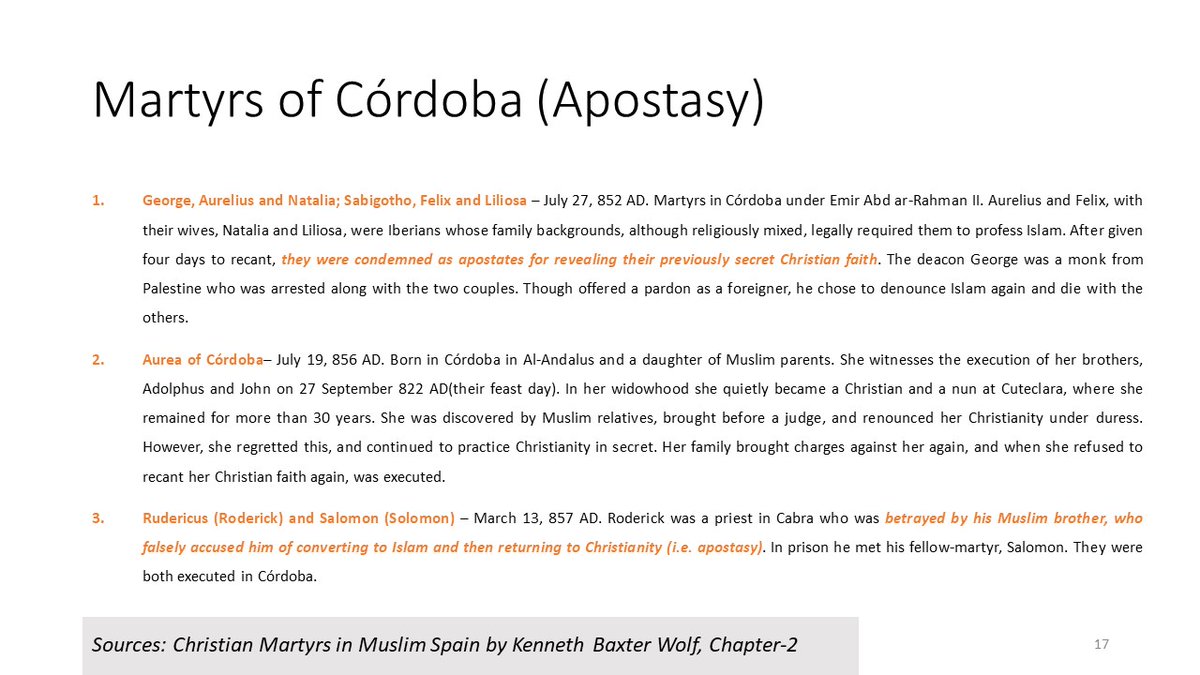
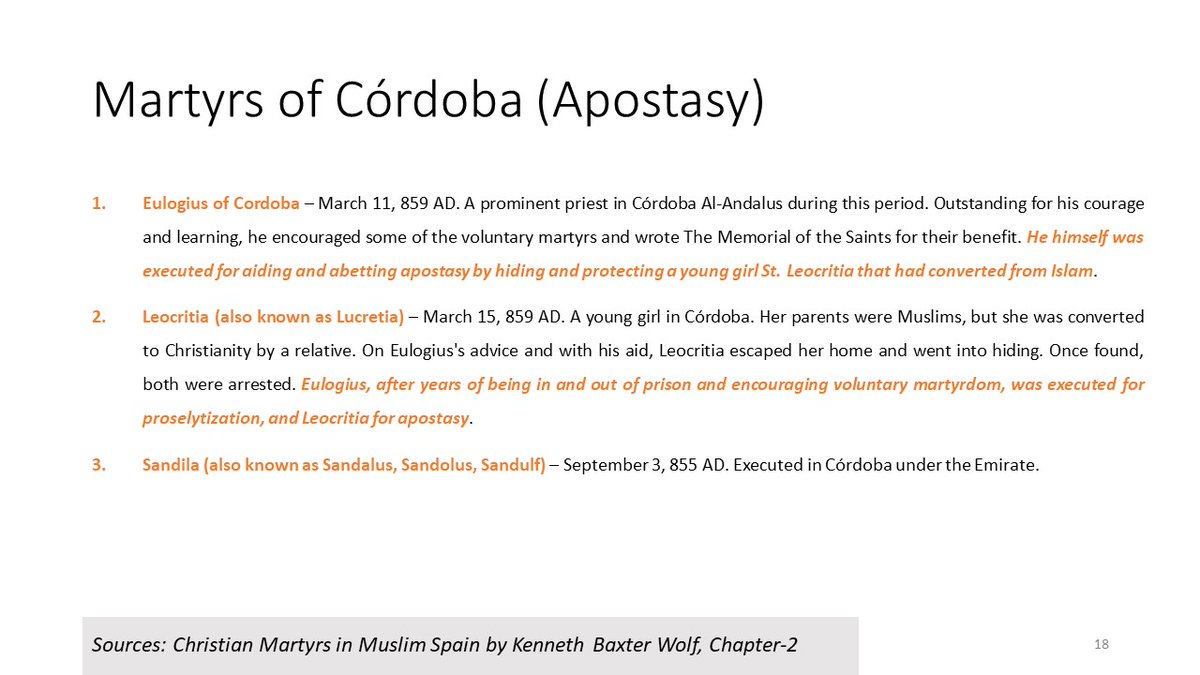
Image 2,3,4 shows the list of Martyrs with the kind of blasphemy.
Image 2,3,4 shows the list of Martyrs with the kind of blasphemy.
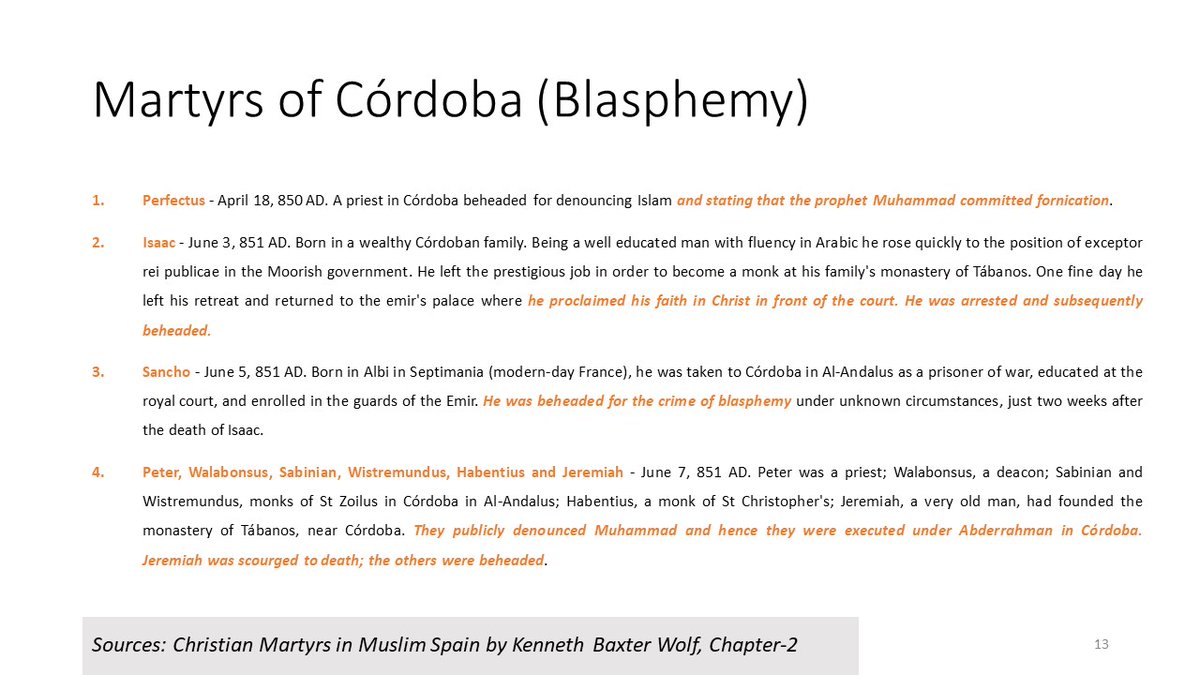
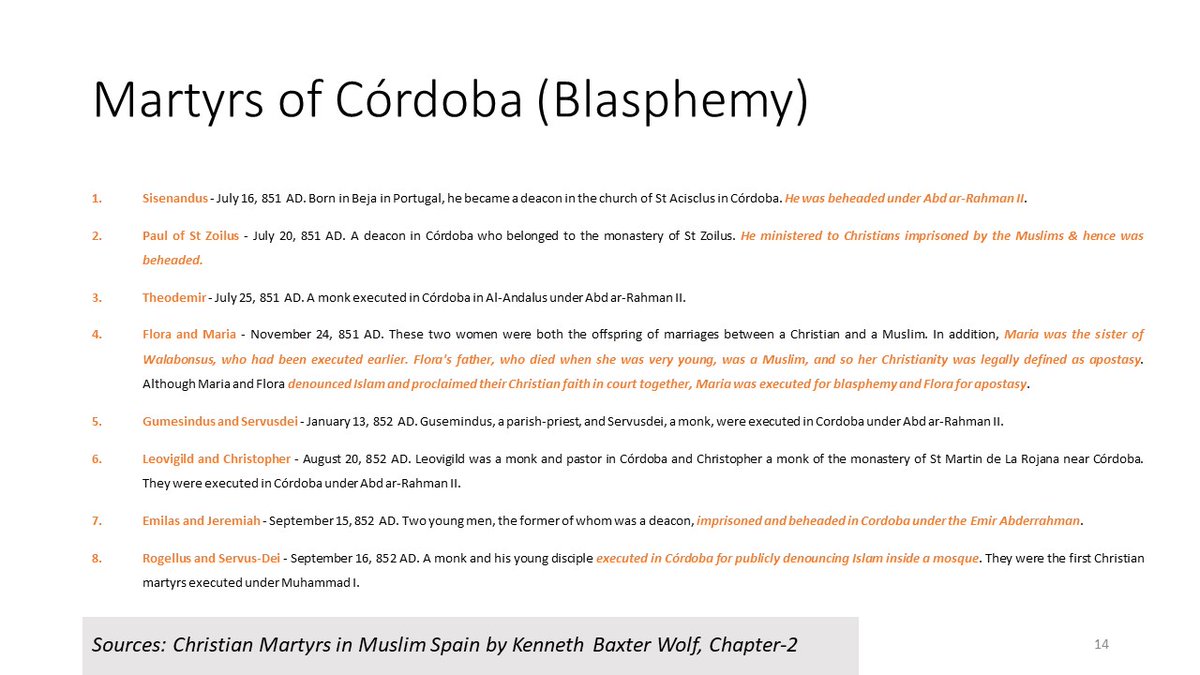

18/n These images shows the list of Martyrs with details of Blasphemy and Apostasy.
19/n I must not forget to mention of the Uprisings of Rabada (818 AD) and how Al-Hakam-I ravished the suburbs to control the growing rebellion.
The Rebellion was against the intolerant policies of Al-Hakam I.
The Rebellion was against the intolerant policies of Al-Hakam I.
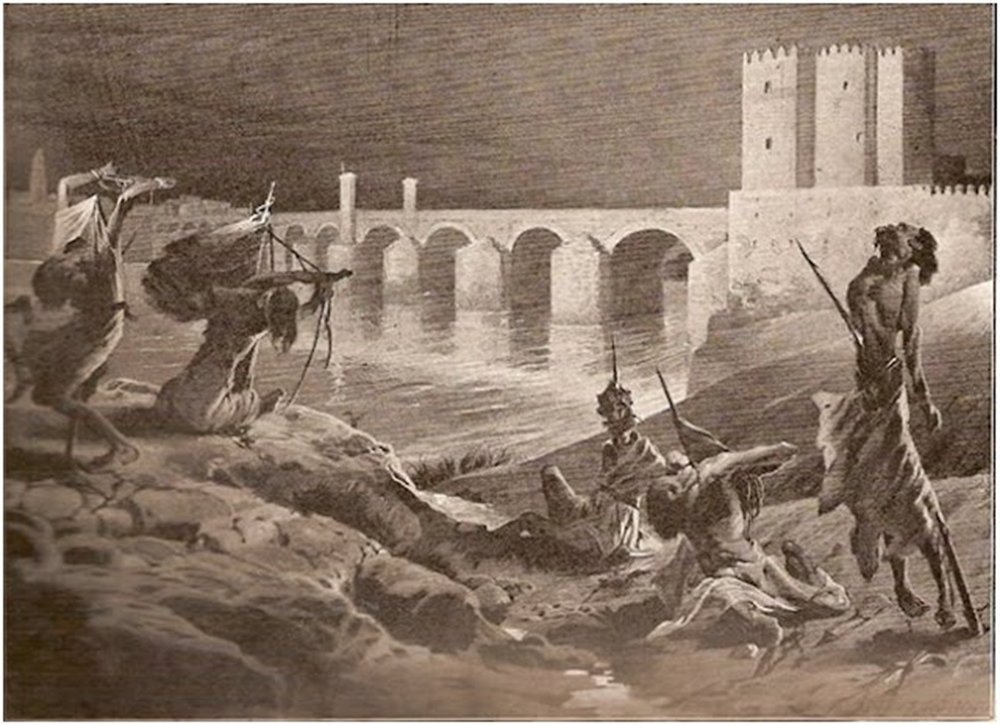
20/n Al-Hakam ordered ruthless crushing of the Rebellion and around 300 leaders were crucified on the south bank of the Guadalquivir river.
The surviving insurgents were expelled from Córdoba and al-Andalus and Rabad was ordered to be razed.
The surviving insurgents were expelled from Córdoba and al-Andalus and Rabad was ordered to be razed.
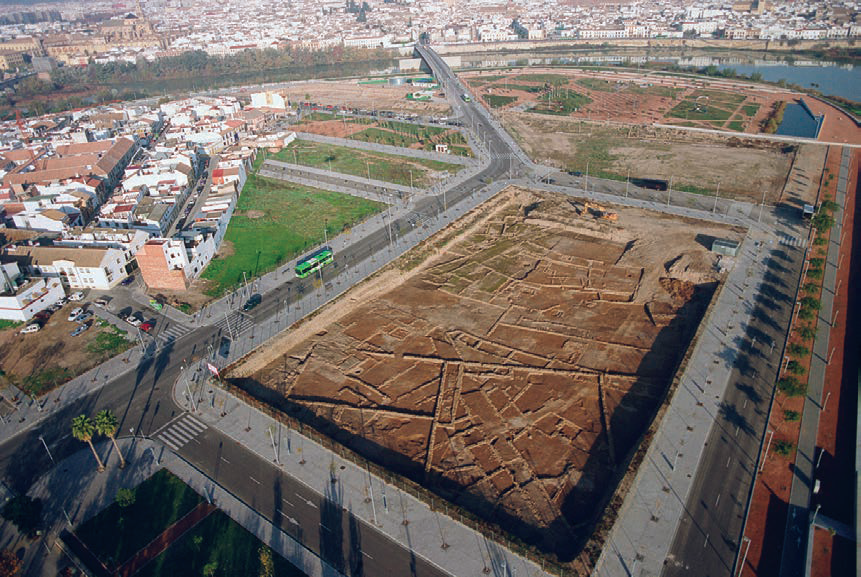
21/n The Caliph prohibited from any construction to happen with fear that it would lead to uprising again. The Prohibition continued.
In the era of last Caliph,Hisham II few people began to construct but he ensured to maintain the order & all attempts were again razed to ground.
In the era of last Caliph,Hisham II few people began to construct but he ensured to maintain the order & all attempts were again razed to ground.
22/n Source for 19/n to 21/n : Crónica de los emires by Ibn Hayyan (796-847 AD)
The series of atrocities continued but Islamic Powers are known to collapse for own infighting. It happened here too.
The series of atrocities continued but Islamic Powers are known to collapse for own infighting. It happened here too.
23/n Caliphate of Córdoba effectively collapsed during the civil war between 1009- 13 & finally abolishing in 1031.
The Al-Andalus broke up into a number independent mini-states called Taifas.
The Al-Andalus broke up into a number independent mini-states called Taifas.
24/n 1013 AD, the invading Berbers sacked Córdoba. The massacred mainly Jewish and Christian inhabitants, pillaged the city, and burnt the palace complex to the ground.
Source: Jews of Spain: A History of the Sephardic Experience by Jane S Gerber, Pg 54 archive.org
Source: Jews of Spain: A History of the Sephardic Experience by Jane S Gerber, Pg 54 archive.org
25/n Berbers are an ethnic group indigenous to North Africa, specifically Morocco, Algeria, Tunisia, & Libya, and to a lesser extent Mauritania,northern Mali, & northern Niger.
Source: britannica.com
& it was Berber force that was part of marauding Invasion in 711 AD.
Source: britannica.com
& it was Berber force that was part of marauding Invasion in 711 AD.

26/n Read 851 AD instead of 1851 AD.
27/n Came the 976 AD and at the "Library of Córdoba" Al-Mansur Ibn Abi Aamir along with other Islamic Scholars destroyed all the books related to Philosophy and Ancient Science with pursuit to favor Islam.
Source:Christians in Al-Andalus 711-1000
by Ann Rosemary Christys
Source:Christians in Al-Andalus 711-1000
by Ann Rosemary Christys
28/n Then came the 1066 Granada Massacre.
Let's begin with the background.
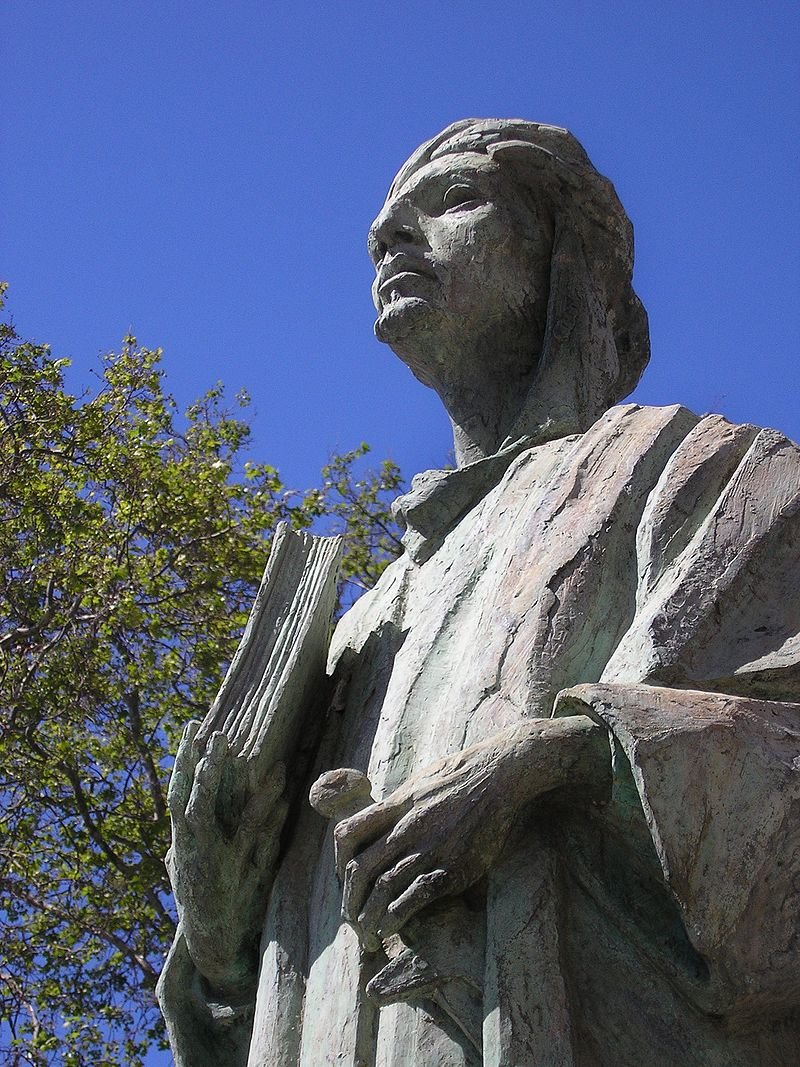
Muslim leaders of Granada untruly accused "Joseph ibn Naghrela" of several acts of violence, which drew upon him the hatred of the Berbers, the ruling majority at Granada.
Let's begin with the background.
Muslim leaders of Granada untruly accused "Joseph ibn Naghrela" of several acts of violence, which drew upon him the hatred of the Berbers, the ruling majority at Granada.
29/n Abu Ishak of Elvira one of his fiercest enemy was looking to be seated in the office at court. Following his hatred he composed a malicious poem against Joseph and his fellow Jews.
Source: jewishcurrents.org
Source: jewishcurrents.org
30/n Although the poem made little or no impression upon the king, who trusted Joseph implicitly, but it created a big provoked sensation among the Berbers.
Joseph was determined to fulfill the dream of his father.
Joseph was determined to fulfill the dream of his father.
31/n Accordingly he sent messengers to Ibn Sumadih, the ruler of the neighboring kingdom of Almeria an old enemy of Granada.
Joseph promised to open the gates of the city to Ibn's army if latter promised to install him as king at cost of submission and allegiance.
Joseph promised to open the gates of the city to Ibn's army if latter promised to install him as king at cost of submission and allegiance.
32/n But at the end moment, Ibn backed out, and on the eve of the supposed invasion, the plot got leaked.
Soon rumor spread that Joseph killed the king and was about to betray the kingdom.
Source: jstor.org
Soon rumor spread that Joseph killed the king and was about to betray the kingdom.
Source: jstor.org
33/n The provoking poem of Abu Ishak was also showing its colors.
December 30, 1066, Muslim mob rushed into the royal palace where Joseph had sought refuge. He was captured and crucified.
Source: horrorhistory.net
December 30, 1066, Muslim mob rushed into the royal palace where Joseph had sought refuge. He was captured and crucified.
Source: horrorhistory.net
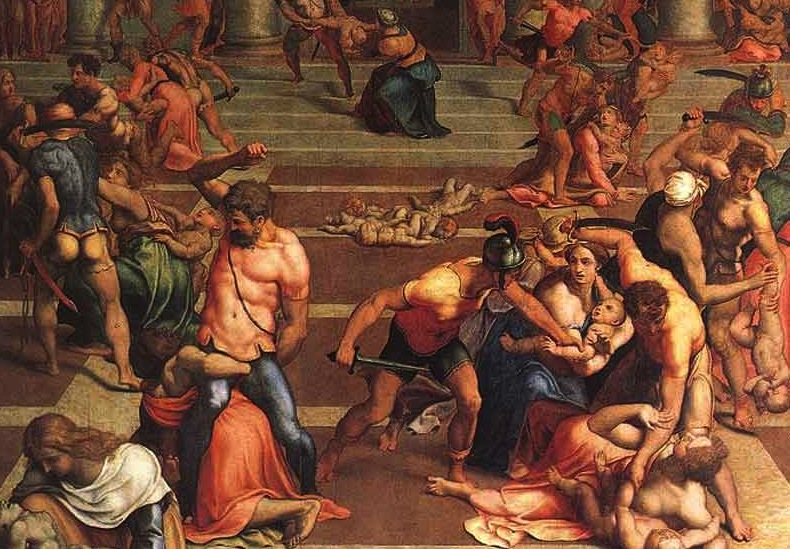
34/n In the massacre many Jews of Granada were murdered.
As per the 1906 Jewish Encyclopedia, "More than 1500 Jewish families(4000 people) fell in one day."
Source: jewishencyclopedia.com
As per the 1906 Jewish Encyclopedia, "More than 1500 Jewish families(4000 people) fell in one day."
Source: jewishencyclopedia.com
35/n The number as stated is also confined in "The Encyclopaedia Judaica", page 32, Vol-8 jevzajcg.me
Loading suggestions...