
I'm not sure I understand why people find wage-price spirals or persistence confusing and controversial but it might be the issue is the terminology. Here is what we know--and one huge thing we don't know.
A short🧵
A short🧵
1. When wages go up that leads prices to go up.
If airline fuel or food ingredients go up in price then airlines or restaurants raise their prices. Similarly if wages for flight attendants or servers go up then they also raise prices. This follows from basic micro & commonsense.
If airline fuel or food ingredients go up in price then airlines or restaurants raise their prices. Similarly if wages for flight attendants or servers go up then they also raise prices. This follows from basic micro & commonsense.
2. When prices go up that leads wages to go up.
This one is a little more subtle: with higher prices a business will find it desirable to hire more people to sell more (a higher marginal revenue produce of labor). To hire them it needs to pay more--and it can afford to do so.
This one is a little more subtle: with higher prices a business will find it desirable to hire more people to sell more (a higher marginal revenue produce of labor). To hire them it needs to pay more--and it can afford to do so.
The link between the two over long periods of time is very close (adjusting wage increases for productivity growth--which generates gains that do not need to be covered with higher prices).
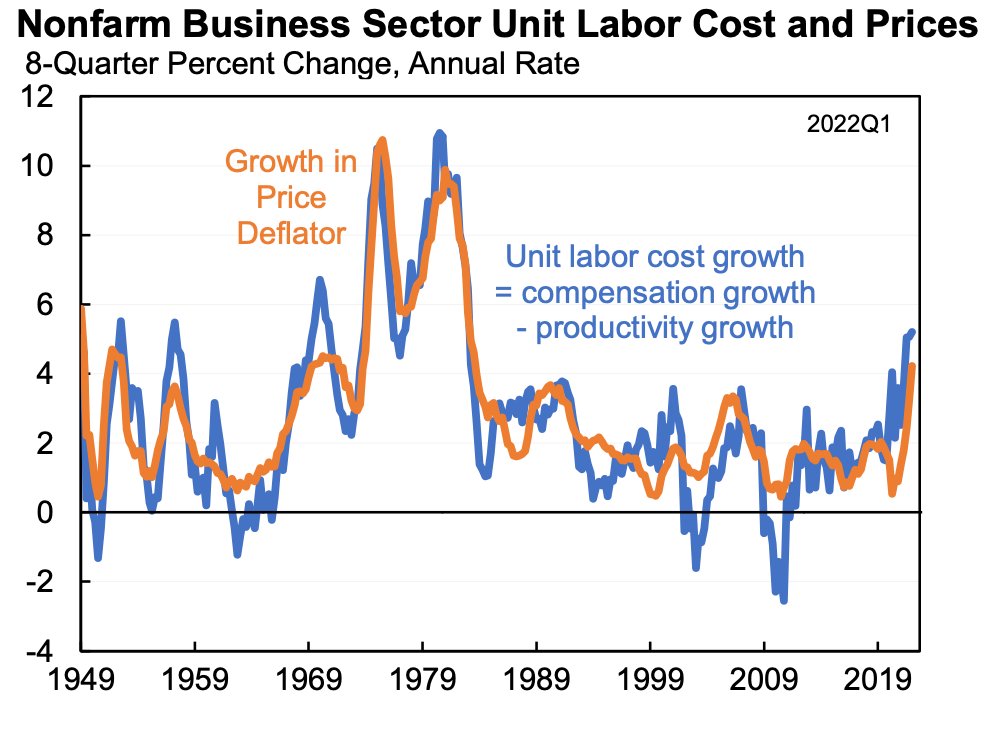
3. The price & wage setting do not happen immediately and are staggered.
This leads to some persistence in inflation. As a rough rule if inflation is 1pp above trend in year 0 then it will tend to be about 0.7pp above trend the next year, 0.5pp above trend the year after, etc.
This leads to some persistence in inflation. As a rough rule if inflation is 1pp above trend in year 0 then it will tend to be about 0.7pp above trend the next year, 0.5pp above trend the year after, etc.
As a result of this if something increases in inflation in 2021 even if the cause is removed the inflation rate will tend to be higher in 2022 and beyond--although trending back to its long-run anchored value.
"Spiral" might sound to people like inflation goes from 5 to 6 to 8 to 12 to 20. There is little evidence for that.
I prefer saying "wage-price persistence" which could be 5 to 5 to 5 to 5. Or more likely 5 to 4 to 3 to ...
I prefer saying "wage-price persistence" which could be 5 to 5 to 5 to 5. Or more likely 5 to 4 to 3 to ...
4. The big mystery is where this process ends.
The standard Phillips curve says it ends at expected inflation. The problem is what expectation? Short-run expectations are around 5% while long-run are about 2.5%.
The standard Phillips curve says it ends at expected inflation. The problem is what expectation? Short-run expectations are around 5% while long-run are about 2.5%.
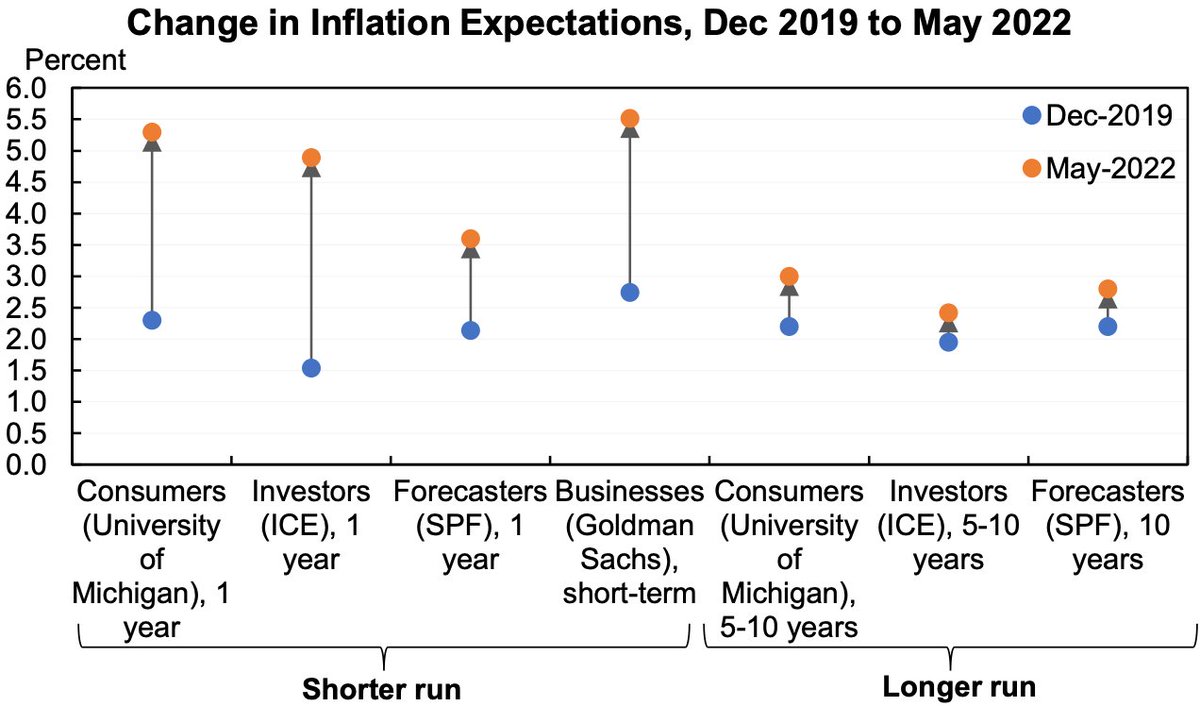
Normally would say LR expectations matter but in the middle of a possible regime shift I'm less sure that statistical evidence for the 25 years prior to the pandemic are valid for today. I discussed this more here. piie.com
Anyway, I don't think any of this is or should be controversial. But let me know what you think.
Very important PS: The reason inflation tends back to ~2% (not immediately but over a few years) is not a law of nature but because the Fed raises rates when it is above that.
So can’t use the return to 2% as an argument against precisely the policy that brings that about.
So can’t use the return to 2% as an argument against precisely the policy that brings that about.
Loading suggestions...