

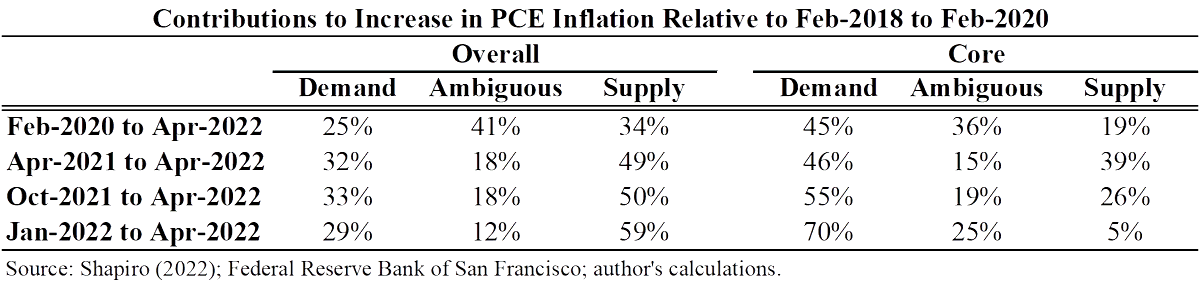
The table in the previous tweet was my calculations of the percentage of the *increase* in inflation that is due to the two factors, using the two years pre-pandemic as the baseline (results basically the same if you use the twenty years pre-pandemic as the baseline).
The reassuring thing about his results is the extra 2.5pp of inflation due to energy and food really do look like a supply shock--and one can infer/expect that this supply shock that will go away. But we sort of knew that already.
The concerning thing about the results is that the large majority of the recent elevated core inflation (which itself is very high) is due to demand factors. And the demand component of core inflation is growing.
Just 5% of elevated core over the last 3 months is supply.
Just 5% of elevated core over the last 3 months is supply.
Hamilton's clever methodology is based on simple supply and demand. He looks at lots of different items and if prices and quantities go in the same direction that is evidence the demand curve shifted, and if vice versa the supply curve shifted.
The results are much better than the educated guesses I had been trying to make about precisely this disentanglement. But I would still take them with a pinch of salt for two reasons:
1. Empirically (and appropriately) he does *unexpected* changes, but a lot of noise in these.
1. Empirically (and appropriately) he does *unexpected* changes, but a lot of noise in these.
2. Conceptually the partial equilibrium analysis does not necessarily add up to general equilibrium. Supposed a supply shock in one good led to reduced consumption in others. That would look like a negative demand shock but really was just supply. Also issues around the baseline.
Hamilton will be updating these every month and I'll be monitoring those updates--along with lots of other data that also suffers from other types of noise and conceptual issues. You can download his data yourself here. frbsf.org
P.S. An important addition to the above tagging the author of the decomposition @adamshap5
And an even more important correction, I multiple times referred to Adam Shapiro as "Hamilton" in the thread. Not sure what I was thinking.
Apologies on both.
And an even more important correction, I multiple times referred to Adam Shapiro as "Hamilton" in the thread. Not sure what I was thinking.
Apologies on both.
P.P.S. A third issue: The methodology is binary, categories get assigned either to supply or demand. That matters a lot because (I assume) the huge car price increases show up as 100% supply when in reality they might have been 75% supply and 25% demand.
Loading suggestions...