

1) At our LA dinner, an attendee shared this shot from his 50th birthday celebration.
“You gotta live your life,” he said. “Don’t be negative. Be present and enjoy the moment.”
We took turns telling each other about our life lessons. 🧵
“You gotta live your life,” he said. “Don’t be negative. Be present and enjoy the moment.”
We took turns telling each other about our life lessons. 🧵

2) “Truly we belong to God, and to Him we return.”
This, according to one participant, is the most important thing he knows.
This, according to one participant, is the most important thing he knows.
3) “It puts everything in perspective,” he said, “the meaning of my own existence, the exercise of human responsibility, and how to treasure this God-given life and environment.”
4) Everyone’s gaze was drawn to the next attendee.
“I learned how important it is to be honest with yourself, and how much effort it takes,” he shared.
“I learned how important it is to be honest with yourself, and how much effort it takes,” he shared.
5) “I began my career with enthusiasm and lots of certainty.
Over time, I became accustomed to saying ‘I don’t know,’ and I was able to recognize when I was being defensive.
It’s so important to just listen.”
Over time, I became accustomed to saying ‘I don’t know,’ and I was able to recognize when I was being defensive.
It’s so important to just listen.”
6) Another attendee agreed, “The older I get the less confident I get.”
7) One of the participants who was able to disconnect and go to the mountains during the pandemic discovered that he was a different person than he thought he was when he was simply office-bound.
“It’s important to spend time in solitude,” he said.
“It’s important to spend time in solitude,” he said.
8) “Life’s a rollercoaster and you can’t get off,” said another attendee.
“Get used to the highs and lows.”
We are wired to avoid, rather than mindfully embrace our emotions.
He fights his escapist inclination by urging himself to “stay invested.”
“Get used to the highs and lows.”
We are wired to avoid, rather than mindfully embrace our emotions.
He fights his escapist inclination by urging himself to “stay invested.”
9) An attendee shared that he’s tuning into his body and the signal it sends.
“Our body is super intelligent,” he stated, “but we’ve been taught to avoid it by focusing on our brains and keeping our bodies in seats all day.”
“Our body is super intelligent,” he stated, “but we’ve been taught to avoid it by focusing on our brains and keeping our bodies in seats all day.”
10) The body can play a role in thinking and decision making.
A fully body yes happens when you are fully aligned with your whole body (head, heart and gut) and there is a bodily sense of well-being as you consider a choice.
A fully body yes happens when you are fully aligned with your whole body (head, heart and gut) and there is a bodily sense of well-being as you consider a choice.
11) After many years of working alone, one participant shared his experience of building a team and getting the culture right.
It was far more difficult than he had anticipated.
For the first time in his life, he sacked two people. They didn’t turn out to be a good match.
It was far more difficult than he had anticipated.
For the first time in his life, he sacked two people. They didn’t turn out to be a good match.
12) “It reinforced the importance of spending time with those with whom you see eye to eye in a deep, fundamental way,” he said.
“I also have a greater appreciation for companies that scale up and can maintain the correct culture.”
“I also have a greater appreciation for companies that scale up and can maintain the correct culture.”
13) There was one person left. “I’ve got two things to share,” he said.
“First, it’s the rate of change that matters.”
“First, it’s the rate of change that matters.”
14) The value of the second derivative was a lesson he learned from his first employer.
For example, if inflation is high but declining month-on-month, that’s positive.
If the economy is in a downturn, but the growth rate is slightly less negative, that’s positive.
For example, if inflation is high but declining month-on-month, that’s positive.
If the economy is in a downturn, but the growth rate is slightly less negative, that’s positive.
15) “The same lesson can be applied in life,” he remarked.
By making little incremental improvements, bad habits may be overcome and good ones can compound.
By making little incremental improvements, bad habits may be overcome and good ones can compound.
16) “What’s the second lesson?”
“YOLO!” he said, banging his hand on the dinner table.
“I just turned 40 and I don’t want to surround myself with douchebags!”
“YOLO!” he said, banging his hand on the dinner table.
“I just turned 40 and I don’t want to surround myself with douchebags!”
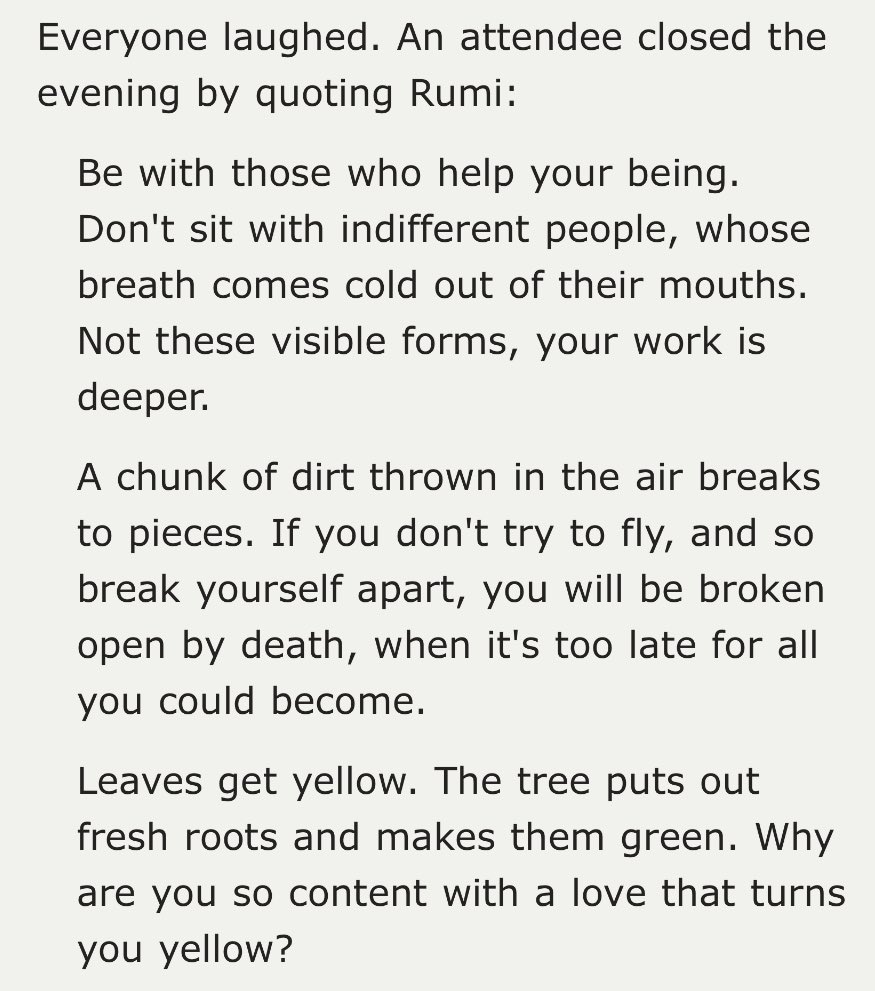
17) Rumi has something to say about that.
18) You can read the full notes from our LA dinner here (members-only). stray-reflections.com
Loading suggestions...