

Today was a Distribution Day just 2 days following Friday's Follow-Through Day.
I collected NASDAQ data from the bear markets of the 21st century and it raised some points about the relationship between FTD's and DD's I've never seen discussed before.
A (I think cool) 🧵
(1/17)
I collected NASDAQ data from the bear markets of the 21st century and it raised some points about the relationship between FTD's and DD's I've never seen discussed before.
A (I think cool) 🧵
(1/17)
First, if you don't already know, here are some definitions:
Distribution Day (DD): A day where an index is down >=0.2% of volume > the previous day's
Follow-through day (FTD): A day >= day 4 following a market bottom, where price is up >= 1.5% on volume > the previous day's
Distribution Day (DD): A day where an index is down >=0.2% of volume > the previous day's
Follow-through day (FTD): A day >= day 4 following a market bottom, where price is up >= 1.5% on volume > the previous day's
For more information on DD's and FTD's and what they mean, I discuss them towards the end of this YouTube video. 👇
youtube.com
youtube.com
A FTD is a sign that the market is staging a legitimate rally attempt off the potential lows of a bear market or correction.
The saying goes:
"Not every FTD starts a bull market, but every bull market starts with a FTD"
The saying goes:
"Not every FTD starts a bull market, but every bull market starts with a FTD"
Historically speaking, when there is a DD within a few days of the FTD, the chances of the FTD failing increase dramatically.
A study of all historic bear markets would say that if there is a DD on days 1, 2 or 3 following a FTD, there is a 70% chance that FTD fails.
A study of all historic bear markets would say that if there is a DD on days 1, 2 or 3 following a FTD, there is a 70% chance that FTD fails.
What I found is that statistic hasn't exactly applied to 21st century bear markets.
The FTD that worked in 2003 had a DD 3 days later. In 2009, a DD came 2 days later and in 2020, a DD came 1 day after the FTD.
Despite the statistical unlikelihood, all of these FTD's worked.
The FTD that worked in 2003 had a DD 3 days later. In 2009, a DD came 2 days later and in 2020, a DD came 1 day after the FTD.
Despite the statistical unlikelihood, all of these FTD's worked.
For the 21 Nasdaq FTD's of the 21st century, if there was a DD within 3 days, it has failed 72.73% of the time, which is close to the total historical average of 70%.
But for FTD's with a DD on later than day 3, the failure rate was actually 100%.
But for FTD's with a DD on later than day 3, the failure rate was actually 100%.
To me, this didn't make any sense.
The closer the signal of institutional selling is to the signal of an uptrend, the more likely it has been to confirm a new bull market?
The data says yes, but let me break it down further.
The closer the signal of institutional selling is to the signal of an uptrend, the more likely it has been to confirm a new bull market?
The data says yes, but let me break it down further.
What I found in my personal study of the relationship between FTD's and DD's is that the number of days it takes to see a DD isn't an indication of how likely it is to be a bottom.
INSTEAD, it can tell us how likely we are to see a prolonged rally, before likely continuing lower
INSTEAD, it can tell us how likely we are to see a prolonged rally, before likely continuing lower
FTD's alone are statistically not a great indication of a market bottom. In the 21st century, 85.8% of FTD's have failed (18/21).
BUT, 75% of the time (6/8) that the DD following the FTD was on day 6 or beyond, it led to a rally of at least 2 weeks before topping again.
BUT, 75% of the time (6/8) that the DD following the FTD was on day 6 or beyond, it led to a rally of at least 2 weeks before topping again.
For every time there was a rally of >10 days following the FTD, the average # of days before a DD was 6.09.
So in the end, this data confirms to me that a FTD is a good signal to buy high relative strength stocks, while actively MANAGING RISK.
So in the end, this data confirms to me that a FTD is a good signal to buy high relative strength stocks, while actively MANAGING RISK.
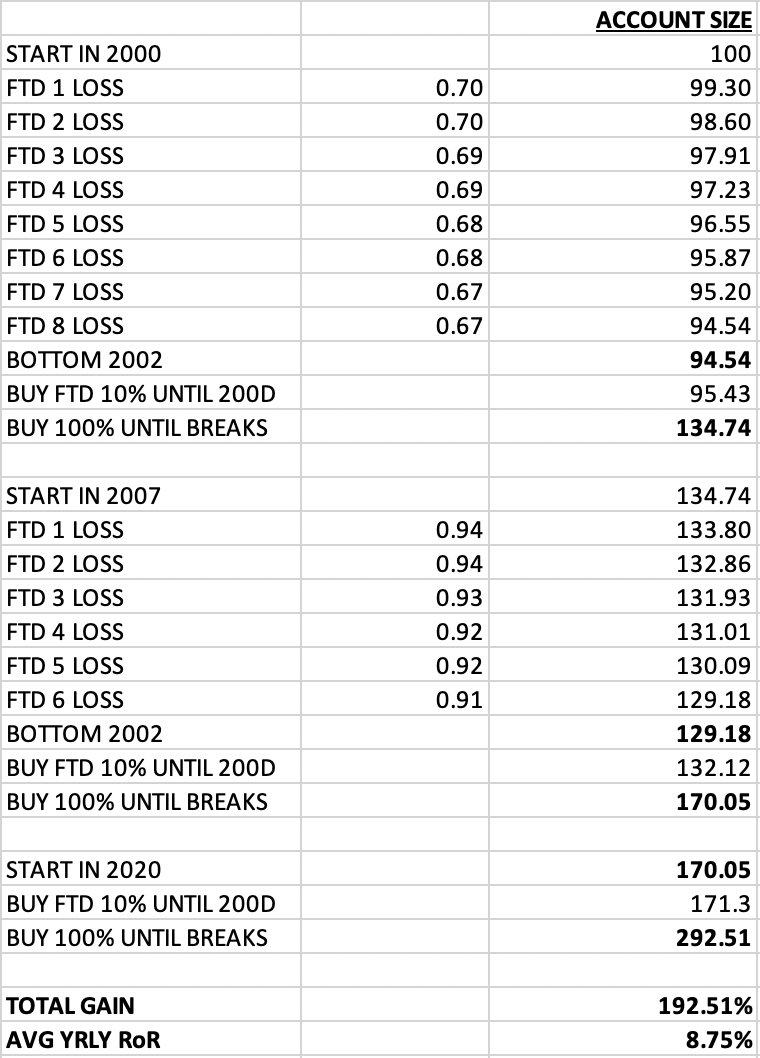
To take it even further, let's take a sample portfolio from '00-'22 and say you bought the Nasdaq with 10% of your account on every FTD and used a 7% stop loss.
Then, once the Nasdaq cleanly broke back above its 200-day SMA you went 100% long until it broke the 200D.
Then, once the Nasdaq cleanly broke back above its 200-day SMA you went 100% long until it broke the 200D.
This portfolio would've returned 192% from '00-'22, an average yearly RoR of 8.75%, 130bps over the Nasdaq's average return of 7.45% over the last 20 years.
This is despite being out of the market for most of the 2000's with a relatively timid strategy.
This is despite being out of the market for most of the 2000's with a relatively timid strategy.
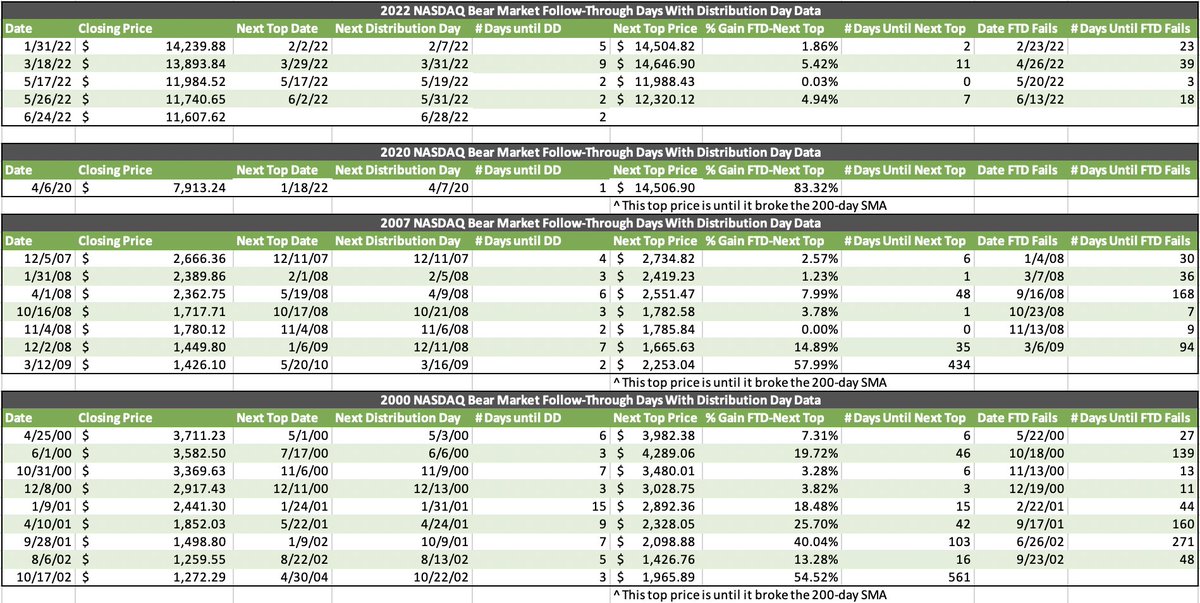
Below is the data I collected from the 4 bear markets of the 2000's.
In conclusion, despite the mean deviation of recent FTD data, it still is a profitable buy signal as long as risk is being managed properly.
Price, and your cost basis, is the only thing that pays. Even tracking DD's following FTD's hasn't panned out quite to plan.
Price, and your cost basis, is the only thing that pays. Even tracking DD's following FTD's hasn't panned out quite to plan.
But that doesn't discount the value of looking at these two indicators. In fact, it made me appreciate the FTD even more.
This study amplifies to me the importance of risk management, compounding interest and that time is your friend.
This study amplifies to me the importance of risk management, compounding interest and that time is your friend.
If you got some value from this thread, I would appreciate a like, retweet or follow.
And of course, I am posting this for educational purposes and it is not a recommendation to use any particular investment strategy.
And of course, I am posting this for educational purposes and it is not a recommendation to use any particular investment strategy.
Loading suggestions...