
Religion
Spirituality
Culture
Linguistics
Religious Texts
religious studies
Vedic Literature
Vedic Culture

Vedic culture recognizes four different speech types.
#Thread
#Thread
The Atharva Veda contains the GaNapati Upanishhad. Here, we discover a verse that refers to the four speech stages.
tvaM chatvaari vaakpadaani
tvaM chatvaari vaakpadaani
tvam = you
chatvaari = four
vaak = speech
padaani = steps (levels of speech)
chatvaari = four
vaak = speech
padaani = steps (levels of speech)
Meaning: The four different sorts of speech are you, Lord GaNesha, who is praised in this Vedic mantra as Bramhan-God. According to Vedic tradition, there are four categories of speech, ranging from the crude to the subtle:
1.vaikharii : physical speech produced by words. The required sounds for words are created by the oral cavity vibrating, which the listener hears and neurologically interprets.
2.madhyamaa : In your head. Telepathic communication is possible. Sometimes people speak for themselves. This includes the phenomenon of mental telepathy.
3.pashyanti : To see is what Pashyanti implies. This is a reference to the Vedic "seers." A Rishi is someone who has heard a certain Vedic chant (The Rishi for the GaNapati Upanishhad is Sage GaNaka )
The universe as a whole vibrates. Sound energy is what is meant by reverb. The universe's truths and knowledge were downloaded by the ancient sages as sounds that they "saw" and "envisioned." Pashyanti is the name of this form of communication.
The Vedas were transmitted to Earth in this way and made available to humanity.
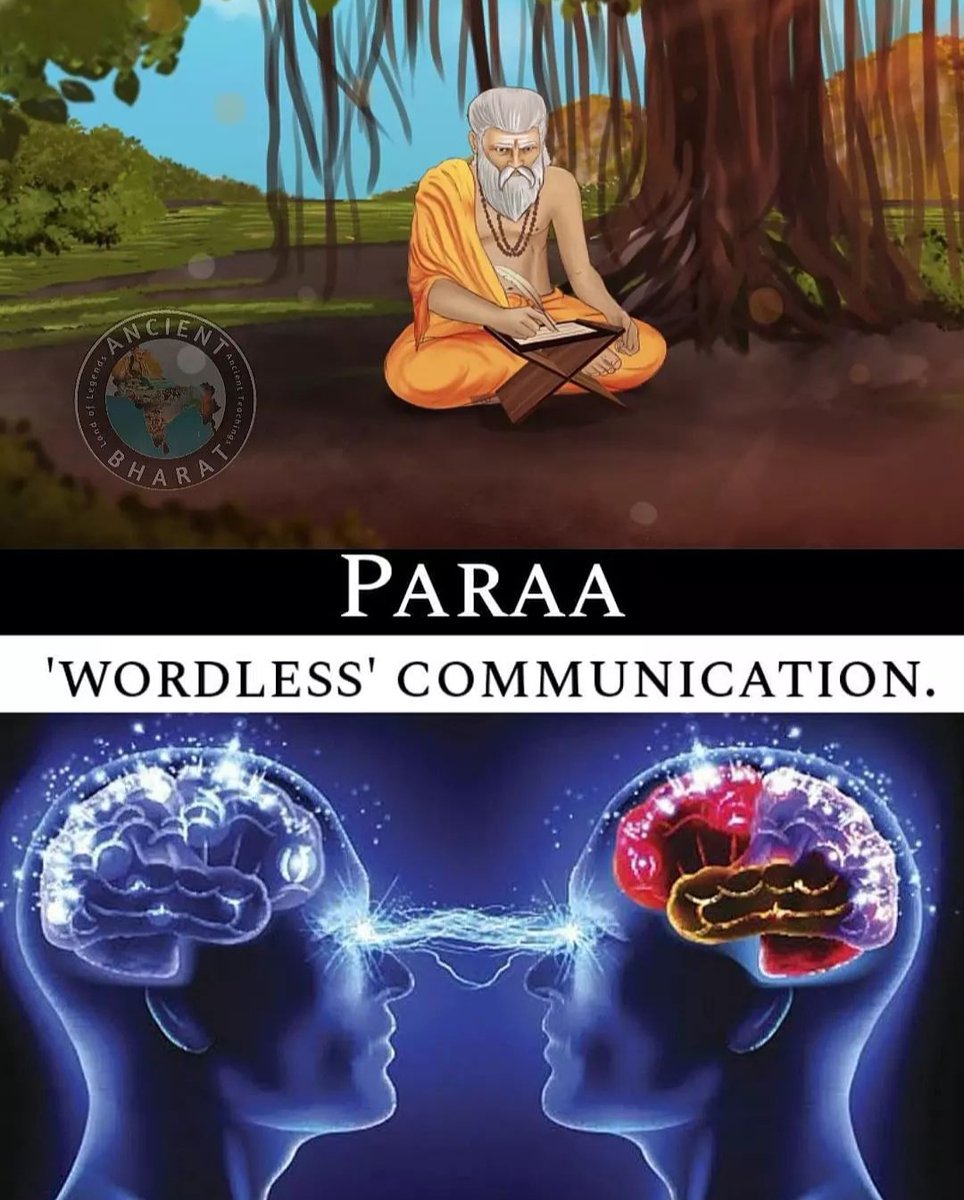
4.paraa: This kind of communication is "wordless." This is the unification with the unwavering consciousness that exists outside the constraints of the time and space matrix. A state, that is. It speaks in complete silence.
Source: @ancient.bharat_
Loading suggestions...