

The Ancient Suraj Kund Temple, Multan, Pakistan.
#Thread
#Thread
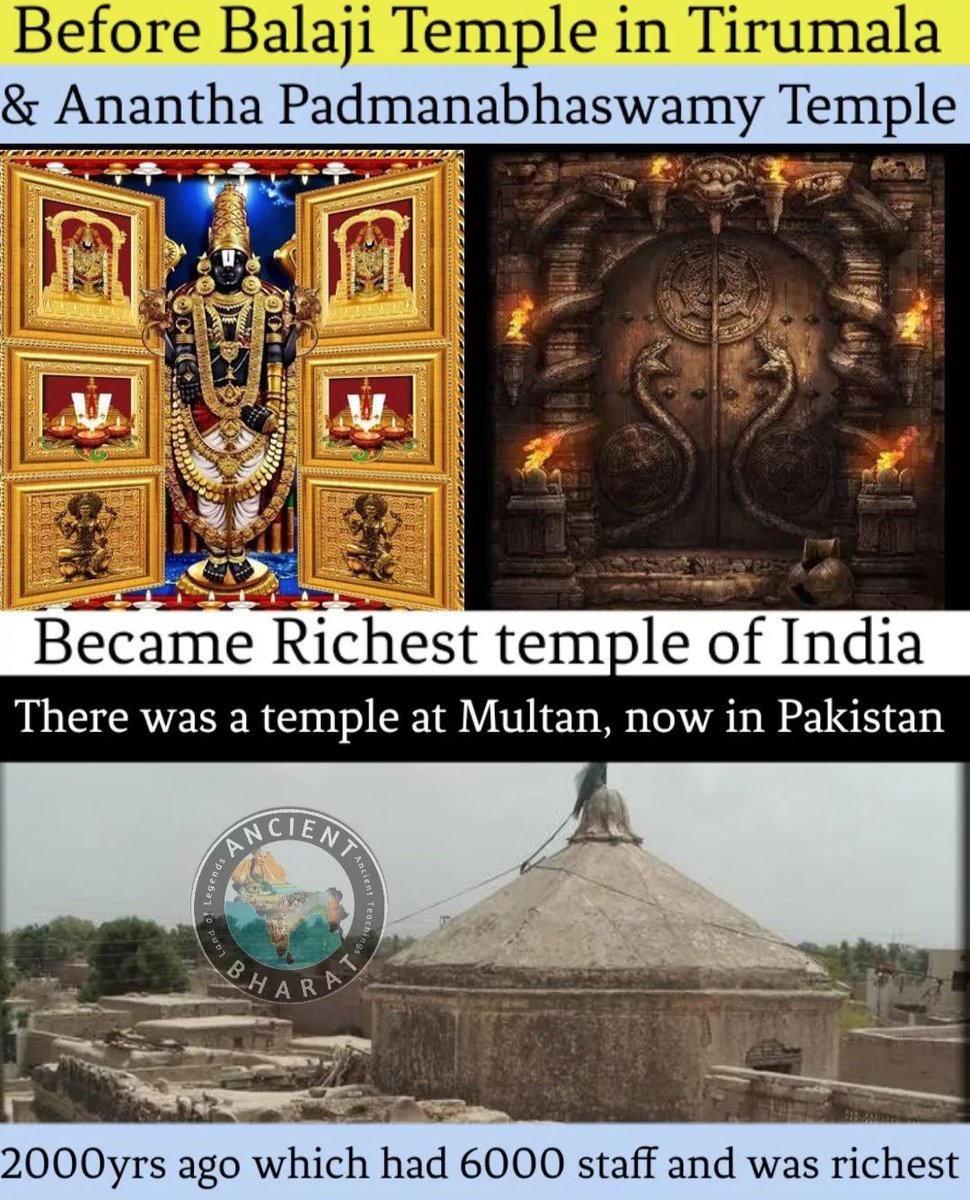
"The term Multan is derived from the Sanskrit Malisthana (Maali- Asthan), which means Maalee's seat." Mali could have been the Maloi of Greek writers, who along with the Shibi (Sibi), were the two great people or tribes who inhabited the majority of the Indo-Pakistan subcontinent
Many names are still associated with these tribes in both India and Pakistan, demonstrating the importance these peoples held in ancient times.
The names of these tribes and the extent of their cultural influence on the subcontinent are perpetuated by the names Malwa in central India, Sibi in Baluchistan, Siwistan in Sind, and Shivi Kot (Shorkot) in Punjab.
Multan's ancient name is said to have been Kasyapa - pura, named after Rishi Kashyapa, one of Manu's sons and a direct descendant of God Brahma. Manu had seven sons, who are represented in the heavens by the Great Bear's seven stars.
It also appears to have gotten its name from "Mul," the sun god, whose statue was adorning the Multan temple. This is supported by Arab accounts that mention Multan as the main centre of Sun worship in the northern Indus Valley.
In Sanskrit, "Mul" refers to the root or origin; it also refers to heaven, ether, atmosphere, space, or God. Any of these names could be applied to the sun, the lord of ethereal space.
According to legend, Samba, Lord Krishna's son, built the first temple in the subcontinent for the worship of the sun god.
Adiyasthana, or the first shrine, was the name given to it. Aditiya is a corruption of Aditiyah (or the sun), which is commonly abbreviated to Adit and even Ayt, as in Aditwara (or Aytwar) for Sunday. Multan's sun worship may be very old.
According to one legend, it was founded by Prahlada, the son of Daitya (or Hiranyakasipu), the son of Manu.
According to the famous Sanskrit scholar AL-Beruni, the Multan deity, which was named after the sun, was built during the Karta-Jug (Krta Yuga), which according to his calculations was 216432 years old.
Rulers of Multan
The names of Multan rulers who reigned for nearly two centuries do not appear systematically in historical sources.
The names of Multan rulers who reigned for nearly two centuries do not appear systematically in historical sources.
According to reports, Quarmathian missionary work was in full swing during the later period of Arab rule in Sind, thanks to the propaganda machinery overseen by men such as al-Haytham and Jalan ibn Shayban.
The latter, a famous Ismaili fanatic, destroyed the Multan god and ordered the destruction of the Umayyad mosque that had been constructed earlier by Muhammad ibn al-Qasim, the Arab ruler of Sind.
The deity of Multan
One of the few deities to which people from different parts of the subcontinent flocked in great numbers was the deity of Multan, who according to Arab historians was connected with Job, the Hebrew prophet.
One of the few deities to which people from different parts of the subcontinent flocked in great numbers was the deity of Multan, who according to Arab historians was connected with Job, the Hebrew prophet.
The temple served as the state's primary source of wealth during the Arab era, helping the rulers meet the majority of their needs.
According to legend, the Multan deity looked like a man sat in a chair. Except for the eyes, which are said to have been two extremely valuable jewels, nothing of its body could be seen due to the redness of its skin.
The jewels were set in the sockets with such care that they appeared to be genuine. These jewels, according to Ibn Nadim, were larger than sparrow eggs and shined brilliantly in the temple.
The deity's head was also adorned with a gold crown, and one of his hands, which was resting on his knees, had fingers that appeared to be counting to four. (It must be the Hindu Gods' Chin Mudra, swami.
Source: @ancient.bharat_
Loading suggestions...