

Indigo & Kingfisher were both founded in 2005.
While Kingfisher crashed & burned, Indigo:
1. Stayed profitable for 10 years
2. Reached INR 2200+ CRORES in profit
3. Became the largest Indian airline with ~60% market share!
Steal Indigo's business strategy for your startup! 🧵
While Kingfisher crashed & burned, Indigo:
1. Stayed profitable for 10 years
2. Reached INR 2200+ CRORES in profit
3. Became the largest Indian airline with ~60% market share!
Steal Indigo's business strategy for your startup! 🧵
1/ Indigo's origin story
The aviation industry is a fossil launched in 1983 by J.R.D Tata!
From the start, the Indian government has had a strong hold on this space.
That was until 1994 when India repealed all the regulations & allowed private players in the market.
(contd.)
The aviation industry is a fossil launched in 1983 by J.R.D Tata!
From the start, the Indian government has had a strong hold on this space.
That was until 1994 when India repealed all the regulations & allowed private players in the market.
(contd.)
Now, in the late 90s, flying via air was a costly affair.
So, the status quo of the industry favoured the "air travel is a luxury" angle.
That changed when a bunch of low-cost carriers made a debut in the early 2000s, most notably — Indigo!
(contd.)
So, the status quo of the industry favoured the "air travel is a luxury" angle.
That changed when a bunch of low-cost carriers made a debut in the early 2000s, most notably — Indigo!
(contd.)
Interglobe Enterprise head, Rahul Bhatia, & IIT Kanpur grad and aviation industry veteran, Rakesh Gangwal, came together to launch Indigo in 2006.
With Rakesh in the US & Rahul in India, the duo essentially built Indigo into an aviation monopoly by sitting 7000 miles apart! 🤯
With Rakesh in the US & Rahul in India, the duo essentially built Indigo into an aviation monopoly by sitting 7000 miles apart! 🤯
2/ Indigo vs Jet Airways & Kingfisher
During the same time, another high-profile airline was making its entry!
Vijay Mallya's Kingfisher was launched in 2005 & they were doing very well.
It quickly grew to become the 2nd largest Indian airline after Jet Airways.
(contd.)
During the same time, another high-profile airline was making its entry!
Vijay Mallya's Kingfisher was launched in 2005 & they were doing very well.
It quickly grew to become the 2nd largest Indian airline after Jet Airways.
(contd.)
But, in a few years, these 2 newcomers went in completely different directions.
While Kingfisher nosedived into oblivion, Indigo soared.
To understand how unprecedented Indigo's growth was, we'll first have to look at some numbers.
(contd.)
While Kingfisher nosedived into oblivion, Indigo soared.
To understand how unprecedented Indigo's growth was, we'll first have to look at some numbers.
(contd.)
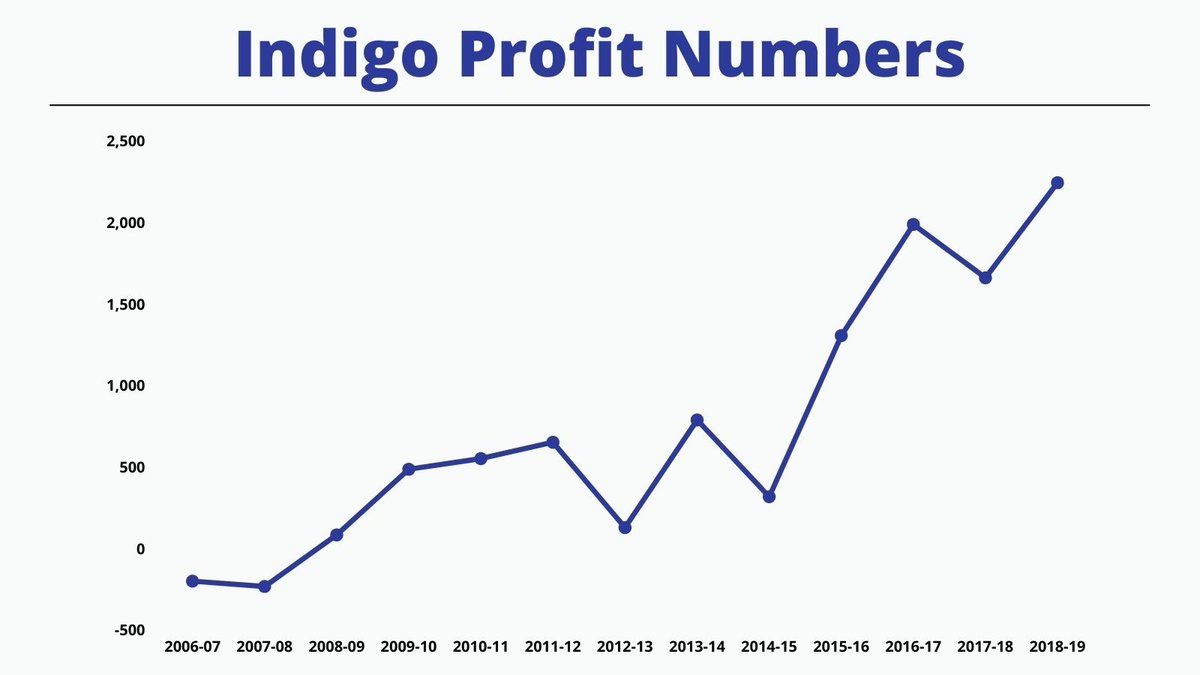
1) 2006-07
Indigo — (-) INR 201 Cr
Kingfisher — (-) INR 577.3 Cr
2) 2007-08
Indigo — (-) INR 234.7 Cr
Kingfisher — (-) INR 408.9 Cr
3) 2008-09
Indigo — (+) INR 82 Cr
Kingfisher — (-) INR 1902 Cr
4) 2009-10
Indigo — (+) INR 484 Cr
Kingfisher — (-) INR 1293 Cr
(contd.)
Indigo — (-) INR 201 Cr
Kingfisher — (-) INR 577.3 Cr
2) 2007-08
Indigo — (-) INR 234.7 Cr
Kingfisher — (-) INR 408.9 Cr
3) 2008-09
Indigo — (+) INR 82 Cr
Kingfisher — (-) INR 1902 Cr
4) 2009-10
Indigo — (+) INR 484 Cr
Kingfisher — (-) INR 1293 Cr
(contd.)
1. Initially, both airlines were making losses. But, in 2008 when the markets crashed and fuel prices increased, Indigo turned profitable 🤯
2. On the other hand, Kingfisher's losses increased by 5x & it ceased its operation in 2012.
2. On the other hand, Kingfisher's losses increased by 5x & it ceased its operation in 2012.
3/ The SECRET strategy
After 2008, Indigo stayed profitable for 10 years!
It credits this sudden turn to its commitment to keeping its balance sheet extremely lean.
But, by nature, you have to enter the aviation space with a truckload of cash.
(contd.)
After 2008, Indigo stayed profitable for 10 years!
It credits this sudden turn to its commitment to keeping its balance sheet extremely lean.
But, by nature, you have to enter the aviation space with a truckload of cash.
(contd.)
After all, you are not paying $10 dollars for a domain name here, instead, you are literally buying a plan!
Indigo's GENIUS lies in how cleverly it has managed this entry-level problem using its "Sale and Lease Back" model.
Let's learn more about it!
(contd.)
Indigo's GENIUS lies in how cleverly it has managed this entry-level problem using its "Sale and Lease Back" model.
Let's learn more about it!
(contd.)
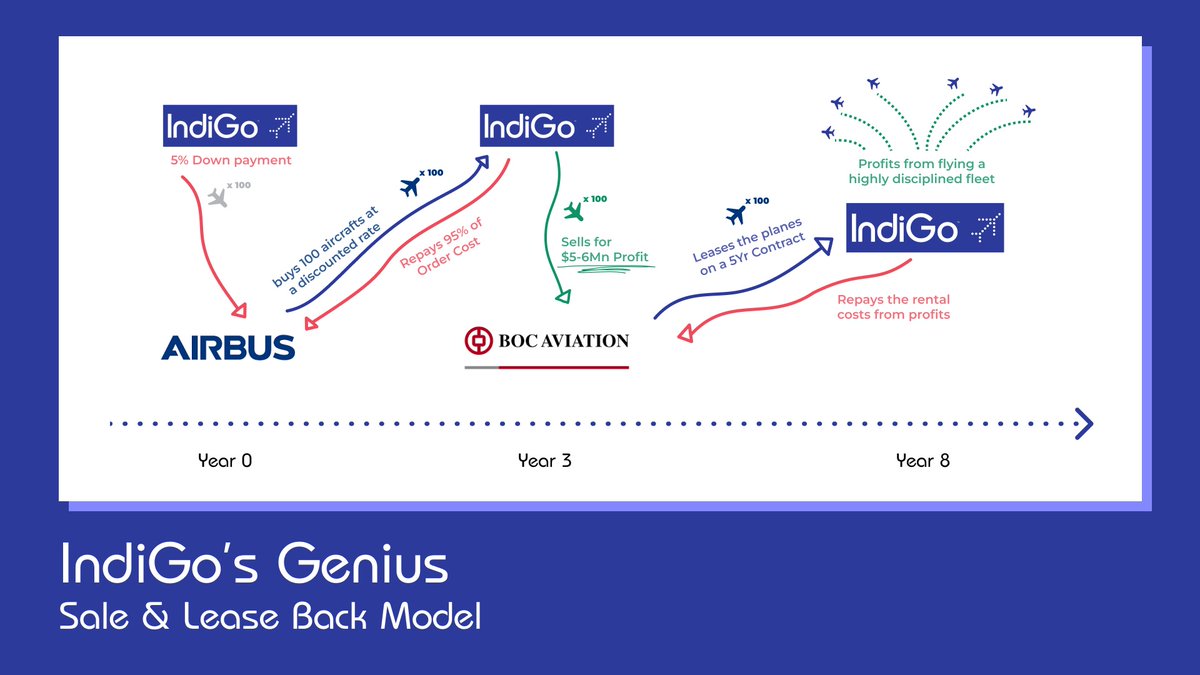
In 2005, prior to its launch, Indigo decided to order a total of 100 aircraft from Airbus!
Airbus was suffering from a bad reputation due to multiple crashes.
So, Airbus was desperate to enter the Indian market. And, Indigo was its gateway!
(contd.)
Airbus was suffering from a bad reputation due to multiple crashes.
So, Airbus was desperate to enter the Indian market. And, Indigo was its gateway!
(contd.)
1. Given the large order size, Indigo bagged a HUGE discount of 40-50%!
- Typically, the list price of Airbus A320 => $110M
- If we consider 50% discount, the cost price => $55M
2. Now, Indigo pays a 5% downpayment to Airbus for the first set of aircrafts.
(contd.)
- Typically, the list price of Airbus A320 => $110M
- If we consider 50% discount, the cost price => $55M
2. Now, Indigo pays a 5% downpayment to Airbus for the first set of aircrafts.
(contd.)
3. And, when the planes arrive, Indigo sells them to a leasing company like BOC aviation at a profit.
4. So, selling price => $60M
Indigo makes a profit of => $5M
5. Now, Indigo leases back that same aircraft for a period of 5-6 years by paying a specific rent amount.
(contd)
4. So, selling price => $60M
Indigo makes a profit of => $5M
5. Now, Indigo leases back that same aircraft for a period of 5-6 years by paying a specific rent amount.
(contd)
At the end of the lease period, the aircraft is returned.
With the revenue made by operations Indigo pays:
1. 95% of cost price to Airbus
2. Rent to the lessor
Given planes depreciate over time & their maintenance costs increase, a 6-year lease period works well!
(contd.)
With the revenue made by operations Indigo pays:
1. 95% of cost price to Airbus
2. Rent to the lessor
Given planes depreciate over time & their maintenance costs increase, a 6-year lease period works well!
(contd.)
This model helps keep Indigo's balance sheet super light & cash flowing.
Over 80% of Indigo's fleet is leased compared to the industry average of 40-50%.
But, this model is not always ideal!
With higher rent amounts for new aeroplanes, the fixed cost also increases.
(contd.)
Over 80% of Indigo's fleet is leased compared to the industry average of 40-50%.
But, this model is not always ideal!
With higher rent amounts for new aeroplanes, the fixed cost also increases.
(contd.)
So many airlines prefer owning part of their fleet.
Indigo at one point backtracked from this model. But, with smaller margins, it eventually went back.
Although the sale and lease back model makes for a great foundation, there is more to Indigo's profitability story.
Indigo at one point backtracked from this model. But, with smaller margins, it eventually went back.
Although the sale and lease back model makes for a great foundation, there is more to Indigo's profitability story.
3/ Indigo's SUPER efficient operations
Again, let's see the contrasting strategies of Kingfisher & Indigo.
1) Airlines Configuration
Indigo ➝ Stuck to 1 configuration, ie complete economy
Kingfisher ➝ Experimented with dual configuration, ie business + economy
(contd.)
Again, let's see the contrasting strategies of Kingfisher & Indigo.
1) Airlines Configuration
Indigo ➝ Stuck to 1 configuration, ie complete economy
Kingfisher ➝ Experimented with dual configuration, ie business + economy
(contd.)
2) Expansion
Indigo ➝ Stuck to domestic
Kingfisher ➝ Spent Rs 550 Cr to buy Air Deccan + went international
3) Bare bones strategy
Indigo ➝ Only offered a seat & little leg space
Kingfisher ➝ Provided entertainment + food + their famous mini-water bottles 😂
(contd.)
Indigo ➝ Stuck to domestic
Kingfisher ➝ Spent Rs 550 Cr to buy Air Deccan + went international
3) Bare bones strategy
Indigo ➝ Only offered a seat & little leg space
Kingfisher ➝ Provided entertainment + food + their famous mini-water bottles 😂
(contd.)
4) On top of this, Indigo only has Airbus planes in its fleet which keeps the maintenance cost low.
5) Its operations are also extremely efficient.
It focuses on keeping its flights in the air for at least 12 hours a day compared to the industry average of 10 hours.
(contd)
5) Its operations are also extremely efficient.
It focuses on keeping its flights in the air for at least 12 hours a day compared to the industry average of 10 hours.
(contd)
This is a story of why "Go Big or Go Home" is a huge myth!
Indigo expanded slowly depending on its capacity. And, with high operational efficiencies, they became the largest airline in India in 2012!
At the same time, Kingfisher made heavy losses & eventually shut operations.
Indigo expanded slowly depending on its capacity. And, with high operational efficiencies, they became the largest airline in India in 2012!
At the same time, Kingfisher made heavy losses & eventually shut operations.
💡 Lessons:
1. Startup battles are regularly won by people who can run longer than those who can run faster.
2. Make things work ⇒ Make things fast ⇒ Make things beautiful.
3. Startups are built by doing simple and "boring" things, consistently, over long periods of time.
1. Startup battles are regularly won by people who can run longer than those who can run faster.
2. Make things work ⇒ Make things fast ⇒ Make things beautiful.
3. Startups are built by doing simple and "boring" things, consistently, over long periods of time.
5/ Road ahead!
Back in 2006, Indigo was entering a very crowded space. But unlike other airlines it got one thing right — India is a price-sensitive market.
So, even if other airlines offer comfy seats & food, an average Indian will still choose the cheaper ticket!
(contd)
Back in 2006, Indigo was entering a very crowded space. But unlike other airlines it got one thing right — India is a price-sensitive market.
So, even if other airlines offer comfy seats & food, an average Indian will still choose the cheaper ticket!
(contd)
So, Indigo basically
- entered a crowded space
- learned what other players were doing wrong
- kept its operations lean
- & beat the giants at their own game
Lesson ➝ Discovering competitors for your startup is a validation of the market, NOT a source of sadness.
(contd)
- entered a crowded space
- learned what other players were doing wrong
- kept its operations lean
- & beat the giants at their own game
Lesson ➝ Discovering competitors for your startup is a validation of the market, NOT a source of sadness.
(contd)
After an incredible 10-year run, Indigo started making losses in 2019.
And, with the pandemic & its expansion strategy, the losses increased. But, in Q3 of FY22, Indigo made a comeback with a small profit of ~130 Cr.
But, that didn't last.
(contd.)
And, with the pandemic & its expansion strategy, the losses increased. But, in Q3 of FY22, Indigo made a comeback with a small profit of ~130 Cr.
But, that didn't last.
(contd.)
Now, with rising fuel prices, a comeback from Air India (backed by Tata) & Jet Airways & increasing costs, the road to profitability will be difficult.
But, Indigo insists it will make it & we are not going to be the ones to doubt it.
(contd.)
But, Indigo insists it will make it & we are not going to be the ones to doubt it.
(contd.)
So, it'll be interesting to see how the AIR GAMES continue.
And if the new/old players manage to dethrone Indigo from its top position.
We at buildd will of course continue to cover this, so stay tuned 😉
And if the new/old players manage to dethrone Indigo from its top position.
We at buildd will of course continue to cover this, so stay tuned 😉
If you liked what you read,
1. Give us a follow
2. Retweet the first tweet :)
1. Give us a follow
2. Retweet the first tweet :)
Loading suggestions...