

Albert Einstein contemplated the use of wormholes as potential pathways for time and space travel during the 20th century.
#LongThread
#LongThread
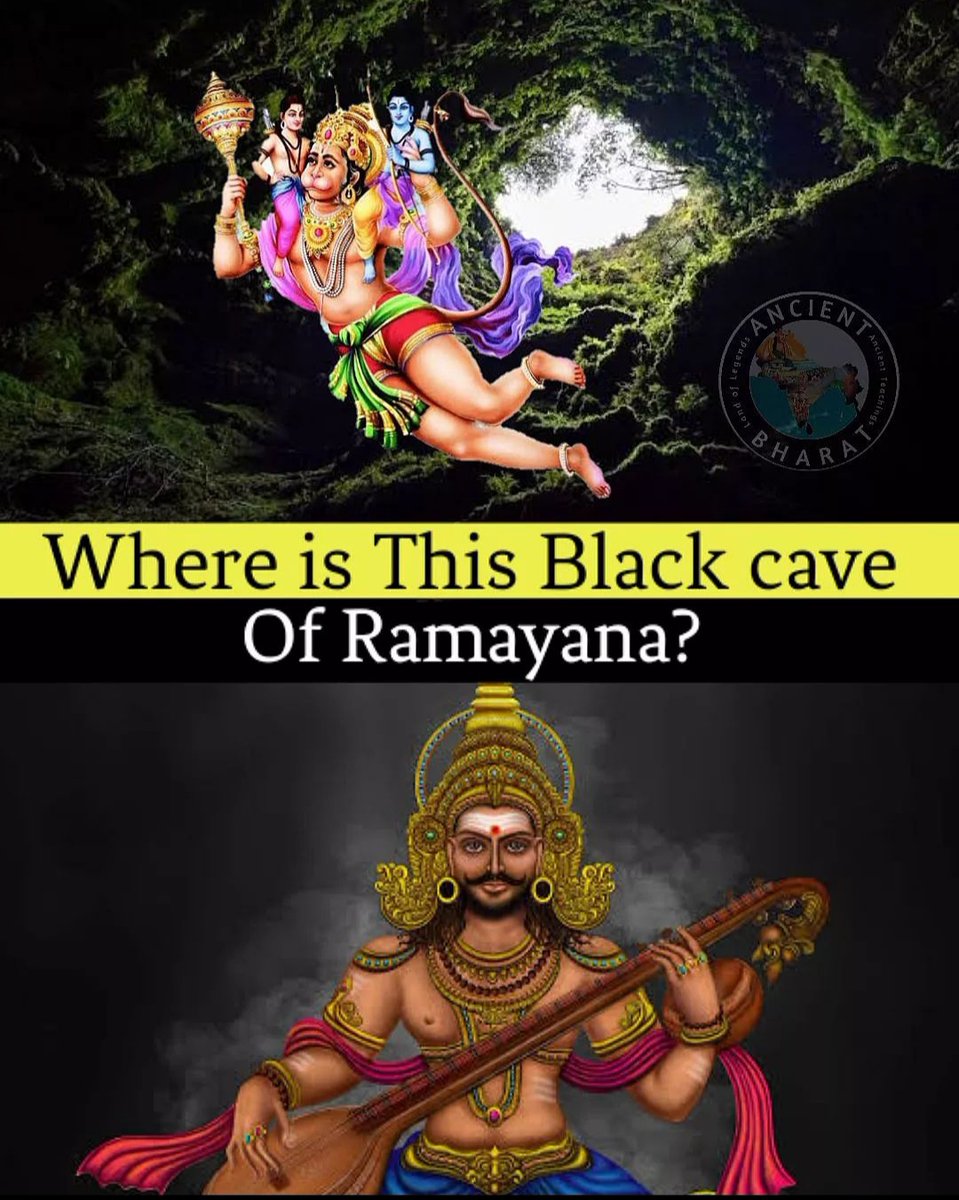
However, the ancient Indian epic tale "Ramayana" envisioned a scenario in which travel into another universe or time zone was accomplished via a black tunnel that served as a wormhole.
An Einstein-Rosen bridge, another name for a wormhole, is a theoretical topological property of spacetime that functions as a kind of "shortcut" through spacetime. Similar to a tunnel, a wormhole has two ends, each at a different location in spacetime.
Wormhole in Ramayana
The philosopher Valmiki relates a situation when Hanuman, Angada, and other Vanaras waited at Mount Vindhya above the time limit set by their monarch Sugreeva to retrieve Seetha and return to their realm in Kishkinda Kanda (Sarga 50-52) of the Ramayana.
The philosopher Valmiki relates a situation when Hanuman, Angada, and other Vanaras waited at Mount Vindhya above the time limit set by their monarch Sugreeva to retrieve Seetha and return to their realm in Kishkinda Kanda (Sarga 50-52) of the Ramayana.
During their exploration, they came to the Riksha Cavern, a wide-open, impenetrable space that is well-guarded by the demon Maya.
When hunger and thirst overcame them, they became exhausted and craved water. As such, they saw the large cavity that is covered in climbers and trees.
Swans and other waterfowl, including Kraunca, Saarasa, and even Cakravaka waterfowl, have been observed leaving the cavity there with their bodies covered in water and stained by the pollen of lotuses.
The best vanaras are discouraged with wonder as they draw closer to that perfumed and opaque hollow.
The very resplendent and great gigantic fly-jumpers have approached it, revelling in the presence of water there, despite their suspicions that it is Naraka, The Hell of Yama, or Paataala, the Netherworld of Emperor Bali.
Similar to the abode of the emperor of demons, namely Emperor Bali, in Paataala, the Netherworld, that terrible hollow is scattered with various entities and is unpleasant and impermeable from everywhere.
Hanuman addressed all of the powerful Vanaras after carefully examining every mysterious woodland. Albert Einstein contemplated the use of wormholes as potential pathways for time and space travel during the 20th century.
However, the ancient Indian epic tale "Ramayana" envisioned a scenario in which travel into another universe or time zone was accomplished via a black tunnel that served as a worm hole.
An Einstein-Rosen bridge, another name for a wormhole, is a theoretical topological property of spacetime that functions as a kind of "shortcut" through spacetime.
Similar to a tunnel, a wormhole has two ends, each at a different location in spacetime.
Similar to a tunnel, a wormhole has two ends, each at a different location in spacetime.
Where is this Black Cave of Ramayana?
A team of anthropologists working with hill tribes in Hoshangabad, formerly known as Narmadapura in Madhya Pradesh, under the direction of archaeologist Mohammed Wasim Khan of the Archeological Environment Research
A team of anthropologists working with hill tribes in Hoshangabad, formerly known as Narmadapura in Madhya Pradesh, under the direction of archaeologist Mohammed Wasim Khan of the Archeological Environment Research
and Tribal Welfare Society made an astonishing finding. In Raisin, they discovered caves tucked away in a dense forest. A remarkable prehistoric painting depicting a person wearing a catsuit, a flying device that resembles a UFO,
and a cylindrical spring-like feature (perhaps a wormhole path) was discovered in one of these caves. Does the scenario from the Ramayana that has Swayamprabha in a cat suit made of deer skin, flying machines, and a wormhole appear in this painting?
In reality, the Mundakopanishad also describes the idea of a black hole (Viswaruchi) and other scientific concepts.
Hanuman travels to Paatala (Brazil) in Yuddha Kanda of the Ramayana to locate kidnapped Ram and Lakshman. He does this by passing via a tunnel that speeds up his travel time.
Hanuma and other characters are told the story of Black Cave by Swayamprabha, a holy woman who guards a demon named Maya's paradisiacal creation. Maya created this cave to resemble heaven on earth, which angered Indra, who killed Maya.
Swayamprabha, a nymphal-virtuoso apsara, receives this wonderful creation from Hema, who also grants hospitality to all the monkeys who entered the cave.
Sainted Lady Swayamprabha is responsible for rescuing Vanaras from the black hole.
Sainted Lady Swayamprabha becomes empathetic after hearing about the plight of the monkeys who entered this cavity to look for Seetha and offers guestship.
Sainted Lady Swayamprabha becomes empathetic after hearing about the plight of the monkeys who entered this cavity to look for Seetha and offers guestship.
Swayamprabha asks Vanaras to cover their eyes before using her ascetic abilities to transport the monkeys from that cave, which exit is otherwise impossible for any other intruder, in his aliveness,
when Hanuman begs for a way out of that confinement and as the period set by Sugreeva has passed in this very cavity.
Vanaras find themselves lost in an ocean south of the Vindyas after emerging from Black Cave.
Source: Ancient.Bharath_
Loading suggestions...