

An interesting Chinese solar PV policy program that hasn't gotten the airtime it deserves: Whole-County Rooftop Solar 整县屋顶光伏.
I think this policy, more than anything else, has led to China's record-setting figures in 2022 for distributed solar.
What is it? Thread!🧵
I think this policy, more than anything else, has led to China's record-setting figures in 2022 for distributed solar.
What is it? Thread!🧵
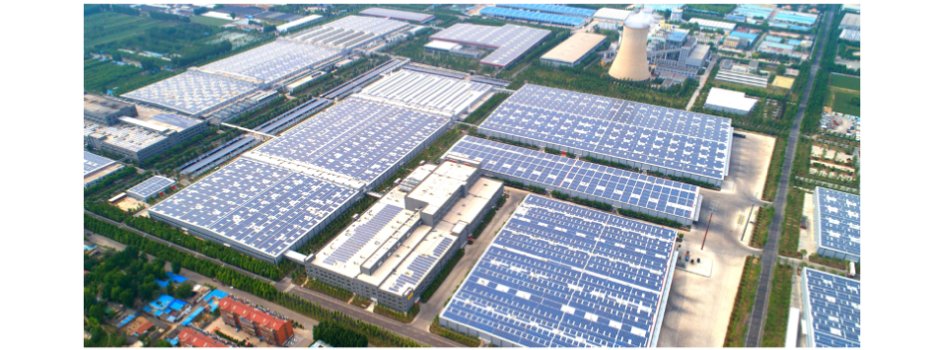
This has been covered in industry media, by the way, but not mainstream, but I wish it would.
Basically, a county is partnered with a large developer in the PV sector to cover XX% of the rooftops in that county with solar PV by a certain date. See:
taiyangnews.info
Basically, a county is partnered with a large developer in the PV sector to cover XX% of the rooftops in that county with solar PV by a certain date. See:
taiyangnews.info
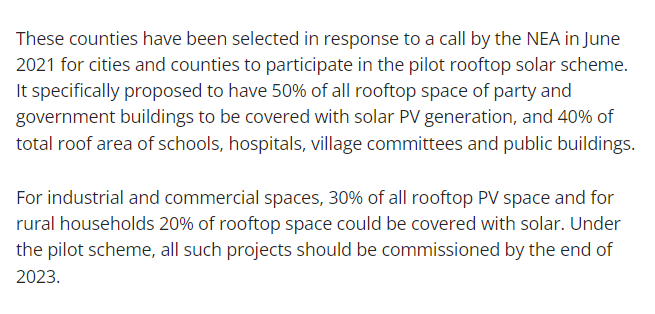
It's worth pointing out that "County" usually means any administrative district at the county level, not necessarily just counties 县, per se.
So that would include county-level cities 县级市 and even city districts 区. See, for example, the 19 pilot sites in Hubei:
So that would include county-level cities 县级市 and even city districts 区. See, for example, the 19 pilot sites in Hubei:

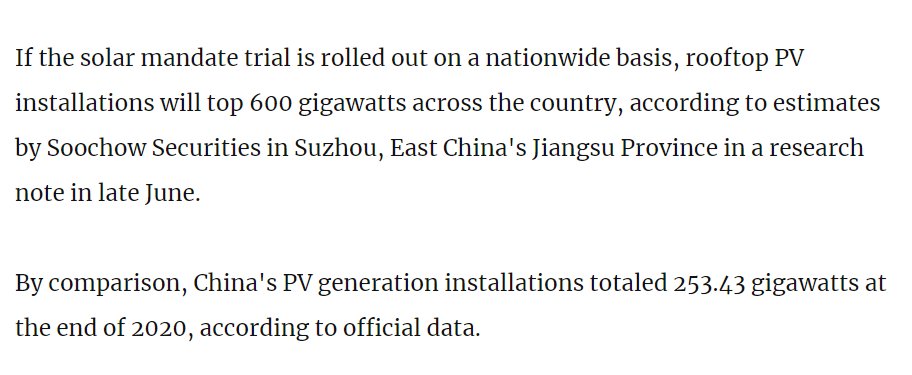
Back in 2021 when the pilot policy was announced, Chinese analysts estimated that implementation of this policy alone represented 600GW (!!) of distributed solar capacity market potential - even with the relatively low coverage targets for residential (just 20%).
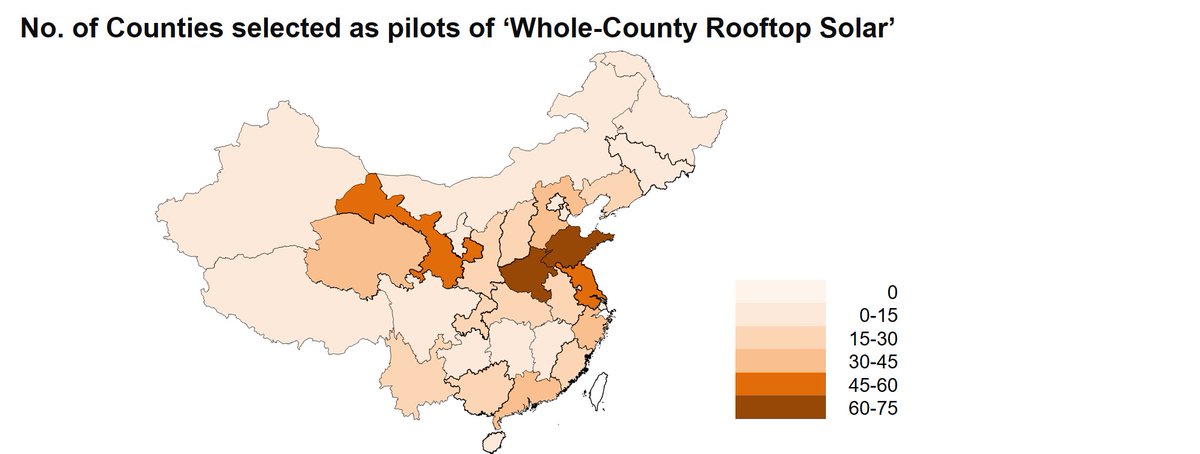
Shortly thereafter, the first batch of 676 pilot counties selected for Whole County Rooftop Solar were announced (there was an application and vetting process).
In places like Shandong or Henan, more than 75% of the counties in the whole province were selected.
In places like Shandong or Henan, more than 75% of the counties in the whole province were selected.
Whole County projects may adopt one of two models:
1. The owners of the rooftops finance the panels themselves and sell the power to the developer;
2. The developer leases the rooftop space from the owners and owns the panels themselves.
The first model is preferred. Why?
1. The owners of the rooftops finance the panels themselves and sell the power to the developer;
2. The developer leases the rooftop space from the owners and owns the panels themselves.
The first model is preferred. Why?
Two reasons:
1. The residents can apply for a VAT exemption for installing rooftop solar.
2. The rural residents tend to take better care of the solar panels when they own them.
There have been problems with rural residents using the panels to hang clothes or dry grain...lol
1. The residents can apply for a VAT exemption for installing rooftop solar.
2. The rural residents tend to take better care of the solar panels when they own them.
There have been problems with rural residents using the panels to hang clothes or dry grain...lol
Obviously the work involved to organize these projects is massive. The developer must submit a consolidated tender to develop the whole county.
This involves an extensive canvassing effort together with local gov't to identify residents willing to host solar panels.
This involves an extensive canvassing effort together with local gov't to identify residents willing to host solar panels.
It's common for this to be farmed out to smaller "village-level" or "town-level" developers, who take the work of identifying the rooftops, secure project development rights, & package it up and 'sell' their piece of the project up the chain to the Big Developer (often an SOE).
There are challenges of course. For instance, unsophisticated rural residents could be pressured to take on bad loans by unscrupulous local developers. We've seen this before for poverty-alleviation projecs too - it's nearly inevitable when you decentralize execution this much.
More care needs to be taken to protect rural residents from bad solar panel debt, & more avenues made available to punish those who take advantage unfairly.
Other types of rooftop owners like industrial parks or hospitals are likely to be savvy enough to stay out of bad deals.
Other types of rooftop owners like industrial parks or hospitals are likely to be savvy enough to stay out of bad deals.
Another issue is the sheer volume of the solar power coming online could create issues for the local grid infrastructure.
We've seen cases of local grid companies demanding a halt/slowdown of these buildouts for this reason, citing insufficient offtake capability/congestion.
We've seen cases of local grid companies demanding a halt/slowdown of these buildouts for this reason, citing insufficient offtake capability/congestion.
But at the end of the day, that's more of a good problem to have.
In these cases, the onus is on the developer to predict local grid congestion caused by these programs and forecast resulting curtailment that will reduce project revenue. We're working on such a project now.
In these cases, the onus is on the developer to predict local grid congestion caused by these programs and forecast resulting curtailment that will reduce project revenue. We're working on such a project now.
I think it's a great example of how to merge public & private resources to implement top-down policy.
A national policy + a rich developer (often SOE) + an army of local-level hustlers, public AND private, a machine that will cover millions of rooftops with solar in just 2 yrs.
A national policy + a rich developer (often SOE) + an army of local-level hustlers, public AND private, a machine that will cover millions of rooftops with solar in just 2 yrs.
Overall, I think this model is one to take notice of, both for what it means for solar development in China, but also for applicability in other countries.
I'd like to hear from people with experience in other markets how/why this would/wouldn't work where you are.
I'd like to hear from people with experience in other markets how/why this would/wouldn't work where you are.
I should clarify - 600GW of potential once the policy is extended to all eligible counties, not just the ones in the pilot.
Loading suggestions...