
My new essay, published at the @CSPICenterOrg Substack, introduces the issue of airspace markets.
Airspace, I argue, resembles spectrum in the 1980s: an appreciating asset that can be bought, subleased, traded, & borrowed against—if it were only permitted. cspicenter.com
Airspace, I argue, resembles spectrum in the 1980s: an appreciating asset that can be bought, subleased, traded, & borrowed against—if it were only permitted. cspicenter.com
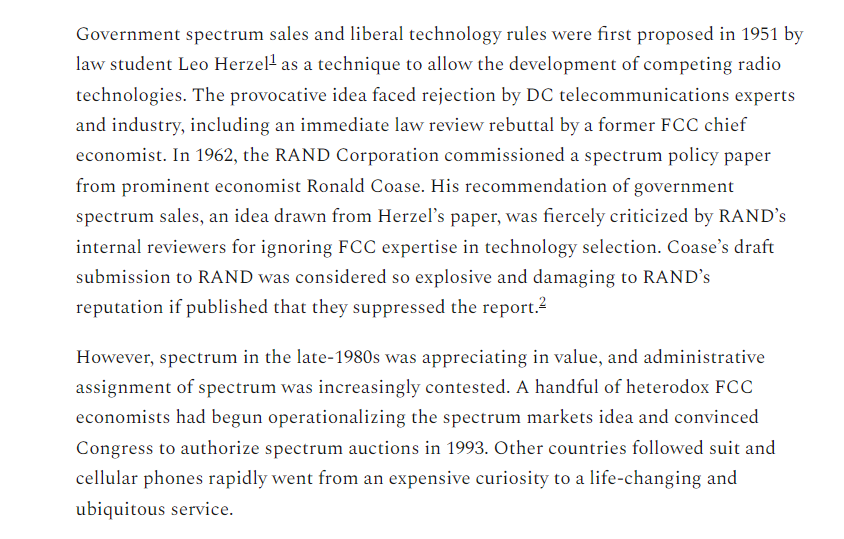
For decades, spectrum was treated like a semi-sacred natural resource and rationed out to industry members only after government experts carefully determined which potential spectrum users would maximize the "public interest."
Government spectrum sales were first proposed in 1951 by law student Leo Herzel as a technique to allow the development of competing radio technologies. It took 40 years (and help from Ronald Coase) for the econ profession and governments to come around to the idea.
Airspace likewise is an appreciating asset and—like cellular spectrum in the 1980s—new tech (electrification, drones, eVTOL) means many new potential users. Before congestion, it's time for regulators to shift airspace from a regulated commons system to a property-like system.
Rationing access to a regulated commons works okay when there's relatively few users. FAA actively manages about 5,400 aircraft at any one time. Millions of drones can't be managed similarly. Property institutions allow a larger number of potential users to share an asset.
Airspace is valuable (airport slots sell for millions) and the current system = a goldrush and DC insider problem for drones. A McKinsey report on passenger drones noted: “[F]irst movers will have an advantage by securing the most attractive sites along high-traffic routes.”
Low-altitude drone airspace is mostly "clean sheet." There's still time for regulators to adopt new institutions and airspace markets that avoid bureaucratic sclerosis and anticompetitive lobbying battles. Some recommendations:
For low-altitude airspace, regulators should endorse the ability of linear property owners to lease airspace to drone & property investors. This could almost immediately summon 8 million miles of drone corridors into existence above roadways & railroad & utility rights-of-way.
For higher-altitude routes, the agency should begin designating cargo and passenger drone routes—central business district to airport corridors will be in high demand—and announce a policy of competitive bidding when there are more interested parties than corridors.
The USDOT and FAA should form an interagency task force with the FCC to advise on auction and lease of government assets. The FCC’s spectrum team has conducted dozens of auctions of public assets yielding hundreds of billions of dollars of revenue.
Loading suggestions...