

In Shaivism, Thirumoolar is regarded as a leading person. He ranks as one of the Nayaanars and is one of the 18 respected Siddhas of the Tamizh tradition (63 revered Saints of Shaivism)
#LongThread
#LongThread
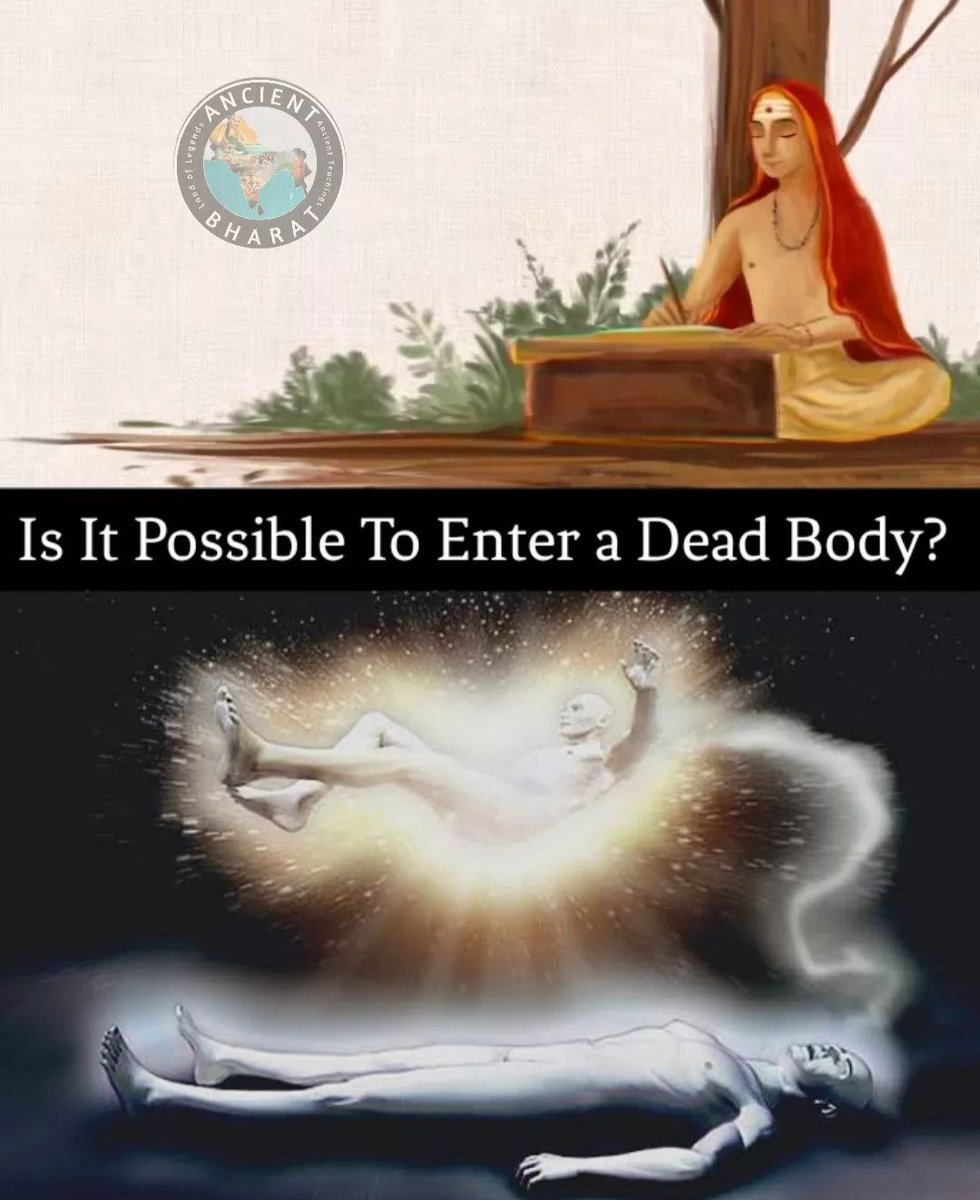
His story has several versions to it. For standardization, we shall look at what the Periya Purana has to say :
Shaiva Siddha Thirumula Nayanar practiced. He was one of Thiru Nandi Deva's eight pupils. Because he invaded Mulan's dead body, he is known by the name Thirumular.
Shaiva Siddha Thirumula Nayanar practiced. He was one of Thiru Nandi Deva's eight pupils. Because he invaded Mulan's dead body, he is known by the name Thirumular.
Tirumular wanted to visit the Pothia highlands to see Agastya Rishi. He then departed Kailasha and headed south. He stopped at numerous Shaivite shrines along the way. He bathed in the Kaveri River when he arrived in Tiruvavaduthurai and then visited the shrine.
He twice walked around the temple. A herd of cows was sobbing when he was strolling along the Kaveri riverbank. He discovered the cause: a dead cow herd. After hiding his native body under a tree's trunk, He entered the cowherd's body to appease the animals.
Mulan, a cowherd from Sattanur, went by the name. He returned the cows to the settlement in the evening. Mulan's wife was looking forward to her husband's arrival. Oh, lady, I am not your husband, he exclaimed. Worship Lord Shiva to find freedom.
The woman voiced her concerns to the village leader. They investigated and determined that he had acquired enlightenment. They so requested that she leave him be. The following day, Thirumular pursued the cows but was unable to locate his native corpse, which he had hidden.
Thirumular left towards Tiruvavaduthurai once more. He meditated while sitting beneath the nearby peepul tree. Three thousand years passed when he was in Samadhi.
He descended from Samadhi every year and unveiled a verse of truth; as a result, he produced three thousand stanzas over three thousand years. The title of this book is Tirumanthiram.
Condensing the Story
We saw a Siddha who successfully transferred his consciousness to a dead corpse. How is this even conceivable?
Pancha Kosha (five sheaths in man)
We saw a Siddha who successfully transferred his consciousness to a dead corpse. How is this even conceivable?
Pancha Kosha (five sheaths in man)
The Vedas speak about something called the "Pancha Kosha" (five sheaths), which is what we modern people refer to as the "self."
Each of these Pancha (five) Koshas makes up both you and I.
Each of these Pancha (five) Koshas makes up both you and I.
Temple deities communicate through life energy (pranamaya kosha). Since they lack an annamaya Kosha (flesh body), we perform these rituals to transmit life force from food to the idol.
Incoming breath is known as prana (respiration). Sensation and mental function are controlled by prana.
As a result, even though your hair lacks Prana because it lacks sensibility and includes the other companions, it is still considered a living tissue ( samana, apaana, udaana and vyaana )
We must therefore comprehend that just the prana portion of the kosha has stopped when a body falls and ceases breathing. Prana exits the body fully in up to 1 1/2 hours.
.
The other four - Samaana,Apaana,Udaana and Vyaana are still intact though the body is not breathing !
.
The other four - Samaana,Apaana,Udaana and Vyaana are still intact though the body is not breathing !
Because the vital parts listed above are still present in the body, Hindus traditionally cremate a body after a short period of time. This indicates that the deceased was still somewhat "alive," albeit not breathing.
It is not practical to keep the body for so long because the Vyana can take up to two weeks to entirely leave the body.
So we at least ensured that the Prana aspect has ceased before burning, so that the person's respiratory faculty is entirely down, shutting his sensation and mental function.
When Mulan died,the cessation of breathing did not negate the life process in him entirely. In addition,it was a 'snakebite'.Possibly a cobra bite.
Cobra venom can cause acute respiratory failure because of the neurotoxins.So he could have experienced an instant death.
In other words,Moolan might have stopped breathing but his prana had not entirely left the body ( remember that it may take upto 1 1/2 hours for that ).It was during this interval in which the Siddha came and saw the situation.
The first is the Annamaya Kosha which is our physical body.We eat and add matter to this lump called flesh.But this alone does not constitute a person.
The second sheath or layer is the Pranamaya Kosha.This Kosha represents life-breath.A body has to be respiring aight?
.
The third is Manomaya Kosha - the Mind.
.
The third is Manomaya Kosha - the Mind.
The fourth is Vignyaana Maya Kosha - The Wisdom Sheath.A person who is centralised in this kosha is wisdom-rich.
Finally,the fifth is Anandamaya Kosha - The Bliss Sheath.This layer is most significant as bliss is our essential state. A person centralised here is always blissed-out.
.
In fact,the first 4 kosha-s arise from the bliss sheath - which is the state of Atma or godhood.
.
In fact,the first 4 kosha-s arise from the bliss sheath - which is the state of Atma or godhood.
Man evolves in consciousness through these 'koshas' in tandem with self-realization. The layers actually progress from the grossest ( physical ) to the most subtle. Enlightenment is moving towards the subtle from gross - from the identity of body & mind to universal consciousness
The Gayatri Mantra expresses this in the second facet of 'bhur bhuvah suvaha' - from bhu loka to suvarga loka - gross to subtle.
.
The Brahmandavalli - also part of the Upanishad expounds on the Pranamaya Kosha and its components - the five vital airs.
.
The Brahmandavalli - also part of the Upanishad expounds on the Pranamaya Kosha and its components - the five vital airs.
The Pancha Kosha-s are sustained by the five vital airs :
.
(1) Prana
(2) Samaana
(3) Apaana
(4) Udaana
(5) Vyaana
.
(1) Prana
(2) Samaana
(3) Apaana
(4) Udaana
(5) Vyaana
If you pay attention to temple rituals, you will notice priests uttering these dimensions of Pranamaya Kosha when offering of food ( Naivedya ) is done to the deity. Water is sprinkled around the naivedya.
Whilst, dimension is uttered with 'svaha' as its suffix. Eg .. Om Praanayaa Svahaaa ..Apaanaaya Svahaa... etc and finally ending it with ' Brahmane Svahaa...
Source: ancient.Bharath_
Loading suggestions...