

News that Russia is firing S-300 surface-to-air missiles (Ukrainian example shown below) at ground targets is producing quite a lot of comments along the lines of 'OMG Russia is desperate'. I think that view is mistaken. A short 🧵. /1
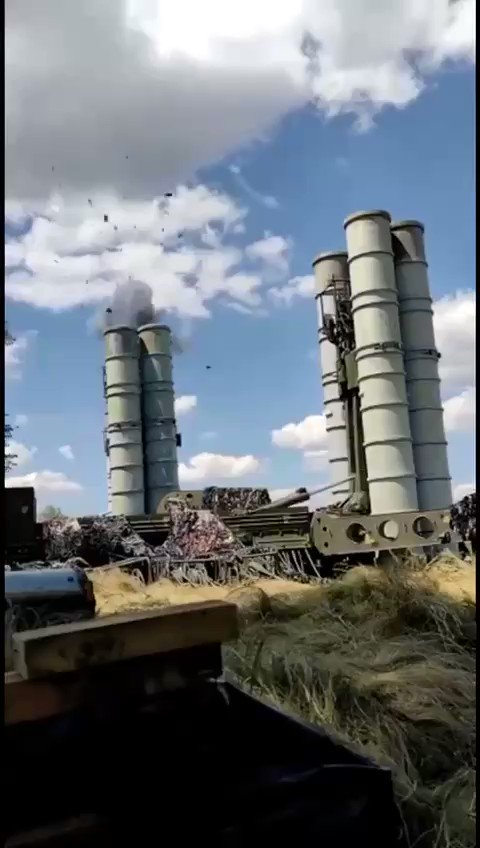
It's easy to picture a surface-to-air missile: it's a ground-launched rocket that flies at extremely high velocity to target and destroy enemy air vehicles. But the Russians did things a bit differently with the S-300. /2

Designed in the late 1960s and 1970s, the S-300 uses over 20 missile variants. Russia currently uses the 5V55K, 5V55R, and 48N6 missiles with high-explosive fragmentation warheads weighing up to 144 kg. /3

It's a very effective system which is part of a wider complex including a long-range surveillance radar, command vehicles and engagement radar in addition to the launch vehicle. The elements of the system can be placed as much as 40 km apart. /4
The long-range radar can track objects up to 300km (185 miles) away. Each battalion has 6 launch vehicles with 2 missiles each. At the instruction of the command vehicle, the best-placed launchers fire at the target. The engagement radar can guide up to 12 missiles at once. /5

It's a widely-used system with 16 communist or former communist countries, in addition to Russia, operating it. Three NATO countries currently or formerly operated it: Bulgaria, Slovakia and Greece. Slovakia has donated its battery to Ukraine. /6

The Greek battery arrived there by an odd route: it was originally purchased by Cyprus in 1997, but following a crisis that nearly led to a war with Turkey, it was transferred instead to Greece in 1998 (and is shown here being test-fired). Why was Turkey so upset about it? /7

The S-300, with its range of up to 150km, could have denied Turkey access to its own airspace – Cyprus is only 75 km away. But even more dangerously, its relatively little-known ground attack capability could have been used to attack ground targets inside Turkey. /8
According to Belarussian reports, the S-300 can hit ground targets up to a range of 120 km. In fact, it can go much further – tests in the 1980s showed it could travel 400 km on a ballistic trajectory, reaching an altitude of 70 km. /9
The main limitation is the guidance system. Although the Soviets designed the S-300 with a ground-to-ground capability, they had little practical use for it and did not bother developing it. They relied instead on dedicated ground-to-ground systems like the OTR-21 Tochka. /10

By the 2010s, the situation had changed: the Tochka was being phased out, to be replaced by the more expensive Iskander, and Russia had large stocks of S-300s in its arsenals, which were being replaced by more capable S-400s. The S-300s were therefore expendable.
According to the Ukrainian government, the Russians have retrofitted S-300s with satellite navigation units. The missiles are now capable of carrying out ground attacks with a greater (though still limited) accuracy than was possible with unmodified S-300s. /12
This is not a new capability. In October 2011, the Belarussian armed forces practiced hitting "important ground targets on the territory of a potential enemy" with modified S-300s. /13

A similar exercise took place in Russia in May 2017, when Rossiyskaya Gazeta reported that units of Russia's Eastern Military District fired five S-300 missiles at a simulated "unknown armed formation" of enemy vehicles during a training exercise. /14
According to RIA Novosti, the S-300s "receive their coordinates from reconnaissance units of the ground forces." Belarussian media sources say that the S-300 uses the target’s coordinates, set before the launch, to guide its onboard inertial system. /15
The coordinates can be updated in flight via a radio link. In the terminal phase, the missile uses semi-active radar homing to bring it onto the target. /16
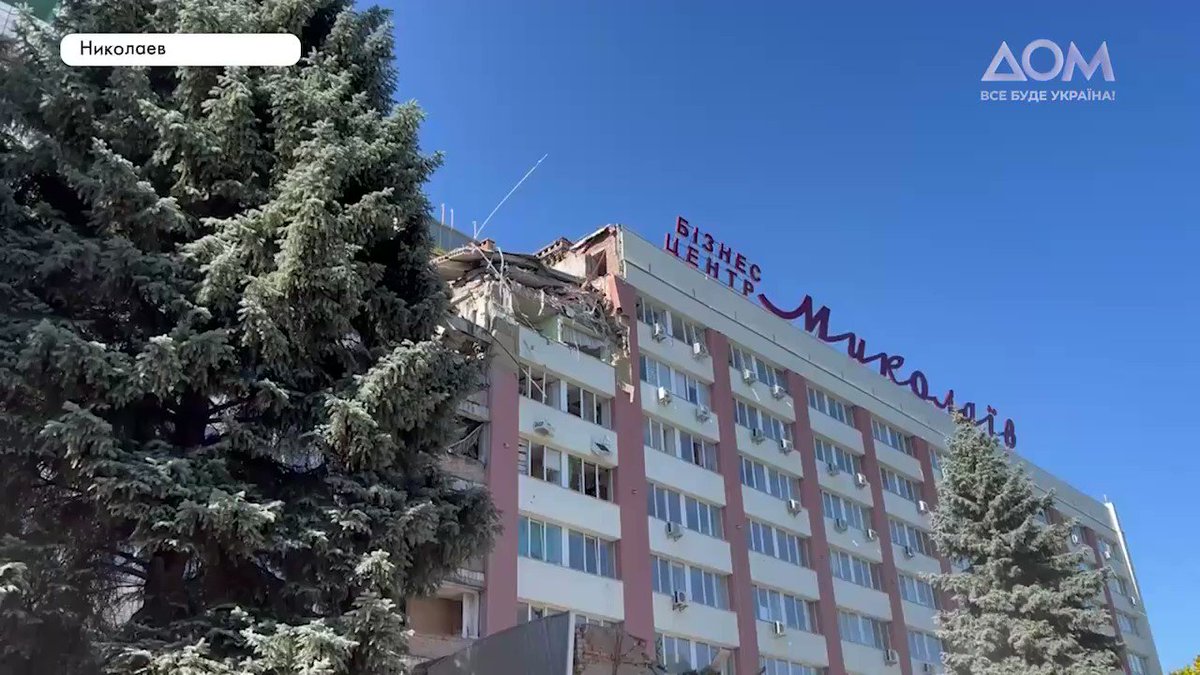
S-300s have reportedly been used to hit ground targets in the Lugansk, Donetsk and in the last few days Mykolaiv regions, though according to Mykolaiv's governor their accuracy and effect has been low. /17

Their effect is also likely to be quite limited - one of the buildings hit in Mykolaiv, a hotel, suffered only fairly modest damage. A 144 kg warhead isn't a joke but it's small compared to bigger missiles like Kalibr. /18
I don't think Russia using these missiles is a sign of desperation. It has a large stock of them, probably tens of thousands, and it's using all the assets at its disposal to win its war in Ukraine. If it has plentiful expendible missiles, why not use them? /19
Given its inaccuracy and small warhead, I don't think the S-300 is likely to be very useful as a ground attack weapon. It's more likely being used simply because it's available, and more as a terror weapon than to achieve purely military goals. /end
Looks like Ukraine is hitting back at S-300 batteries being used for ground attacks:
Loading suggestions...