

Startups may fail. But entrepreneurs ALWAYS succeed!
After 2 failures, this IITB duo found their next idea on Twitter!
2005 ➝ Startup 1 fails
2008 ➝ Startup 2 fails
2011 ➝ BrowserStack is BORN
2021 ➝ 200M revenue & $4B valuation
Here's BrowserStack's inspiring story! 🧵
After 2 failures, this IITB duo found their next idea on Twitter!
2005 ➝ Startup 1 fails
2008 ➝ Startup 2 fails
2011 ➝ BrowserStack is BORN
2021 ➝ 200M revenue & $4B valuation
Here's BrowserStack's inspiring story! 🧵
1/ The early journey
Ritesh Arora & Nakul Aggarwal were roommates pursuing Computer Science at IIT Bombay.
They came from a hardcore business family. So the duo had set their hearts on becoming entrepreneurs.
Given their IIT tag they were ready to take the plunge!
(contd.)
Ritesh Arora & Nakul Aggarwal were roommates pursuing Computer Science at IIT Bombay.
They came from a hardcore business family. So the duo had set their hearts on becoming entrepreneurs.
Given their IIT tag they were ready to take the plunge!
(contd.)
Startup 1 — Sentiment Analysis
They started working on their first idea during the final year of BTech.
It was 2005, and Ritesh got very interested in the topic of Sentimental Analysis.
He read 76 research papers on NLP & ML to solve a particular problem statement.
(contd.)
They started working on their first idea during the final year of BTech.
It was 2005, and Ritesh got very interested in the topic of Sentimental Analysis.
He read 76 research papers on NLP & ML to solve a particular problem statement.
(contd.)
Problem Statement
1. Consider a site like Amazon, that has 1000s of reviews under any product.
2. Now, no one customer can go through all these reviews to make the best decision.
3. But, statistically, the data can suggest the general sentiment about the product.
(contd.)
1. Consider a site like Amazon, that has 1000s of reviews under any product.
2. Now, no one customer can go through all these reviews to make the best decision.
3. But, statistically, the data can suggest the general sentiment about the product.
(contd.)
So, the duo built software that'd derive insights from data & present them to users.
The idea was to have this software as a layer on top of a company like Amazon.
They worked on the product for a year. But, after being rejected by 50 VCs, they dumped the idea.
(contd)
The idea was to have this software as a layer on top of a company like Amazon.
They worked on the product for a year. But, after being rejected by 50 VCs, they dumped the idea.
(contd)
Startup 2 — Information Aggregation
Ritesh & Nakul eventually took up day jobs. But the startup bug was still alive and thriving!
Their second attempt was focused on information aggregation.
Problem Statement => Consolidate all the data on any topic on the internet.
(contd.)
Ritesh & Nakul eventually took up day jobs. But the startup bug was still alive and thriving!
Their second attempt was focused on information aggregation.
Problem Statement => Consolidate all the data on any topic on the internet.
(contd.)
Example => If the topic is "Elon Musk", you'll aggregate all the unique information on this topic from pages on the internet
This idea instantly got traction & it was number 1 on Hacker News.
But the duo couldn't figure out a way to monetize it. So, they had to dump it.
This idea instantly got traction & it was number 1 on Hacker News.
But the duo couldn't figure out a way to monetize it. So, they had to dump it.
2/ Building a service business!
Two failed startups over 6 years are enough to crush your hopes. But, Ritesh and Nakul learned very important lessons through them.
The previous 2 attempts had the same problem:
1. How to monetize the idea?
2. How to get real customers?
(contd.)
Two failed startups over 6 years are enough to crush your hopes. But, Ritesh and Nakul learned very important lessons through them.
The previous 2 attempts had the same problem:
1. How to monetize the idea?
2. How to get real customers?
(contd.)
The flaw here was in the approach.
In both cases, the duo started with an idea and began building the product.
They used ML to solve the problem (a rarity for 2005) and pulled it off. Kudos, right!?
But this only made for a great project but not a good business.
(contd)
In both cases, the duo started with an idea and began building the product.
They used ML to solve the problem (a rarity for 2005) and pulled it off. Kudos, right!?
But this only made for a great project but not a good business.
(contd)
So, they had to start thinking like entrepreneurs rather than engineers!
💡 Lessons:
1. Startups should be
⇒ Customer-driven > Idea-drive
2. DON'T build startups based on popular trends. Build to solve real customer problems.
So, their search for a problem began.
(contd.)
💡 Lessons:
1. Startups should be
⇒ Customer-driven > Idea-drive
2. DON'T build startups based on popular trends. Build to solve real customer problems.
So, their search for a problem began.
(contd.)
They spent over a year looking for a good problem, but it was in vain.
They had also left their jobs at this point. So the stakes were high.
That's when a great idea came along!
You see, the duo was excellent at building products, although their startups failed.
(contd.)
They had also left their jobs at this point. So the stakes were high.
That's when a great idea came along!
You see, the duo was excellent at building products, although their startups failed.
(contd.)
So, they launched their 3rd startup Downcase - a profitable consultancy business!
The consultancy company was a much-needed lifeboat for them.
And, it allowed them to stay on their entrepreneurial journey and also sustain themselves.
(contd.)
The consultancy company was a much-needed lifeboat for them.
And, it allowed them to stay on their entrepreneurial journey and also sustain themselves.
(contd.)
💡 Lessons:
1. Start as a service, buildd product later
2. A service business brings you immediate revenue & cash flow. So start by making your offering a service (eg. consulting) while building your product on the side.
1. Start as a service, buildd product later
2. A service business brings you immediate revenue & cash flow. So start by making your offering a service (eg. consulting) while building your product on the side.
3/ Discovering THE problem to solve!
Their search to discover a universal problem ended while they were working on Downcase.
Ritesh and Nakul were preparing to scale their consultancy company and for that, they needed to buildd a website.
(contd.)
Their search to discover a universal problem ended while they were working on Downcase.
Ritesh and Nakul were preparing to scale their consultancy company and for that, they needed to buildd a website.
(contd.)
Nakul quickly built a website & the only task left was testing.
They both despised testing, so they got into an argument over who'll be testing that day.
That was the EUREKA moment!
The duo thought that surely they cannot be the only developers who hate testing.
(contd.)
They both despised testing, so they got into an argument over who'll be testing that day.
That was the EUREKA moment!
The duo thought that surely they cannot be the only developers who hate testing.
(contd.)
After all, building a website in 2 days & testing it for 4 days doesn't sound fair or even productive.
A quick one-day search on Twitter showed that developers were not only facing the same problem but they were also extremely vocal about it.
(contd.)
A quick one-day search on Twitter showed that developers were not only facing the same problem but they were also extremely vocal about it.
(contd.)
If this problem had troubled 1000+ developers to harass Microsoft every day on Twitter. Then, it was surely a problem worth solving!
But, what is so bad about testing?
Well, you see, your users might run your website on a number of different browsers.
(contd.)
But, what is so bad about testing?
Well, you see, your users might run your website on a number of different browsers.
(contd.)
So you need to make sure the site runs perfectly in different environments.
With Microsoft's Internet Explorer, some of the problems were
1. Getting access to older versions of IE
2. Testing on Macbook (iOS)
So, Nakul and Ritesh decided to solve it with BrowserStack!
With Microsoft's Internet Explorer, some of the problems were
1. Getting access to older versions of IE
2. Testing on Macbook (iOS)
So, Nakul and Ritesh decided to solve it with BrowserStack!
4/ Evolution of BrowserStack
Version One
Since all the complaints were exclusively directed towards Internet Explorer, BrowserStack only focused on building an IE testing software.
The tool was ready in 4 months & was released as a free version.
(contd.)
Version One
Since all the complaints were exclusively directed towards Internet Explorer, BrowserStack only focused on building an IE testing software.
The tool was ready in 4 months & was released as a free version.
(contd.)
The product was a HIT!
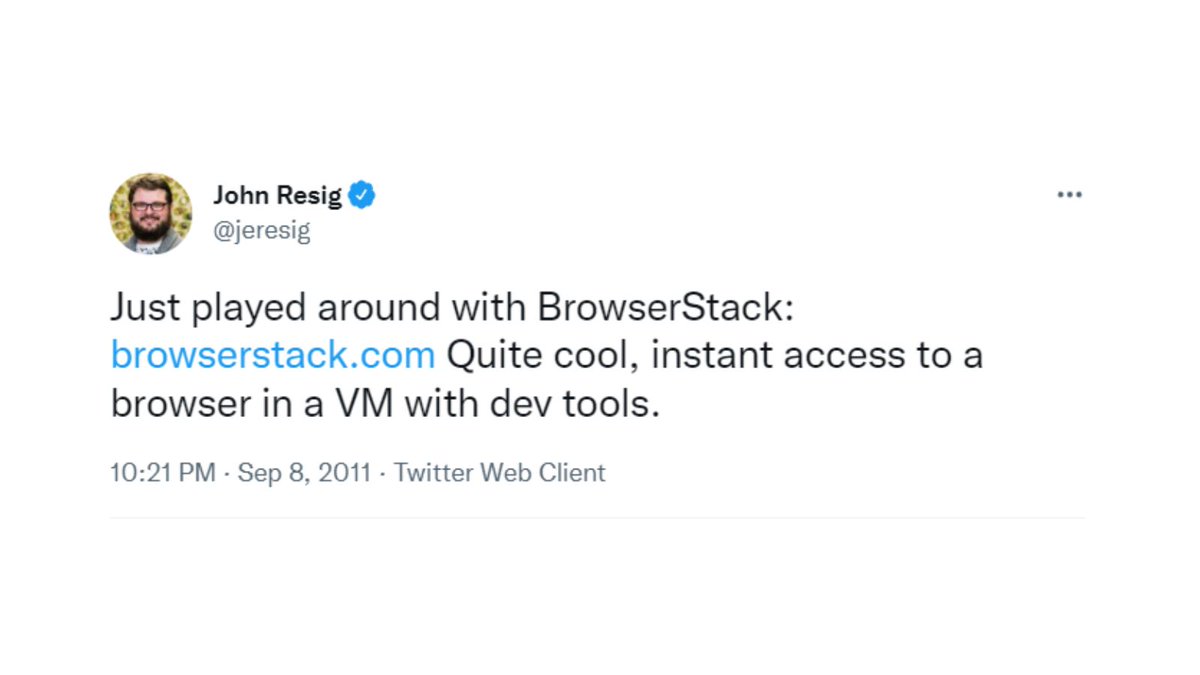
Ritesh and Nakul, even reached out to John Resig, jQuery founder to get his feedback.
And he was instantly thrilled that someone had finally solved this problem.
He tweeted about BrowserStack which resulted in 10K beta user sign-ups in 3 weeks!
(contd)
Ritesh and Nakul, even reached out to John Resig, jQuery founder to get his feedback.
And he was instantly thrilled that someone had finally solved this problem.
He tweeted about BrowserStack which resulted in 10K beta user sign-ups in 3 weeks!
(contd)
Version Two
As more and more developers started using the product its popularity increased.
People started demanding a paid version with better functions.
So, the duo released the second version in a few months & they got 10 paying customers on the first day!
(contd.)
As more and more developers started using the product its popularity increased.
People started demanding a paid version with better functions.
So, the duo released the second version in a few months & they got 10 paying customers on the first day!
(contd.)
While building BrowserStack Nakul & Ritesh actively avoided making the same mistakes as their first 2 startups.
Their approach here was simple
⇒ Work fast ➝ Fail fast ➝ Try new iteration.
They didn't sit for a year to buildd the best testing software out there.
(contd.)
Their approach here was simple
⇒ Work fast ➝ Fail fast ➝ Try new iteration.
They didn't sit for a year to buildd the best testing software out there.
(contd.)
No! They instead focused on building a quick solution that was most in demand.
💡 Lessons:
1. Keep shipping ⇒ Perfect is the enemy of good.
2. Use tech to buildd your startup. DON'T use your startup to buildd fancy tech.
(contd.)
💡 Lessons:
1. Keep shipping ⇒ Perfect is the enemy of good.
2. Use tech to buildd your startup. DON'T use your startup to buildd fancy tech.
(contd.)
3. Don't try to solve all problems at once. Solve the most critical problems first. Iterate for the rest in later versions.
4. When building a product, always think of building an MVP first. Launch a version of the product, get feedback, iterate & build on top of it.
4. When building a product, always think of building an MVP first. Launch a version of the product, get feedback, iterate & build on top of it.
5/ Rise to $4B valuation
Since the 1st iteration in 2011, BrowserStack has gone through many more evolutions.
And, as the product improved, so did the revenue!
Within 6 months, BrowserStack acquired 1k paying customers.
And, within a year, they scaled to $1M revenue!
(contd)
Since the 1st iteration in 2011, BrowserStack has gone through many more evolutions.
And, as the product improved, so did the revenue!
Within 6 months, BrowserStack acquired 1k paying customers.
And, within a year, they scaled to $1M revenue!
(contd)
All with a team of 2, i.e. Ritesh and Nakul working in a coffee shop!
In 2018 when BrowserStack was making $50M in revenue they decided to take VC funding to get expert advice to help them scale.
Today, they make a crazy $204M in revenue and have reached a $4B valuation!
In 2018 when BrowserStack was making $50M in revenue they decided to take VC funding to get expert advice to help them scale.
Today, they make a crazy $204M in revenue and have reached a $4B valuation!
If you liked what you read,
- Give us a follow
- Retweet the first tweet :)
- Give us a follow
- Retweet the first tweet :)
Loading suggestions...